To visitors, Dumbarton Oaks unfurls like the opening scene of a Henry James novel. Settled deep in residential Georgetown, the sun-dappled grounds blend manicured gardens with patches of pure wilderness and a dizzying array of mythological theming.
Those who work there, however, describe it a little differently. To them, the whole thing’s more like a toasted English muffin.
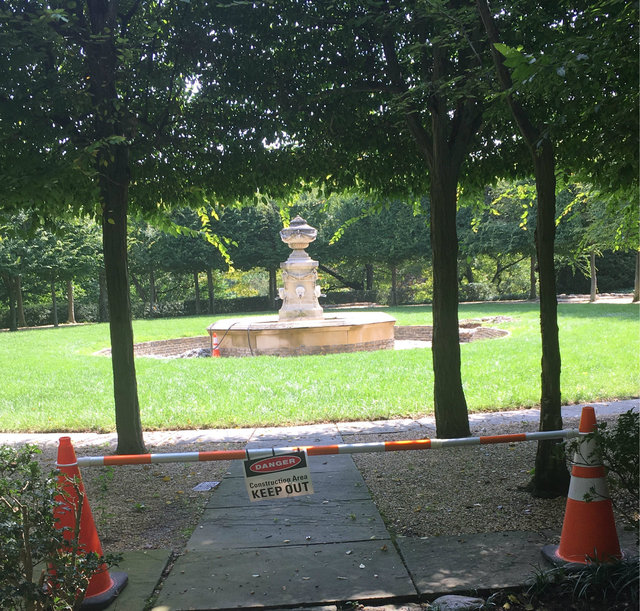
The nooks and crannies of Dumbarton Oaks make it a difficult place for large-scale maintenance or renovations—renovations like the current project, which has closed the gardens to the public since July 10. After nearly a century of use, it was time to replace the gardens’ subterranean network of irrigation and drainage pipes. When they reopen March 15, the grounds will have 5,600 feet—more than a full mile—of new pipes. They will also have a much leaner water-use footprint.
“This,” said Gail Griffin, Dumbarton Oaks’ director of gardens and grounds, “will help us be a better neighbor in the city.”
In the meantime, though, it’s a tricky endeavor. Heavy machinery is a luxury, used only sparingly. Planners and workers are going over, under, around, and in some cases through the bumpy topography, century-old trees, and delicate masonry work that densely cover the gardens’ 16 acres.
“This isn’t a golf course,” said Tom King, Dumbarton Oaks’ representative for the project. “It’s really hilly, and that makes it hard. We can’t get big equipment in there.”
Like their iron forbears, the new plastic pipes will lie as deep as 3.5 feet below the ground. Four-inch pipes form the spine of the system, with narrower pipes fanning out to specific irrigation areas.
Seems relatively straightforward, until you walk the ground and see those nooks and crannies for yourself. The gardens are on decidedly uneven ground, in places becoming downright treacherous. Then add in the various natural and manmade elements of the gardens’ 16 individual sub-areas—largely authentic to the original gardens, created beginning in 1921 by revered landscape gardener Beatrix Farrand—that always seem to recalculate the route. Everywhere one looks there are ornate footpaths, water features, or furniture. Every bench and tree seems to be part of the lesson. It’s art, it’s history, it’s education, and it’s a construction minefield.
That’s why you see a lot of hand-digging on the grounds. You also see a lot of air spades, which use forced air to “dig” near tree roots and other sensitive areas. In some spots, work can become even more painstaking. Paving stones in “The Ellipse” garden, for example, were hand-numbered after removal so they could be replaced exactly as they were.
Dumbarton Oaks officials declined to release cost figures for the project.
In any case, those who are overseeing the renovation don’t waver for a second on its importance. An excavated length of the old iron pipe is in visible distress, orange and flaky on the outside and bumpy, almost wrinkled (a phenomenon called tuberculation) on the inside. Not unlike a clogged artery, corrosion has in some areas caused ruptures and blockages in the pipes, including those that were charged with draining the property.
“There are leaks in the pipes we were not even aware of,” said Griffin. “We put cameras through the stormwater lines and realized some parts had collapsed and were no longer functioning.”
The new pipes will improve water management. So will new recirculation capabilities in several fountains. New swales being constructed as part of the project will catch and absorb stormwater before it hits nearby waterways, including Rock Creek.
The swales also will help with erosion, particularly along some of the gardens’ steeper inclines, where water has washed away up to a foot of ground over the decades.
“The water has been running downhill toward a creek,” said King. “We’ve had erosion and water going downhill since 1940, and we want to mitigate that erosion.”
Although it has been difficult and at times slow going, officials remain confident in their March 15 re-opening date. (The Dumbarton Oaks museum, by the way, remains open and is unaffected by the garden renovations.) It’s not like they didn’t know about the difficulty of their site, after all. They aren’t sure exactly how much water the project will save, but they do expect it to be “significant,” while providing needed stability to a set of gardens that attract tourists and scholars alike.
“The bottom line is that after 90 years the pipes needed to be replaced or Dumbarton Oaks would face either a catastrophic failure or just tiny bits and pieces of work over a long period time,” said King. “We figured, do it all at once and take care of it, hopefully for the next hundred years.”