 Rachel Sadon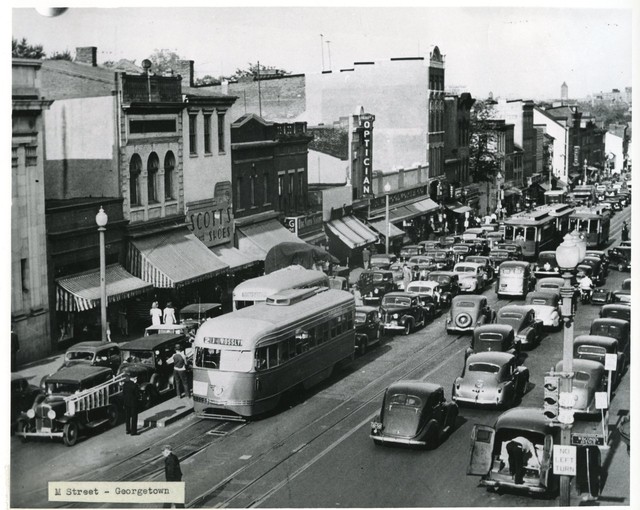
When Kathleen Crabb first started working at the District Department of Transportation’s library, she realized that the institution was sitting on a trove of historic images. But first they needed to be excavated, after decades of being thrown in boxes with little regard for organization, preservation, or reference.
For the past two years, Crabb has been physically sorting through the materials and getting them online. The result, unveiled last week, is a new digital archive called DDOT Back In Time.
Most of the photographs were taken by officials with prior iterations of DDOT. So far, Crabb has uploaded about 2,000 photos of things like roadways, bridges, cars, cyclists, and the old streetcar system, with the eventual goal of having the entire collection of roughly 10,000 images online.
Getting them from messy boxes to the online archives is a slow process. Crabb, sometimes with the help of an intern, has to scan two copies of the image and input them along with data about the photo, which may or not be easy to track down.
“Sometimes it’s just an engineer’s messy handwriting from 50 years ago,” Crabb says. She expects it will take several years before the entire physical collection is available digitally.
The trove has already yielded some gems, like an image of an old bridge over 14th Street being sailed down the Potomac, on its way to be used for bombing practice at the Dahlgren Naval Surface Warfare Center. The oldest photo in the repository dates back to 1933, showing the Calvert Street Bridge—now called the Duke Ellington Bridge.
Crabb particularly enjoys finding scenes that show a radically different D.C., like one of the old Loews Palace Theater surrounded in neon lights that looks like it wouldn’t be out of place in Manhattan.
It comes in handy for city planners, who head to the archive looking for things like images that show the position of the Long Bridge or what kind of landscaping had previously been done on Pennsylvania Avenue.
The resources aren’t just limited to transportation officials, though. Anyone can make an appointment to come in and use the collection for research.
“When people know that they’re here,” Crabb says, “they really like to come and use us, which is why I wanted [the online archive] to be public.”
Previously:
This Amazing Map Matches Google Streetview With Historical Images Of D.C.