Rachel Kurzius
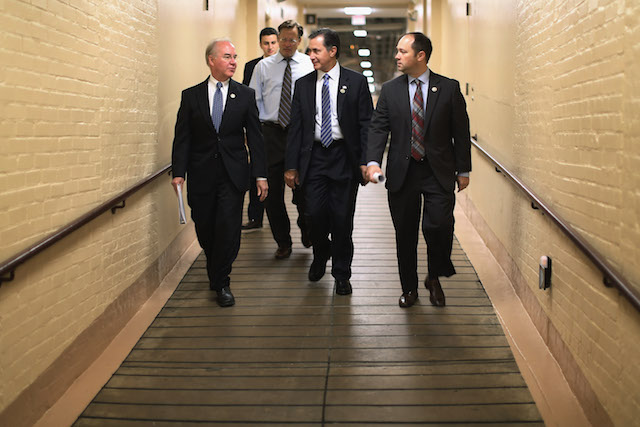 Rep. Gary Palmer is in the center, surrounded by then-Rep. Tom Price (R-GA) (L) and other members of the Freedom Caucus (3rd L-R) Rep. Dave Brat (R-VA) and Rep. Marlin Stutzman (R-IN) in the basement of the U.S. Capitol October 9, 2015 (Photo by Chip Somodevilla/Getty Images)
Stop me if you’ve heard this one before. A person voted into office by constituents more than 800 miles away has decided that he needs to stymie a law passed by D.C. politicians that will only affect residents of the District.
Meet Congressman Gary Palmer, a Republican representing Alabama’s 6th District. Ever since he made it to Capitol Hill in 2015, he’s made a habit out of trying to block the Reproductive Health Non-Discrimination Act.
The law makes it illegal for employers to discriminate against workers based on their reproductive health choices, meaning a person can’t get fired for, say, being on birth control or getting an abortion.
The House has tried to prevent this bill from being enacted a couple of different ways, beginning with a disapproval resolution in 2015. It takes 30 legislative days for every bill passed by the D.C. Council and signed by the mayor to become law. During that time, if the House and Senate both pass what’s called a “disapproval resolution” that gets signed by the president, it blocks the bill. This has only happened three times since the process was established in the Home Rule Act in 1973.
House Republicans took this tack in 2015, ultimately passing a disapproval resolution in their chamber. However, the Senate never took up the disapproval resolution and the Reproductive Health Non-Discrimination Act became law.
Last year, Palmer tried a far more common technique: the budget rider. As a way to dictate policy in the District, members of Congress will include amendments to appropriations bills that prevent the federal government, and often the D.C. government, from using funds towards implementing a policy.
He said in a statement at the time that “this amendment protects life and religious liberties. The Reproductive Health Non-Discrimination Act (RHNDA) could force employers in DC to cover abortions in their health insurance plans and require pro-life organizations to hire individuals who advocate for abortion. Freedom of religion does not stop at the District of Columbia’s borders.”
Conservative groups like Right to Life Committee and Concerned Women for America encouraged members to vote for Palmer’s amendment, which last year made it into the 2017 Financial Services Bill that the House passed. However, the rider did not survive the Senate’s version of the bill.
Palmer is at it again. Late last week, he submitted a rider to a House appropriations bill to block funding for the Reproductive Health Non-Discrimination Act. It joins efforts to control D.C.’s implementation of its physician-assisted death bill, along with amendments that block D.C. budget autonomy, prevent spending local funds on abortion, and stop D.C. from crafting regulations regarding the sale of marijuana.
Every time that Republicans from elsewhere attempt to control the District, D.C. Delegate Eleanor Holmes Norton responds with a vow to stop them, despite not having a floor vote. This instance is no exception.
“Ignoring the bedrock Republican principle of local control of local affairs, Representative Palmer is doing the bidding of far-right interest groups to try to block a local D.C. anti-discrimination law, while ignoring work that needs to be done for his own constituents,” Norton said in a statement. “No employer has the right to know, much less interfere, with the most private of health decisions of their employees. We have defeated every attempt to block or overturn RHNDA, and we will do it again so that no employees in the District need to fear discrimination based on their personal, reproductive health.”
Previously:
Policy Riders And Lack Of Statehood Put A Major Burden On Abortion Care In D.C.
House Passes Appropriations Bill Riddled With Anti-Home Rule Riders
Rider Cowboys: This Is How Congress Dictates Policy To D.C.
People We Didn’t Elect Say No To Budget Autonomy, Abortions, Weed, Needle Exchanges
Updated with a statement from Palmer.