 Rachel Sadon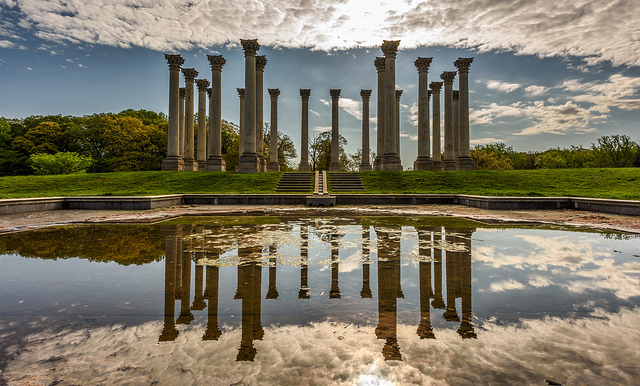
 (Photo by Geoff Livingston)
When Bernice Blacknell was a student at Blow Pierce Elementary School, decades ago, she and a group of friends had a routine.
‘We’d grab our paper bag lunches, and we’d have our little lunch and our canned soda and we would walk in a group to the Arboretum,” the ANC 5D04 commissioner recalls. “They had a fish pond, a duck pond, and we would just sit there and talk and observe the trees and everything.”
That was made possible by both laxer attitudes about children’s autonomy and the original entrance to the National Arboretum, which is located near the intersection of Maryland and M Streets in Northeast.
It has been closed to the public since 1992. To get to the 450-acre facility from Carver Langston, Trinidad, Kingman Park, and other surrounding neighborhoods today, visitors have to trek up through busy Bladensburg Road to arrive at the R Street NE entrance or drive over through New York Avenue.
“R Street is really isolated. It’s wonderful for the people in the [immediate] neighborhood but everyone else has to go up to Bladensburg on a thin sidewalk that makes it difficult to walk or bike. You almost have to drive to New York Avenue—it’s just terrifying,” says Robert Coomber, who has lived in Kingman Park for eight years and represents ANC 7D01. “We’ve got four kids. We’re not going to load them into a double stroller and walk 2.5 miles on a narrow sidewalk on Bladensburg Road … my family accesses the Arboretum all the time, but we can drive and not everybody can.”
A few months ago, a post on a neighborhood social network got the community talking: what if the original M Street gate was reopened?
“It’s one of the most popular threads I’ve seen since being on Nextdoor,” says Meredith Holmgren, the president of the Friends of Kingman Park civic association. “It’s been this incredible response from people who said they really wanted the gate to be open.”
At a community meeting in June, 20 members of Friends of Kingman Park voted in favor of opening the gates, while one person voted against it. Two ANCs, including the one that encompasses the area directly around the gate, have passed resolutions in support of re-opening it to pedestrian and cyclist traffic, and more than 125 people have signed a petition to that effect.
The decision is entirely the National Arboretum’s to make. For the first time, the facility’s leadership says it is willing to consider the idea.
“Opening that gate isn’t as simple as opening a lock off,” says National Arboretum Director Richard Olsen, who came into the position two years ago. “But what I told the ANC folks is that I’m philosophically not opposed to a gate there. If everything was perfect, we’d have a gate there.”
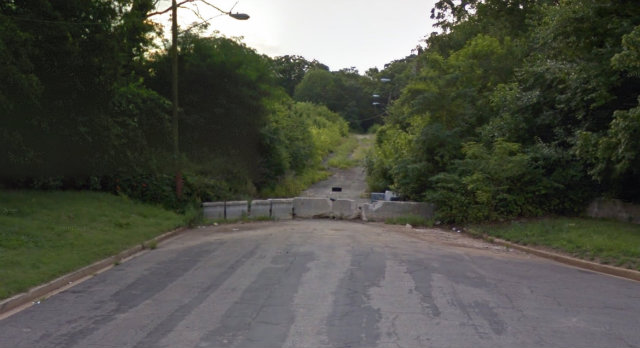 The original entrance to the National Arboretum sits where M Street and Maryland Avenue NE meet. (Photo via Google Streetview)
Now a downtrodden road, with crumbling concrete blocks and a fence stopping visitors from entering the Arboretum, the M Street entrance to the National Arboretum was once meant to be a grand, verdant welcome to the District of Columbia.
Under the original plans, the Baltimore-Washington Parkway was slated to be built on the west side of the Anacostia River. Officials put the gate to the National Arboretum on M Street so that visitors driving in from Maryland could come take a tour of the beautiful grounds on their way into the city, according to Olsen.
The BW Parkway never got built that way—New York Avenue instead became the main entrance into the District—but the National Arboretum was already oriented for that never-realized reality. The original guardhouses and greenhouses were all situated near the M Street entrance until around 1960, when officials built the administration building and the R Street gate.
In subsequent years, Arboretum officials realized that people weren’t coming down to M Street; they were driving in from New York Avenue. “We built all of our stuff before the city build theirs,” Olsen says. “Since the city didn’t develop the way they said they would, we’ve been trying to fix it ever since.”
Still, the M Street gate remained open for decades, even as the crack epidemic made the surrounding area more dangerous.
In the early 1990s, when D.C. was known as the murder capital, criminal activity had spilled over onto the grounds, with cops chasing suspects through the Arboretum, according to Olsen. Horticulturalists would find vehicles abandoned nearby, sometimes prostitutes walked the grounds, and drug dealers were frequently spotted nearby. Drivers, meanwhile, also started using the entrance as a cut through to avoid traffic.
For the Arboretum’s leadership, the final straw for the southern gate was when an elderly woman was severely beaten and left near the M Street entrance.
“Our major concern is for the safety of visitors and employees who use that gate,” then-facilities director Carl Momberger told The Washington Post at the time. “There have been drug busts in the apartment complexes on M Street. It is a high-crime area.”
Blacknell, who grew up in the area and has lived there continuously since moving back in the 1970s, remembers the closure. Some people were unhappy about it, she recalls, whereas others said it made them feel safer.
Then-Ward 5 Councilmember Harry Thomas approved of the move. “Just like the commuters, the drug dealers use the park as a shortcut too. I am for anything that cuts down on the influx of drugs in my ward,” he said at the time.
About a year later, after the M Street entrance was already closed, a woman was stabbed to death elsewhere and her body was dumped near the gate.
The streets around the M Street gate had earned the nickname “Little Vietnam.”
A quarter century later, crime has drastically decreased citywide while housing prices have risen sharply. Carver Langston, Kingman Park, Trinidad, and the east end of H Street are no exception.
“There’s a lot going on here. There’s a lot of development, infrastructure improvements, the population is increasing,” says Holmgren, the Friends of Kingman Park president. “The Arboretum gates have kind of become this nexus where a lot of these issues are sort of coming together,” she says, citing the Anacostia Riverwalk Trail and a bike network planned for the area as other examples.
The Arboretum, which is the only one of 90 federal research facilities that is regularly open to the public, and its surrounding community have not always had a peaceful coexistence.
When community members suggested reopening the shuttered gates in years past, they’ve felt brushed off by federal officials. Neighbors have also complained about traffic impacting residential neighborhoods, which the Arboretum sought to remedy in March by cutting off vehicular access to the R Street entrance at 2 p.m.
For its part, the Arboretum has struggled to contain aggressive driving, particularly as apps like Waze have sent more commuters on its roads to avoid traffic. They also must continually remind visitors that it is not a local park, but a research facility.
‘If people are climbing trees, stealing vegetation, the dogs aren’t being cleaned up, the visitors are disrespecting the collections,” Olsen says. “They feel like this is an open space and they have a right to treat it as a D.C. park—that’s where friction comes. I just ask people to respect that what I have to balance is this overwhelming need and desire for people to engage in the outdoors, but perhaps a lot of them are not engaging in the way would like to engage as plant people, as horticulturalists.”
The most high-profile incident came over the spring, when a group of visiting first graders were horsing around on a set of picnic tables near a parking lot. The kids were unknowingly in a restricted area, and armed security officials were sent to keep them out.
Two Rivers Elementary School parent Alayna Waldrum sent a letter to Olsen demanding an apology and other changes, backed by local lawmakers. “I got the clear feeling that [field trip attendees] were really frightened by the behavior of the staff, and they felt like the Arboretum was off limits to them,” she told DCist at the time.
Blacknell suspects that if the M Street gate had been open, the whole thing would have been avoided. Two Rivers has a campus that is just a few blocks away, and the students could have easily walked instead of taking a fleet of buses.
“If that back gate was opened, things might have been better,” she says.
Coomber had reached out to her about the incident as a parent at Two Rivers, which sits in Blacknell’s single-member district, and they got to thinking that maybe it was again time to try mobilizing efforts to get the gate open.
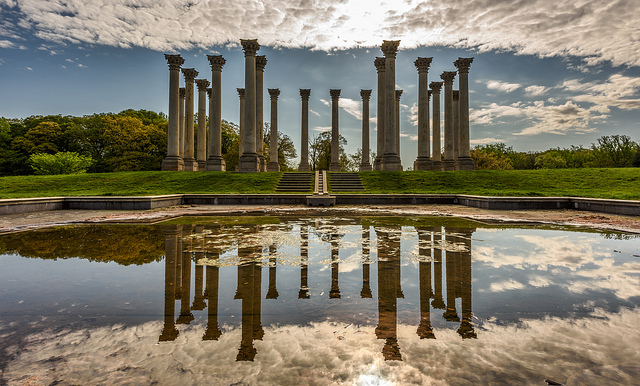 (Photo by Geoff Livingston)
In fact, the Arboretum had already begun rethinking the issue as part of a larger appraisal of the visitor experience.
Officials commissioned a design study of how to address vehicular traffic and pedestrian flow issues, as well as reduce the amount of impervious surfaces that are subject to the city’s stormwater fees (there are currently 9.5 miles of roadway, a legacy of the 1920s and 1930s design when it was expected that visitors would experience the Arboretum by car).
“We’re not limiting our designers. We don’t want to remove any option from the table,” Olsen says. Those include reopening the M Street gate as a pedestrian and cycling entrance, as neighbors support, or even opening it to vehicles, too. Creating another entrance that was once proposed for Bladensburg Road is also among the possibilities.
“We were kind of moving along quietly, we figured—seeing the writing on the wall with the development in the area—that this issue was going to come up,” Olsen says. “I feel like we were in front of it, and then the citizens came by and have now sort of elevated our time frame.”
Olsen has attended several meetings with community members, where he’s explained that reopening the M Street gate is open for discussion while also cautioning that it isn’t something that could happen overnight.
“I do think it’s fitting with where we want to go. I think it can work, but I want to do it thoughtfully,” he says. “I really want to go through our design process and see what we can come up with. We’ll share that with the community.”
The design recommendations are due to be delivered to Arboretum officials in May 2018.
Even if reopening the gate fits in with overall plans, though, there are still significant barriers to getting the gate back in working order, chief among them being the cost.
The Arboretum has an operating budget of $12 million a year, about 90 percent of which goes to salaries. Although there is no hard estimate of what it would take to re-open the M Street gate, Olsen suspects that it would take several million to add and fix the infrastructure in the area, redo the signage and maps, and clear out overgrown areas, plus about half a million annually for additional maintenance and extra staff to guard the area. It would likely take a combination of federal and private funds to get such a project done, which he hopes that the Friends of the National Arboretum could help raise.
Several city agencies would also have to get on board to remedy the poorly maintained access roads up to the gate, add lighting, commit to keeping the area clean, and step up security patrols.
“They have to work with us, they have to recognize how valuable we are. The city is getting, for free, this incredible urban green space,” Olsen says. “If the city can recognize that we bring a considerable value to its citizens, then hopefully they can go to bat for us and step up and work with its citizens who clearly, based off the meetings I’ve attended and the letters I’ve received, want to make this happen.”
It isn’t clear if Ward 5 Councilmember Kenyan McDuffie would be the strong champion of the project that Olsen believes is necessary to move the project along, though he does generally support the plan.
“When I first learned of the idea to reopen the Maryland Avenue, NE gate of the National Arboretum to pedestrians and bicycles, I was excited at the prospect of more Ward 5 residents and young students at nearby schools having access to this national treasure,” McDuffie said in an emailed statement. “As with any change of this nature, the Arboretum and District officials must engage the impacted community and ensure that the safety and security of residents is a top priority.”
But at least one city institution is already on board. The commander of the Metropolitan Police Department’s fifth district, William FitzGerald, has pledged to work with the Arboretum on providing additional policing for the area outside the gate.
“The District of Columbia has vastly improved since April 1992 and serious violent crime issues have substantially decreased since that period,” FitzGerald wrote in a letter of support on behalf of MPD for re-opening the gate. “If we are to continue to progress as a city and distance ourselves from the stigma of the past, then we must look and move forward and not be tethered by the past.”
For residents, it’s a future they’d welcome with open arms.
“It’d just be a huge benefit for the residents of Carver Langston, Trinidad, Kingman Park, and the larger Capitol Hill area to be able to access such an amazing green space on foot or by bike,” Coomber says. “It would give kids in the area a better place to go instead of hanging out on Benning Road. Being able to walk among the trees is definitely a better option.”
At a recent community meeting to discuss the proposal, Blacknell and a group of people walked over to check out the area around the M Street gate in person. As they were talking, a couple walked over, searching for the entrance into the Arboretum that they didn’t know had closed 25 years ago.
“The GPS sent them there,” Blacknell says. “I explained the situation to them, and they signed my petition.”