The AFI Silver consistently offers the best film festival programming in Washington, and AFI Docs is just the tip of the iceberg. Now in its 28th year, the Latin American Film Festival showcases the best new cinema from Latin America, as well as Spain and Portugal. Most of these films are unlikely to be picked up for commercial distribution, so this may be your only chance to see these onscreen. DCist previewed a handful of this year’s selections. All films will be screened at the AFI Silver. The festival runs from September 14 through October 4. See the complete festival program here.
 (Sundance)
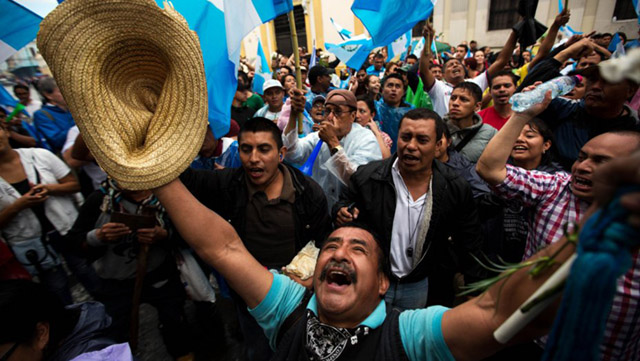
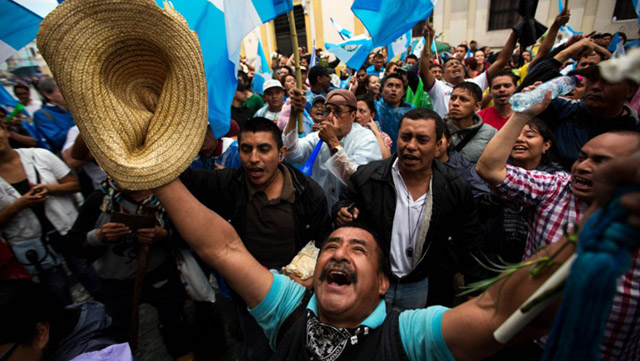
The final film in director Pamela Yates’ trilogy about Guatemala, this documentary tells of the centuries of persecution and eventual genocide of the nation’s Mayan population, whose suffering was only recently vindicated by the 2013 trial of General José Efraín Ríos Montt, who ordered the torching of 600 villages in the early 1980s. Yet despite crisp cinematography and harrowing reports of the junta’s atrocities, the film seems to keep its characters at a distance. From peasant activists to a Guatemalan elite who frequently seem like figures out of a telenovela, there’s plenty of powerful material here, but the final format seems like a two-hour news report. Still, 500 Years tells an important story that overlaps a bit with the truly gut-wrenching documentary Finding Oscar.—Pat Padua
Watch the trailer.
Sunday, October 1 at 4:45 p.m.
 (AFI)
(AFI)
Shot in the Caribbean region of northern Colombia, the feature debut from Bogata-based director Samir Oliveros is a coming-of-age movie that observes the contentious relationship between a brother and sister (Honlenny Huffington and Kiara Howard). But this is no John Hughes joint—on an errand in their parents’ truck, the teen siblings accidentally kill a goat (Vincent Van Goat), which sends the pair on a strange and mystical journey.The central relationship isn’t well developed, but fluid camerawork carries you along for an episodic ride whose highlights are vivid details like a cockfighting match and the various rural musicians they encounter.—Pat Padua
Watch a clip.
Friday, September 29 at 7:30 p.m. and Saturday, September 30 at 3:10 p.m.
 (AFI)
(AFI)
A rich and emotional complex drama, director Ernesto Contreras’s film has a strong, simple premise that develops into deep observations of life and love. Martin (Fernando Álvarez Rebeil) travels to a small village to study the pre-Hispanic language Zikril. He plans to spend time with its last three native speakers, but when the most cooperative of the trio suddenly dies, he’s left with two old men who haven’t spoken to each other in decades. If Martin wants to save Zikril, he has to rebuild the bridge between the two former friends, but the love triangle purported to have caused this years long rift is not at all what it seems. Astonishing performances sell the enthralling rivalry between Evaristo (Eligio Meléndez) and Isauro (José Manuel Poncelis) (Juan Pablo de Santiago and Hoze Meléndez play the leads as younger men), and the story leaves so much space for heart-piercing dramaturgy, all while doing incredible things with the very nature of language and communication. Isauro lives in a world where the only person in the world who can understand him is a man who hates him. The journey to the root of their schism is the most nourishing cinematic road you’re likely to traverse this year.—Dominic Griffin
Watch the trailer.
Friday, September 22nd at 7:20 p.m., followed by a Q&A with director Ernesto Contreras, plus a post-screening reception sponsored by the Mexican Cultural Institute.
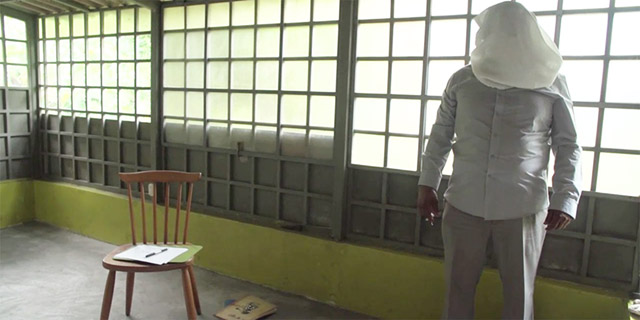 One of Ruben Zamora’s torturers, who agrees to appear in the film on the condition that his face was obscured. (Pragda)
One of the highlights of last year’s LAFF was director Marcela Zamora’s Room of Bones, which observed the forensic anthropologists charged with sorting out the unidentified remains of thousands murdered during the Salvadoran civil war. For her latest film, Zamora tells a more personal story related to that conflict: after decades of avoiding the subject, she asks her father, politician Rubén Zamora, to tell her about his experience as a prisoner, when he was tortured for 33 days. Through intimate interviews with survivors and raw video footage, Offended documents a volatile era whose atrocities included the massacre of Jesuit priests and the assassination of a Catholic Monsignor. It’s one of the most powerful documentaries I’ve seen this year.—Pat Padua
Watch the trailer.
Tuesday, September 19 at 7:15 p.m. This screening will be followed by a reception sponsored by the Embassy of El Salvador
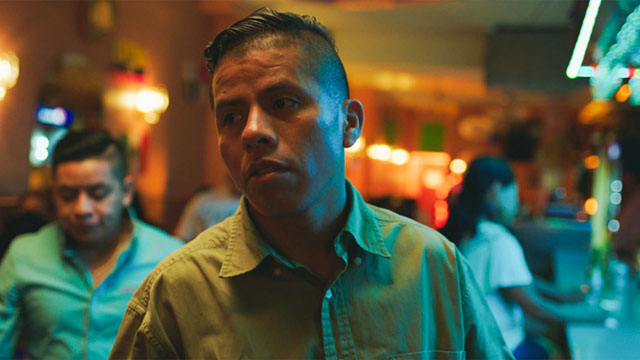 Fernando Cardona (Charles Libin)
The latest film from New York writer-director Jim McKay (The Wire, Mr. Robot) follows a group of undocumented workers in Brooklyn who work long hours six days a week all to blow off steam on Sundays in their local soccer league. When Artemio (Genoel Ramírez) injures his leg in a semi-final game, it sets off a chain reaction that leads José (Fernando Cordona), their team’s best player and de facto leader, to work on his day off—which happens to be the day of their championship game. McKay’s script has a straightforward narrative with plenty of room for the characters (played largely by non-actors) to breathe and interact. The ultimatum at the heart of the plot calls to mind the race against the clock at the center of Doug Liman’s 1999 film Go. But rather than a high octane thrill ride about club culture and twenty-something malaise, it’s a kaleidoscopic series of day-in-the-life vignettes presenting a deeply human view of the razor thin wire immigrants walk just to survive. The film’s last act, though lower in stakes than your average end of the world actioner, will have audiences biting their nails and rubbing their midsection with stomach churning suspense.—Dominic Griffin
Saturday, September 23 at 7:20 p.m.
 (AFI)
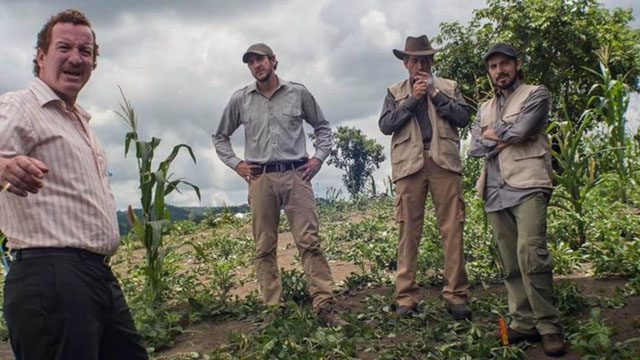
(AFI)The festival’s opening night film is an elite thriller heavier on melodramatic intrigue than emotional resonance. Shortlisted for the Best Foreign Film Academy Award as Ecuador’s official selection, it’s easy to see why the film was in contention, but also why it didn’t make the final list of nominees. Writer-director Sebastián Cordero weaves a brutal tale of a corrupt development deal as Emilio (Daniel Adum Gilbert) enlists shady counselor Lisandro (Andres Crespo) to help rid him of the families squatting on his father’s land. The set-up and locale are rife for a meaningful rumination on the sociopolitical complexity of the terrain, but film is so concerned with depicting a pervasive sense of dread that a maudlin narrative bogs down its potential to say anything of substance. Cordero crafts an intricate story of desperation, greed, and the lengths men will go to consolidate power, but struggles to develop memorable characters. Crystallizing the problem is an early scene where Emilio, Lisandro, and two co-conspirators look over a hilltop at the squatting village, exchanging dialogue that suggests mustache twirling villains out of a James Bond movie while their gritty surroundings evoke a grittier narrative. The only character with any charisma is Lisandro, thanks to Crespo’s brilliantly vile portrayal of a man willing to sell out the villagers he’s sworn to protect. The film’s final act is flawlessly executed, doling out karma and vicious justice in satisfying blows, but the journey there is an exhausting slog swallowed up by its own nihilism.—Dominic Griffin
Watch the trailer.
Thursday, September 14 at 7:30 p.m. and Sunday, September 17 at 6:15 p.m. Opening Night screening on September 14 features a Q&A with actor Daniel Adum Gilbert, plus post-screening reception sponsored by the Embassy of Ecuador.
This post has been updated with additional information about filmmaker appearances.