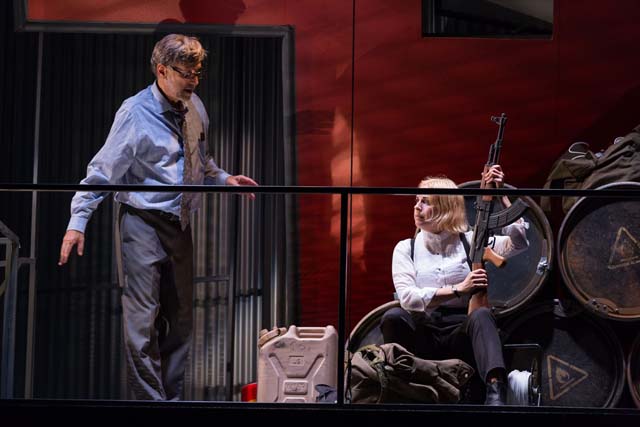
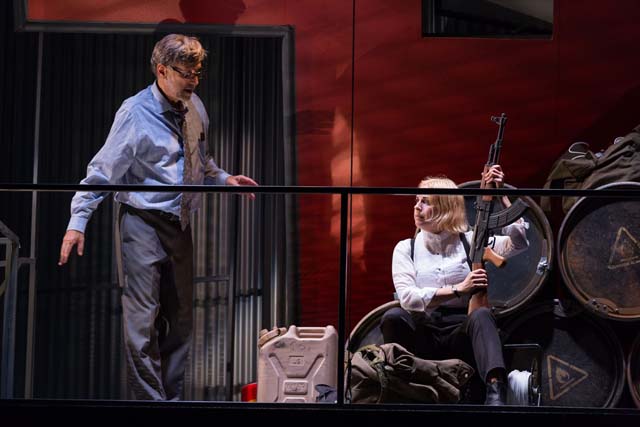
 Howard Shalwitz and Kimberly Gilbert (Scott Suchman)
By DCist Contributor Allie Goldstein
Adapting a 1958 work by Swiss playwright Max Frisch, Woolly Mammoth’s The Arsonists is the company’s answer to the Trump era. “On the morning after the election, we decided it was the most essential play to launch our new season,” said artistic director Howard Shalwitz, who found the task important enough to take into his own hands—he also performs the show’s leading role.
This tense, absurdist play observes a wealthy couple, organic hair tonic businessman George Betterman (Shalwitz) and his wife Becca (Bahni Turpin). The pair reluctantly invites into their home two downtrodden strangers, Joe (a raucous Tim Getman) and Billie (a sinister Kimberly Gilbert), despite every indication that their guests intend to destroy them.
Often interpreted in the context of the rise of Nazism and Communism, the play has a tough time translating to the present day despite director Michael John Garcés’s best efforts to drill home the modern-day setting with an onslaught of current-day cable news constantly flickering in the Bettermans’ living room.
Furthermore, with most of the play’s female characters stifled, the play seems stuck in Frisch’s 1950s script. While George chooses not to exercise his authority, Becca and the Bettermans’ maid Anna (Regina Aquino) seem to not have any in the first place. The women reclaim some of this ground with stellar performances (Aquino in particular makes the most of limited lines), but there is only so much dimension an actress can add to a flat character.
A larger problem is that Woolly is so dead-set on using The Arsonists to explore complacency and complicity that it fails to recognize another, potentially bigger question that the play evokes for modern audiences. Namely: Are the arsonists really the enemy? On an interpersonal level, sure, they’re the people stacking gasoline drums in the attic, but on a societal level, could their cause be justified? Why should we take it for granted that George, a man who has made his fortune on a fraudulent product and seems indifferent to the death of a colleague, is so deserving of our sympathies?
Though it does explore income inequality in a cursory way, the play fails to offer enough of a glimpse of the world outside the Bettermans’ home to convey what drives the underclass to fight with fire. Billie hints at the arsonists’ motivations with the line, “Every citizen is guilty, over a certain income,” but her portrayal as a crazy-eyed ex-con who touches herself at the thought of flames undermines any deeper exploration of her grievances. Similarly, Joe’s atrocious table manners and huge spider tattoo are amusing but a mere caricature.
What could be a nuanced exploration of morality and the true definition of violence instead reads as black-and-white as the audience is steered to consider only why the Bettermans didn’t kick out their uninvited guests sooner. A chorus of firefighters reinforces the idea that we are all bystanders to unfolding destruction, but this “conscience” of the play never considers whether destruction could ever be justified.
Such willful blindness feels relevant in our current political moment. Billie notes that the best tactic is “the naked truth” because “oddly enough, no one believes it.” The Arsonists conveys this message, but doesn’t allow space for any other.
The Arsonists is at Woolly Mammoth through October 8, 2017. $20-$79. Buy tickets here.