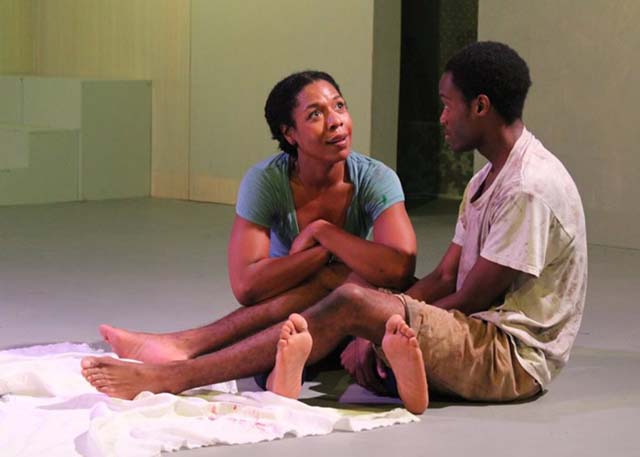
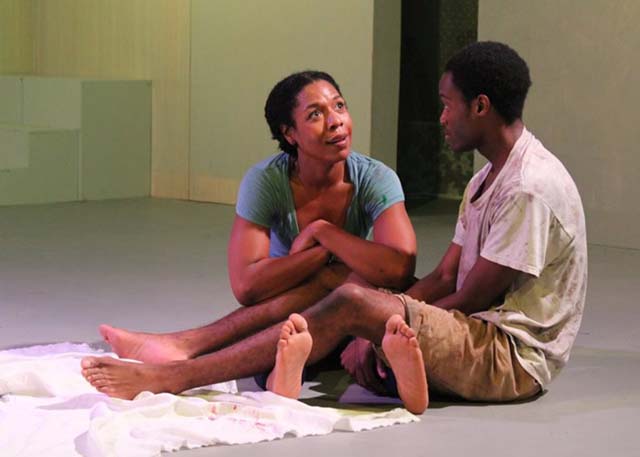
 Erica Chamblee and Kevin E. Thorne II (Bryanda Minix )
The most difficult part of a biographical show is communicating the facts along with the feelings of the subject’s time and place. It isn’t enough to tell us where and when they grew up and came into themselves; a good script and the production behind it needs to make us feel how they reacted to those circumstances. Natalia Gleason’s I Killed My Mother does the latter so well that it neglects some of the former.
Penned by the Hungarian playwright Andras Visky, the play recounts the whirlwind story of Bernadette, a biracial, bisexual Romanian orphan who narrowly escaped the horrors of Nicolae Ceausescu’s Communist Romania. Bernadette is not strictly real, but Visky and his family were relocated to a prison camp when he was two years old, and he grew up to develop an artistic theory around the exploration of captivity through art, so reality at least heavily informs her existence.
What reality does not inform is the substance of the production itself. Scenes flit between time, place and medium with a manic energy, shifting from songs about Bernadette’s childhood to dances about her mental state to poetic recitations to interpretative renditions of a time when her fellow orphans hijacked an escape bus, and all this before the close of the first act. This scattered focus effectively combines with much of the action running through Bernadette’s filter of childlike mysticism to generate a feeling of stark unreality, as if the inner world of Bernadette we are witnessing matches the chaos of her outer life.
It’s an ambitious approach to a story already broad in scope, and for as much as it attempts, each individual scene taken on its own largely succeeds. Erica Chamblee’s Bernadette brings a cold, consistent intensity, anchoring the audience with her presence even as nothing around her ever quite seems to make total sense. Her training as a dancer helps, and some of the dance interludes represent some of the best moments of the show.
The crew deserves its share of credit for forging this atmosphere. The show takes place in a back room with concrete walls supplemented by further grey constructions and located a few hallway’s worth of rooms from the box office, which makes it feel like the audience has been stashed like orphans in a dank basement. Jesse Marciniak’s sound design of passing trains and marching soldiers during scene transitions always seems to be coming from above, as if that world exists separate from us where we’ve ended up.
However, for all the ways I Killed My Mother succeeds at communicating a very specific emotional state, it doesn’t always use this in service of telling the story of Bernadette. The time jumps eventually settle down into something resembling a linear narrative, but they’re frequent enough that it can be difficult to get a read on what happens to her. With so much time spent on interpretive interludes, there’s barely any time to answer some basic questions about Bernadette: who is she? Where did she come from? How did she get from place to place and where is she eventually going? We barely even learn anything about the camp, and the lack of basic grounding for a period of history that so few know about and so many should can’t help but come across as jarring.
I Killed My Mother was an exhausting show to watch, and considering its subject matter, this is more a strength than a weakness, but the exhaustion did not always come from the right sources.
I Killed My Mother runs through September 30 at Spooky Action Theater. $25 minimum. Buy tickets here.