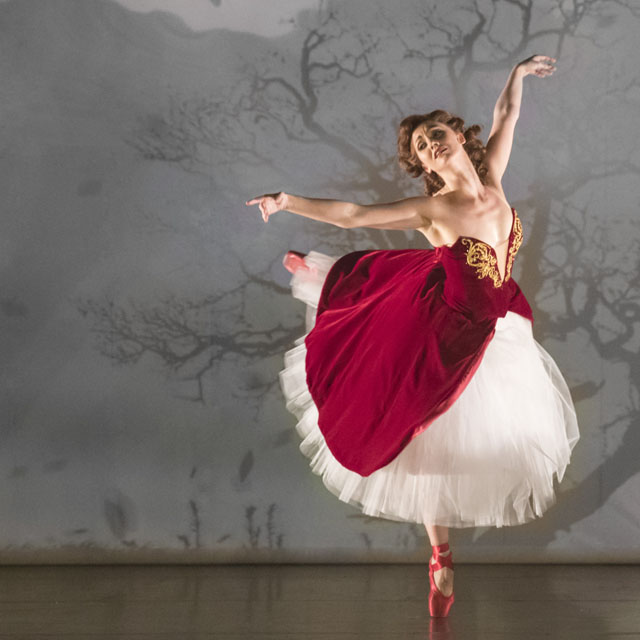
 Ashley Shaw (Johan Persson)
By DCist contributor Leigh Giangreco
When Matthew Bourne’s The Red Shoes makes its Washington premier at the Kennedy Center next week, the ballet’s greatest challenge may not be the jetés and pirouettes, but measuring up to Michael Powell and Emeric Pressburger’s cherished 1948 film.
The story follows vivacious ingenue Victoria Page, who longs to dance in the ballet company of Boris Lermontov, the dictatorial impresario loosely based on the Ballets Russes’ founder. Lermontov professes dance as a religion and the cold-hearted high priest expects Page to lead a solitary life devoted to the art. After Lermontov’s prima ballerina leaves the show, Page springs headfirst into the leading role.
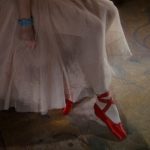
But her passion for dance turns fateful when Lermontov concocts a new ballet based on a Hans Christian Anderson tale about a young girl who is gifted a pair of scarlet slippers that never tire despite their owner’s wishes.
With the captivating British actress and ballerina Moira Shearer, the tinkling piano and haunting wind section of Brian Easdale’s original music, and hypnotic palette of
cinematographer Jack Cardiff, the movie still looks fresh today, its central ballet-within-a-ballet scene a Technicolor carousel that turns from a buoyant fairytale into a harried nightmare. Even Darren Aronofsky, a modern master of hallucinogenic cinema, owes some of the most frenzied moments of his backstage ballet film Black Swan to its fever dream dance sequence.
Yet for all the paeans to the film, Bourne, who adapted it for the London stage in 2016, promises one thing audiences will never receive from the original: flesh and blood. Ashley Shaw, who originated the starring role in Bourne’s London premier, has played an array of pointed princesses from Aurora to the Sugar Plum Fairy. But she has poured more of her own self, emotionally and physically, into Page.
“There’s lots of parallels between myself and Vicki,” she says. “But that’s also a really interesting to place to draw inspiration. Having played so many characters in my career, it’s really interesting to play a dancer, something that’s much closer to home.”
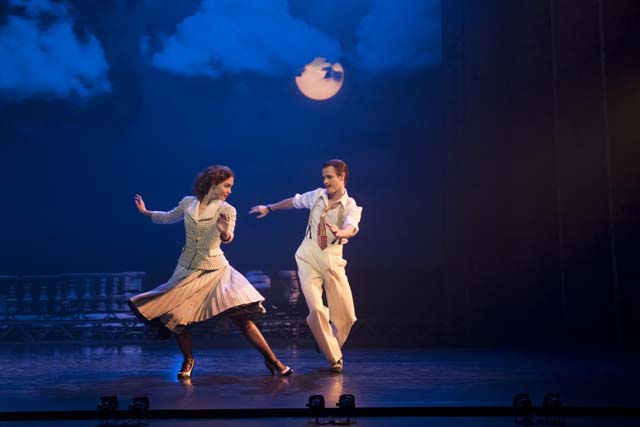 Ashley Shaw and Sam Archer (Johan Persson)
In the film, “The Red Shoes Ballet” sends Page dancing across forests and fields, and eventually into oblivion, for at least 12 minutes. Bourne’s production has stretched that into an excruciating physical feat of almost 17 minutes, without any cuts.
“You can’t really fake it, you have to dance yourself to exhaustion every night to get that genuine feeling across,” she says. “Again, it’s nice to be acting something that you genuinely feel as well.”
While the ballet sequence pushed Shaw’s physical stamina, an intense duet between Page and romantic interest Julian Craster makes of her emotional energy as, past the honeymoon stage, the young couple begin to long for their lost arts.
Page and Craster’s interactions, whether they are clinging to each other beneath a blue, midnight sky in Monte Carlo or tearing themselves away from their marriage to dance, are not choreographed as a traditional ballet duet. Audiences may be shocked at how little actual ballet dancing is involved in Bourne’s production, which drew its inspiration from symbolic poses and the physical style of Gene Kelly.
Along with watching The Red Shoes several times, the cast studied Kelly’s work to understand the dancing style of the 1940s and 50s. It’s an interesting callback to Kelly, who showed The Red Shoes; to persuade MGM executives to greenlight An American in Paris; which features a similar ballet interlude.
During their duets, Shaw strikes a more natural look of the period with heels rather than pointe shoes. Both Lermontov and Craster’s characters do not perform ballet at any point, opting for more naturalistic poses. In one duet between Page and Lermontov, he remains shy of soft-shoe choreography with mere twists of his hands as he tries to lure her into his company.
“He’s conjuring up the dance, kind of svengali-like,” Shaw says. “[He’s] almost like a magician in that scene using his hands to make me turn.”
So much of the production’s physical work is still grounded in the dancing styles of Margot Fonteyn and Gillian Lynne, ballerinas who dominated the stage in the post-war era. Bourne’s nod to “Sylphide” is taken from a post-war production, which Shaw says portrayed a more genuine and romantic style of dance compared to the technical approach today.
“They would just go through as many pirouettes as they could, they had a real sense of throwing themselves into it,” she says. “I feel like it was less focused on technique, it was focused on within. It had to come from the heart, I find.”
The Red Shoes is at the Kennedy Center Opera House from October 10—October 15. $29-$129. Buy tickets here.