 Rachel Sadon
 (Photo by Elvert Barnes)
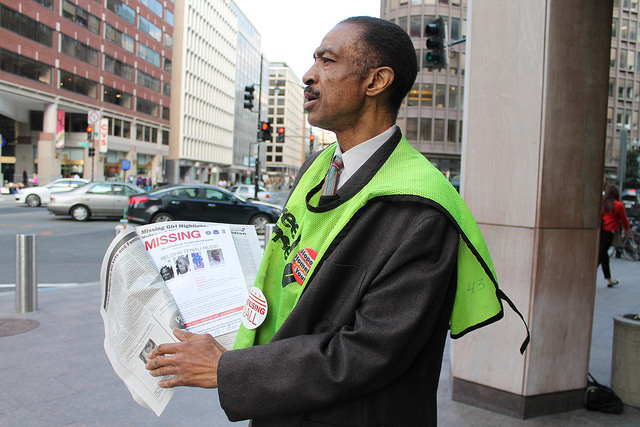
More often than not, people walk by Street Sense vendor Sheila White and say variants of the exact same thing: “I don’t have cash on me.”
“Some of the people even ask, do you take credit?” says White, who has been selling the homelessness-focused newspaper for about a year and a half. “I’m like, no I don’t take credit cards. That means I miss out on the sale.”
That’s changing today, as Street Sense Media launches an app to allow for cashless payments.
Customers will be able to download the app on their own phones. Once the transaction is confirmed, vendors will hand over the physical newspaper, and they can pick up the cash from Street Sense’s offices within the same day.
It “seeks to ensure that our newspaper reaches as many people as possible and that our vendors are maximizing their earning potential,” says Street Sense Media executive director Brian Carome.
The newspaper is one of a consortium of more than 100 so-called “street papers” around the world, which aim to empower people experiencing homelessness by providing an outlet to write about their experiences and a product to earn cash. At annual meetings the past few years, outlets have all swapped similar stories of seeing declines in sales.
About a third of Americans say they never or rarely carry cash, and another 38 percent say they would go cashless if it was up to them, according to a study conducted for the Dutch bank ING.
With Washingtonians increasingly swapping bills and coins for credit cards and apps, people who eke out a living on the street say they’ve felt the pinch. For homeless residents who write and sell the 14-year-old biweekly newspaper, it might mean the difference between selling 40 copies in a few hours versus having some left over at the end of a long day.
When people tell White that they aren’t carrying cash, she sometimes offers them the option of taking the paper and coming back when they have $2.
“Some might keep walking. But some will talk to me about it, and I’ll say ‘I’d like you to read the paper, anyway. I wrote an article in it,'” says White. “Some of them do come back—I had one lady ask me how school was going” after she read a story about White in the paper.
That’s part of why Street Sense chose not to make the entire paper digital.
“That core interaction between customers and vendors is what we think is really important,” says spokesman Jeff Gray. “We don’t just want people downloading our content. We want them interacting with people who sell it. That’s how you break down the stereotypes and challenge the perceptions that people about people experiencing homeless.”
Still, it took some creativity to get there, since it wasn’t as simple as giving homeless vendors a Square reader.
“A lot of the issues revolved around the fact that it was going to be used by people experiencing homelessness who may or may not have access or knowledge of smartphones,” say Gray.
It turns out that a Vancouver street paper, Megaphone Magazine, had already solved the issues that Street Sense was grappling with. Denim & Steel Interactive built the outlet an app that allows for digital payments, a tip, and a dual screen where both the customer and vendor confirm the transaction. The developer then released it as an open-source product.
Street Sense had it modified slightly (they contracted with Denim & Steel for the work but anyone could do so), and the hope is that other papers will follow suit.
“We really hope that it is going to catch on with other street papers across the world,” Gray says. “Megaphone was the first, then it spread to us. We expect this to be adopted across the country.”
The app will formally launch this afternoon in a ceremony, which will include At-large councilmember David Grosso and D.C. Deputy Mayor HyeSook Chung, though vendors have been testing it out on the street for the past week.
The first person that White offered the credit card option to went ahead and pre-bought the paper for the entire year.
“With the app,” White says confidently, “sales will definitely go up.”