By DCist contributor Courtney Calvin
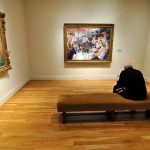
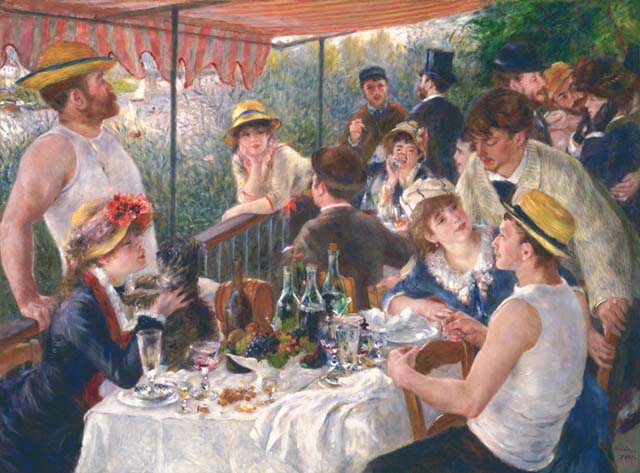
One of the signature masterworks at The Phillips Collection, Pierre-Auguste Renoir’s Luncheon of the Boating Party has been part of the Washington area’s art world for nearly a century. One of the most recognized impressionist paintings in the world, it captures a social experience en plein air as the socialites, seamstresses, artists, and businessmen of Paris mingle in the suburb of Chatou along the Seine. Renoir and Friends, a new exhibition at the Phillips, offers a “who’s who” of the characters depicted in this iconic work and walks us through the artist’s relationships with them.
The Phillips acquired Renoir’s masterwork in 1923, just a year after the institution opened. Founder Duncan Phillips had set his sights on it as early as 1911 and eventually purchased the work from Renoir’s dealer for $125,000. It was a focal point in Phillips’ strategy to identify key masterworks that would attract visitors from all over the art world to Washington, D.C.
Displaying the masterwork alongside other works by Renoir and his contemporaries further contextualizes the painting, says Phillips Director Dorothy Kosinski. It’s also a case study in conservation, with research using fresh findings from x-rays, infrared images, and cross-sections of microscopic paint chips that uncovered new clues in the development of a complex masterwork that was Renoir’s last big project. Two digital interactive kiosks allow visitors to track the changes that were revealed.
But the exhibition does more than look deep inside the canvas—it shows us the world outside it. More than 40 works on loan from public and private collections around the world introduce the viewer to Renoir’s fascinating group of friends, culminating with the composition of all the characters in the painting.
These characters include:
Aligne Charigot, a seamstress who later married Renoir, 18 years her senior. Charigot features prominently in a number of Renoir’s works, including Madame Renoir with a Dog (1880), and most notably, Dance in the Country (1883). According to the artist’s son, all of his father’s paintings of women after he met Charigot resembled his mother.
Alphonsine Fournaise, whose father owned La Maison Fournaise, the restaurant depicted in Luncheon, and who is also seen in The Dreamer (1879).
Ellen Andrée, an actress and favorite model of Renoir as well as of his contemporaries Edouard Manet and Edgar Degas, whose portraits of Andrée are in the exhibition.
Jeanne Samary, an actress Renoir painted in Woman with a Fan (1879). She can be seen in the upper right corner of Boating Party.
Gustave Caillebotte, a fellow artist and boating enthusiast whose A Man Docking His Skiff is one of this exhibition’s highlights.
Charles Ephrussi, an art critic and collector who was a patron of the impressionists. He purchased a still life of a bunch of asparagus from Manet that was priced at 800 francs, but paid 1,000 francs. To thank him, Manet painted a smaller canvas with a single stalk of asparagus and gave it to Manet with a note: “There was one missing from your bunch.”
Georges Rivière, whose long locks and pencil thin mustache make him easy to identify.
Curators sought to create a balance of sense of place, landscape, and portraits tied to Renoir’s milestone. But the pieces that make up the exhibition did not fall into place easily. “It was a quest,” says Phillips chief Curator Emerita Eliza Rathbone, explaining that many of the works on display came from private collections.
To further demonstrate the sense of time and place, a costume historian contributed a display of hats of the sort that would have been worn by the boating party to signify the importance of the accessory among the late 19th century French. The son of a tailor and a seamstress, Renoir appreciated how the shape of a hat could flatter a woman.
“Boating Party was Renoir’s most complex undertaking, says Rathbone. “His key friendships buoyed his career and allowed him to undertake this complex work.”
Looking closely, there are brushstroke changes all over the painting that shows it is not a snapshot in time, says Phillips head of conservation Elizabeth Steele. “Renoir labored over each detail.”
The pattern of raking light across the canvas viewed at the right angle shows variances in texture, particularly see where there may be additional layers of paint. Looking closely in certain areas, slight changes in the brushwork that do not relate to the surrounding area allow other colors peek through, indicating that Renoir changed details such as the color of a dress and the direction someone is facing.
The show is the first in a drumroll of great projects leading up to the institution’s hundredth anniversary in 2021, says Kosinski. As reported in the Washington City Paper, The Phillips Collection looks forward to an exciting future, with plans to build a new facility in Prince George’s County; meanwhile, the Dupont Circle museum is taking a moment to celebrate its past.
Renoir and Friends: Luncheon of the Boating Party is at The Phillips Collection through January 7, 2018.