 Rachel Sadon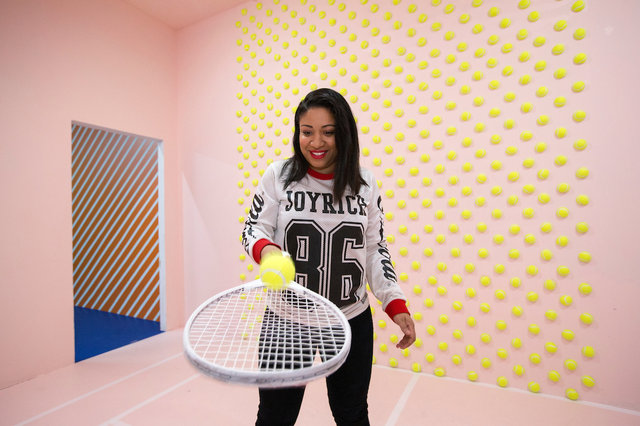
Potted palms sit in the corner of the millennial pink tennis room, almost as if Wes Anderson had specified it himself. Two bicycles reflect back the only light in a black room—red neon. The wall of a basketball court with a holographic floor declares in giant purple letters: FEARLESS.
They are all set pieces in D.C.’s latest art installation/pop-up/experience/Instagram backdrop.Visitors are invited—at a ticket price of $15—to take their selfies and interact with the “Future of Sports” on H Street.
“I was an athlete—I played soccer my whole life. I’ve also been creative my whole life,” says Nicole Pinedo, the founder of Made in the District and the project’s mastermind. “I always wanted to do an art installation, and I just thought of the things I love the most.”
The result is a temporary installation at 7th and H streets in Northeast, with a giant track on the first level where visitors check in and nine rooms to wander through below. Pinedo’s work on music video production shines through in the bold colors and minimalist design, with each room feeling like a distinctive set that still somehow adds up to a cohesive vision.
In effect, D.C. has its answer to the Ice Cream Museum, which has been an Insta-success in New York and San Francisco, though Pinedo bristles a little bit at the comparison.
She acknowledges that the National Building Museum’s blockbuster summer exhibitions helped inspire her to think big, but Pinedo says she dreamed up the installation long before learning about the Ice Cream Museum, and attributes the conceptual similarity to pop-culture trends.
“Everybody pulls from the same kind of inspiration, especially with pop culture” she says. “I think people love to touch. In every room here, you can touch a ball, you can play, you can feel the sand.”
As the art world increasingly reacts to a hunger for spectacle and interactivity, there are clear parallels to other installations that have brought massive crowds with social-media friendly aesthetics. An all-white autograph room where you can sign the walls calls to mind Yayoi Kusama’s dot room; a volleyball court filled with white salt feels like an answer to the pool at The Beach (or the Ice Cream Museum’s sprinkles); the bold colors throughout reminded me of the pink bug room at WONDER.
Just like those exhibits, the “Future of Sports” (the title came from earlier iterations of the designs, which had a more futuristic aesthetic that is most embodied by the holographic basketball court) is catnip for people with itchy camera phone fingers.
“It’s all on social now, and I obviously purposely designed every room to be on social media,” Pinedo explains. The pale pink paint color in the tennis room was no accident. “I wanted every person to be able to take a picture in every room.”
It is a little rougher around the edges in places than one might expect after visiting, say, the National Building Museum’s summer exhibitions. There’s no external signage demarcating the building and they’re still working to get a bar on the first floor up and running. In some places, it feels otherworldly; in others, you can see the seams.
Pinedo self-funded the project, which cost about $50,000 to pull together, and she readily admits that there are parts she had envisioned differently. A wall that was originally going to be made of tiles, for example, was swapped out for tape to save on cost. With a bigger space and budget, she would have made each of the courts full-size. She also only had four weeks to put the installation together.
But none of that shows up on Instagram, where hundreds people have tagged glamour shots of the space, and increasingly, that’s what matters.
The Future of Sports is open from 10 a.m. – 10 a.m. until November 30. Tickets are $15.