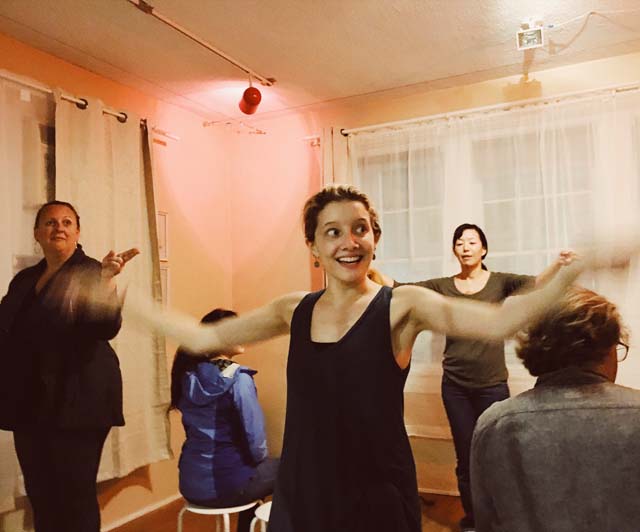
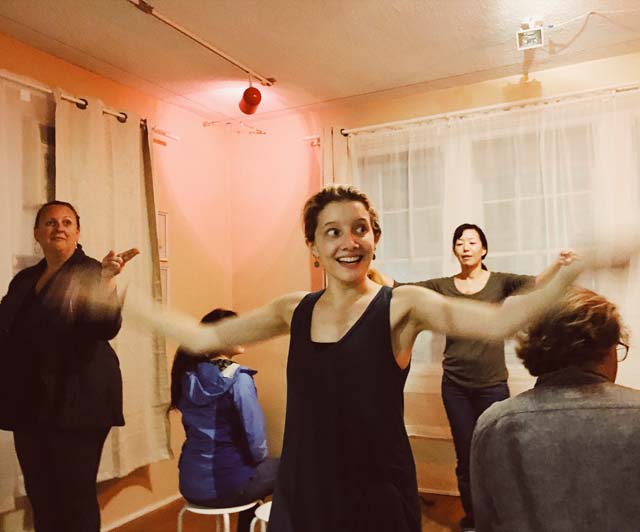
 Wyckham Avery, Emily Sucher, and Momo Nakamura in rehearsal. (Jennifer Knight)
The immersive theatrical installation Hello My Name Is… starts with a problem: how do you make a site-specific show tell an autobiographical story? The answer is that you get a designer to write your script.
In this case, the autobiography is that of The Welders‘ Deb Sivigny and her experiences growing up as a Korean adoptee in America. None of the show’s three characters (June, Brian, and Dan) represent her specifically, but their story is drawn from the experiences of her and hundreds of other adoptees interviewed and surveyed for the project.
“They’re trying to find home, the abstracted version of home, what that means to them,” said Sivigny. “I wanted to be able to tell the story from the perspective of the adoptee, because so many of the narratives that have come out about adoption have been told by parents or social workers.”
Most would find a basic stage sufficient to tell that story, but Sivigny is a designer first, and her choice of a site-specific venture is no cheap marketing gimmick.
The site in question is Rhizome DC, an art space that has played host to various experimental and immersive art projects in the city. Compared to the multi-floor spectacle of something like New York’s long-running Sleep No More, it’s downright tiny: just two floors and a handful of rooms to work with.
However, restriction breeds the kind of creativity that the playwright collective The Welders thrive on, and they’ve tapped the advantages of the smaller space while minimizing its disadvantages. Each room is packed to every wall and corner with carefully constructed detail, and it’s clear every piece was built with the specific story of a character in mind. Even the impression left by an unfinished installation actively crisscrossed by busy techs and lounging actors is one of profound intimacy.
Still, disadvantages remain. When I first entered the back door, I stepped into a kitchen space where a lightboard sat ready to be wired on a nearby table. Sivigny related how they’ve drafted plans to plant stealth assistants in the audience to turn the needed knobs and buttons, or even get the actors to contribute by learning some sleight of hand.
“It’s a very strange game of space Tetris,” said Sivigny.
“In a theater, a costume change would just take place backstage and the actors would leave their stuff in a laundry basket. Instead, for here, you have to make that costume change and your clothes go into a box that then goes on the set dressing because there’s just nowhere else to put it.”
Once the construction is complete, audience members will be guided from room to room, with each scene representing a different experience of a character at a different time in their life. Just as the characters are composites, so too is the house: stripped of context, it seems like Rhizome could be just another empty nest with a child’s room upstairs, but the script adds the context to make it more than the sum of those rooms. Sivigny uses the metaphor of a moving snapshot.
In her research for the show, Sivigny traveled back to Korea, a country she’d been told held the keys to her heritage but of which she had no real memories. The experience made her feel more detached than connected: she’d never been around so many people that looked like her before. When she returned, she went to a conference in Pittsburgh attended by a hundred or so fellow adoptees, Korean and otherwise. Her discussions with them and understanding of their fundamental differences informed her approach to the show.
She references a line from The Avengers where Thor explains his brother’s bad behavior with “he’s adopted: she wanted to relate the zoomed-in lives of people with the same strengths and blemishes as everyone else, not the tropes and archetypes pop culture shunts adoptees into.
“People are like ‘so what’s your story’ said Sivigny. “And you spend two minutes being like ‘well I was adopted in 1978, I was born in Seoul, I was five months old’ and then you move on and you talk about life because it’s not the big deal that it is to non-adoptees who suddenly want to know everything about your life.”
Hello My Name Is… isn’t likely to tell you everything about her life, or about the life of it’s characters or even about the lives of the many others it represents. It might give you what a more traditional show can’t, however: a view into some underappreciated slices of life as they were and are lived.
Hello My Name Is… runs from October 20 through November 12 at Rhizome DC in Takoma. Tickets can be purchased here.