It is our great fortune to live in a city where, starting Sunday, one can walk up to a museum, and without spending any money on admission fees, look at ten paintings by the most revered Dutch master and dozens more by contemporaries that informed his world. Vermeer and the Masters of Genre Painting gives area art patrons the first chance in twenty years to bask in this much sublime lighting and composition. Sure, you can look at the digital gallery above or a catalog full of reproductions, but the hues and brushwork and nuances of light are best appreciated in person. You will have to line up for the privilege—and indeed, that’s what it is—but it will be worth it.
Born in Delft on October 31st, 1632, Johannes Vermeer is today the best known of the Dutch masters. But as the exhibition’s subtitle, Inspiration and Rivalry, demonstrates, he did not work in a vacuum.
Vermeer’s work is helpfully placed in the context of peers that helped feed healthy competition in artists’ content and technique. For instance, the high-life genre subject matter that we associate with Vermeer was inspired by Gerard ter Borch (1617-1681), a pioneer in the portrayal of young women at their daily routine. The skin and clothing textures in work by Frans van Mieris (1635-1681) attain a photographic realism in the turn of a lady’s wrist or the folds of an elegant skirt; of all the masters on display, he had fur lining down.
Spurred by such accomplished contemporaries, Vermeer built on their example, and with tighter, geometrically precise compositions, he mastered a signature natural light that put his work on a higher plane altogether—and in a sense, that’s what he strove for.
That light is a spiritual, moral element. Take Woman Holding a Balance (1664), and its companion piece by Pieter de Hooch (1629-1684), hung beside it. The latter artist depicts a woman caught in the specific task of weighing gold coins. Vermeer’s subject is observed in a more allegorical duty, holding empty scales until they come to balanced rest. Among the frames-within-frames that are Vermeer’s wont, he likes to hang paintings as background for commentary, and behind the woman is a painting of The Last Judgement. That gorgeous light falls upon a woman measuring out justice.
The Dutch genre painters typically depicted the domestic life of upper class women; and a favorite subject of the period was a woman writing or reading a letter. (A contemporary equivalent might be Teenager Sending a Snarky Text). One of the most revealing galleries displays pendants, paired paintings that show, in one canvas, a gentleman penning a letter; in the next painting, a woman reading it.
There’s an example of such a pairing by Gabriël Metsu (1629-1667), who could also suggest more vivid narratives in a single canvas such as Man Visiting a Woman Washing her Hands; in this frame, as the man enters, the lady’s maid gives him a look that seems to say, “Who IS this guy?”
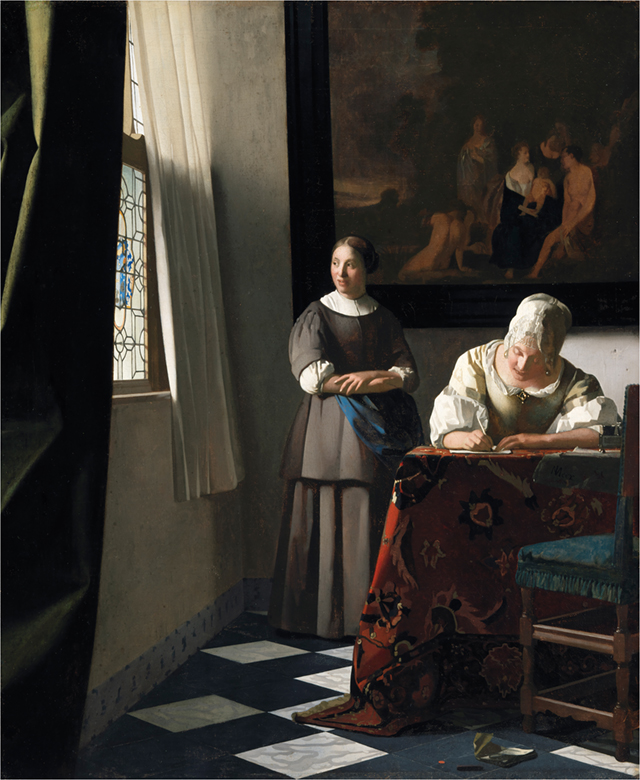
In Vermeer’s Woman Writing a Letter with Her Maid, perhaps the most stunning piece (and one of the funniest) in the exhibition, the artist tells a story with more subtlety; a crumpled piece of paper on the floor seems to indicate a man’s letter hastily discarded. As the woman writes her response, she and her maid are lit by Vermeer’s signature side-window, the maid looking onto the distance as if in eager anticipation of her lady’s scathing retort.
Curator Arthur K. Wheelock. Jr. mounted the 1995-96 exhibition Johannes Vermeer, which notably went dark during a blizzard and two government shutdowns for a few weeks during that year’s government shutdown. At a preview of the Gallery’s fall exhibitions last month, Wheelock’s enthusiasm for his subject was infectious; while the show is informed by the usual standards of academic rigor, it’s also full of life, the contrasting views of classic but seemingly sedate subjects as a woman performing music enhanced by the contrasting personalities of a master and his peers. Don’t even think of missing it.
Vermeer and the Masters of Genre Painting: Inspiration and Rivalry runs from October 22, 2017 – January 21, 2018 at the National Gallery of Art, West Building, Main Floor.