 (The Orchard)
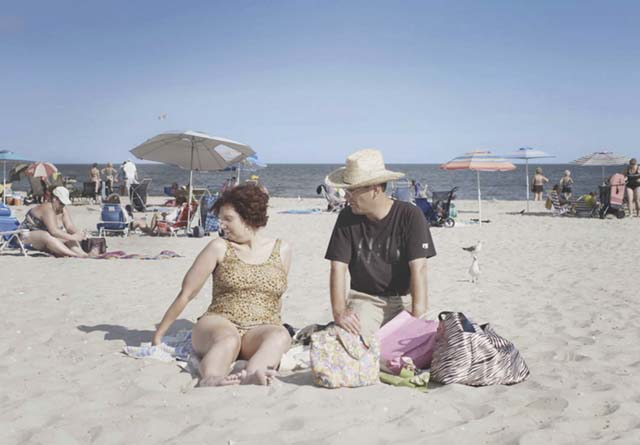
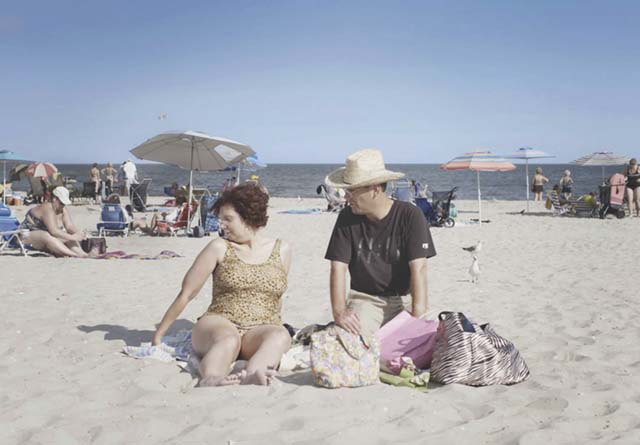
We live in an anxious age of irony and increasing rancor, and if earnest antidotes seem too easy to dismiss, just try to resist Dina, a documentary about a middle-aged autistic couple. It may be the year’s best documentary, and the best rom-com.
The film opens in a location that would make anyone anxious: A dentist’s office. As 49-year old Dina gets ready for the dentist’s drill, she reaches out for a hand to hold. This is how we meet her, and it gently establishes the mild quirks and profound need for comfort for a documentary subject who’s entirely ordinary and sweetly endearing.
Directors Antonio Santini and Dan Sickles (Mala Mala) use static medium and long shots to observe Dina, her friends, and her fiance Scott as they get ready for their wedding. The film isn’t structured like other documentaries, not even of the cinema verite kind. There are no talking head interviews; simply observation from a respectful distance that allows Dina to, in a sense, direct the show, while the filmmakers weave establishing shots and patient editing rhythms to evoke a well-developed sense of mid-Atlantic suburbia (the movie was shot outside Philadelphia).
Aside from the great, real life characters at its core, the movie Is a case study in linear film-making that makes it look so easy you wonder why it can be so difficult for directors to follow such classical patterns.
What’s more, the movie’s use of pop music is perfect. Early on, we see Dina’s fiance picking up an order in a pizza shop, singing to himself the Billy Joel hit ‘The Longest Time.” We jump in mid-song, around the line, “The greatest miracle of all.” Scott’s voice is halting and awkward, his choice of song perhaps cheesy, but as a man who has found a woman to spend the rest of his life with, the coffee shop standard becomes an achingly sweet triumph, as if its singer is in awe at the idea that such songs could really come true.
This is just one of the modestly observed moments in a documentary that’s shot in such a way that it lends a grand dramatic import to an ordinary couple that Hollywood would never deign to put on screen.
Co-director Dan Sickles has known Dina Buno his whole life; she frequented the Abington Aktion Club, a social/community service organization for developmentally disabled adults, created by his late father Ed Sickles and Darlene Anderson. Dan Sickles reconnected with Dina at his father’s funeral, and when he broached his idea of a documentary about a woman who had overcome her disabilities, she was thrilled at the idea.
A dedication to Ed Sickles notes the elder’s all-encompassing empathy, which inspired the filmmakers gentle approach. But the primary inspiration is Dina herself, who has survived physical and emotional wounds and is still open-hearted.
Instead of a trailer, watch the directors’ music video for Michael Cera’s “Best I Can,” featuring Sharon Van Etten and written especially for the movie:
Directed by Antonio Santini and Dan Sickles
With Dina Buno, Scott Levin
103 minutes
Not rated
Opens today at E Street Landmark Cinema