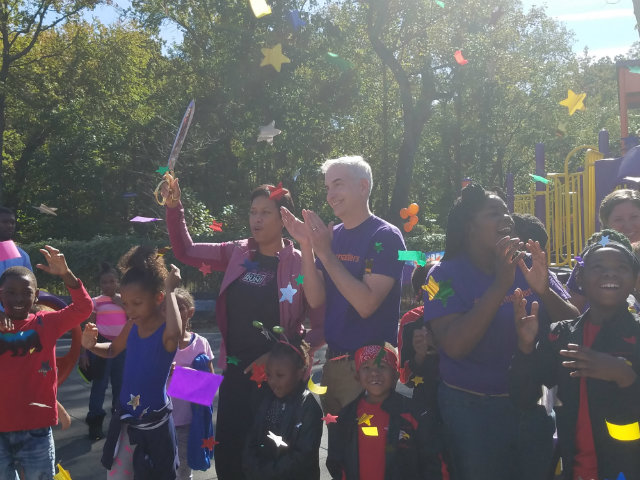
Mayor Muriel Bowser cut the ribbon on a playground on Saturday, commencing hours of climbing, swinging, and jumping for kids in Congress Heights.
“It’s just another indicator of how much we love you, how high are expectations are of you, and how far we’ll go to help you have a great life,” Bowser said, standing in front of the 3,000th playground built by KaBOOM!—a national non-profit that builds, opens, and renovates playgrounds in under-resourced communities across the country.
The organization built its first playground in the District 22 years ago to the day, also in Ward 8. It’s since opened about 80 playgrounds in the city—half of which are located in Wards 7 and 8.
The bright yellow, orange, and purple play space is outside of the Town Hall Education Arts Recreation Campus, also known as THEARC, which currently houses nine nonprofit organizations that serve families east of the Anacostia River.
It replaces another KaBOOM! playground that stood for a decade before being removed in 2015 as THEARC expanded on the Mississippi Avenue SE property.
For the past two years, the neighborhood has been one of D.C.’s physical activity deserts—an area where it’s hard to find a safe, affordable place to engage in physical activity. The Active Kids, Healthy Community initiative found last year that the most concerning activity voids are concentrated in neighborhoods east of the Anacostia River where some children have to walk more than half a mile to a recreation space, sometimes in dangerous conditions.
“It’s really nice to have the playground back,” said Violet King, who works at THEARC Farm and saw how frequently kids played at the previous space. Between the children who visit THEARC and those who live across the street at the Parklands apartment complex, officials expect that about 500 children to take advantage of the new amenity every day.
This playground is also bigger and more advanced than its predecessor. “It has a lot of things I’ve never even seen before,” said Teallia Holland, whose 10-year-old son took to the swings on Saturday.
One of those never-before-seen components is an infiNET, a netted climbing structure that’s new to the D.C. region, according to Roxane Rucker, KaBOOM!’s vice president of community impact. What’s more, all of the playground’s components, aside from the swing set and another moving object, are linked.
“You can jump on a piece of equipment starting anywhere on the playground and if you’re physically able, you can traverse the entire playground without ever hitting the surface,” Rucker explained. “The variety of challenges—balancing, spinning, climbing, jumping—is just phenomenal.”
Society has become so litigious, Rucker said, that builders have removed a lot of the risks from playgrounds. But providing safe and healthy opportunities to take risks can be just as important as giving kids the freedom to release energy and bounce around.
“When you reach out to grab something, you’re assessing distance, you’re assessing your capability, you’re pushing yourself to your limits—these are all skills that we take with us through adulthood,” Rucker said.
The ability to play and interact with others is also “an essential part of human development” that people learn early on how to regulate emotions such as anger, joy and frustration. It’s also helps children to develop cognitive patterns and skills, she said.
For adults, playgrounds are a place to get to know one another and chat about what’s happening in the area.
“It’s a place where parents get engaged, involved, and invested in that community—so the playground is an essential community hub that makes a community a community,” said Rucker, adding that even though this is KaBOOM’s 3,000th playground, the organization will continue to “actively address play deserts here in the District.”