Rachel Kurzius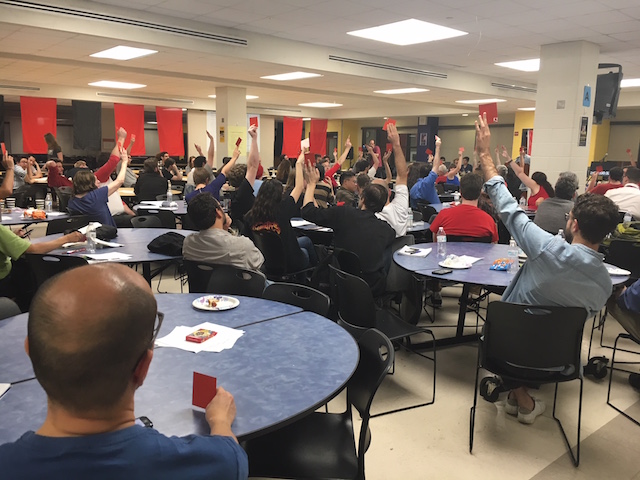
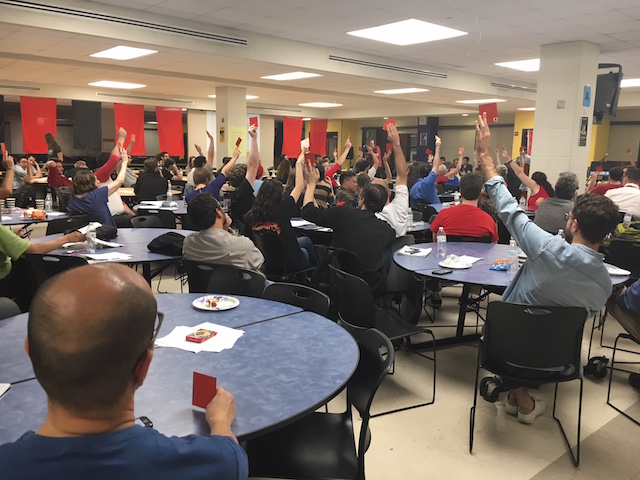 Attendees at the Metro D.C. DSA convention vote on a measure. (Photo by Rachel Kurzius)
There was only one place to go on Saturday to hear someone say “The chair recognizes the comrade in the polo shirt,” and that was the convention of the D.C. Chapter of the Democratic Socialists of America.
The “big tent” left-wing organization has grown by about 500 percent in the last year—from 200 to about 1,000 current members looking to “escape capitalism,” as one of the group’s official t-shirts says.
More than 100 of them spent their sunny weekend afternoon in a Columbia Heights cafeteria adorned in red and black flags to hash out the nuts and bolts of how to organize their organization, which has already gotten hundreds of people involved with tenants’ rights canvassing and a Virginia House of Delegates race.
“Ad hoc structures had formed to deal with the explosive growth, but they didn’t scale well,” says Natarajan Subramanian, who joined after the election of the Democratic National Committee chair made him realize that the “party system was not suited to address my needs.”
By raising red cards in the air, the group voted to increase its number of elected leadership roles, pass a policy on sexual harassment, and otherwise futz with its bylaws, which hadn’t been updated since the Occupy D.C. days of 2011.
Sure, many of the questions up for debate might sound arcane to an outsider, like whether the chapter caucuses should have enumerated rights in the bylaws or how, precisely, to structure an internal organizing committee. But they spoke to different attitudes about what reform should look like to better accommodate the infusion of new members.
“There was one vision that was more diffuse, and one that was more centralized,” says Adam Marshall, the member who served as the convention chair, implementing Robert’s Rules of Order with the help of a parliamentarian. “The members who advocated for a more diffuse chapter structure carried the day to some extent, but not in its entirety.”
Marshall joined D.C. DSA in November 2016, after the presidential election. That motivation is so common that those members have their own nicknames, “November 8th babies” and “November Niners,” though at least one person cited a different election: the British parliamentary election in June that nearly saw Jeremy Corbyn ascend to prime minister.
Merrill Miller joined D.C. DSA more than two years ago because it was a “socialist organization that didn’t just focus on class.” Now a member of the group’s steering committee, she says that “there was a slight uptick after Bernie Sanders’ campaign, and it really took off the day after the election.”
While many of them are from D.C., there’s also large contingents in Northern Virginia and Montgomery County—enough for them to each have their own sub-branch. DSA gets flack for being dominated by white men, and the convention certainly had its share, though the meeting also included women and people of color, and had an ASL interpreter. (Disclosure: also in attendance were some people who I consider friends, though none of them are in leadership roles or are quoted in this article.)
To those who’ve been members since the group’s formation in the early 1980s, it’s generally easy to see who the newcomers are. “New members tend to be younger—the average age of the chapter has dropped by 30 years,” says Christine Riddiough, a DSA member since 1982.
The growth of the D.C. chapter mirrors that of the national organization, where Riddiough sits on the national political committee. She says that two to three years ago, there were 20-30 DSA chapters nationwide, and now there’s close to 200. The national membership has swelled to 30,000, and annual dues begin at $45.
That means there’s a “bigger budget, more visibility, and much more we can do to get the word out” about issues like universal healthcare, says Riddiough. “There’s an incredible amount of new energy, but there’s a lot we all have to learn. We have different experiences we bring to the table. Ultimately, it makes us stronger but it does lead to tension.”
The generational divide was most apparent in a vote over snap elections. The bylaws stated that elections would occur annually, but members who tended to be younger pushed for an amendment that would allow the recall of elected leadership, calling it a “good governance addition.”
The old guard countered that it could lead to “factional mischief,” with some people packing a meeting to kick out leadership with whom they disagreed.
Ultimately, the measure passed. “It’s younger people’s world,” says Kurt Stand, a member of D.C. DSA since the early ’80s. “They’ll make or break this.”
Stand says he’s excited by the group’s newfound enthusiasm, but worries that “sometimes the forest is lost for sight of the trees … Yes, we have 30,000 new members, but we live in a society where Donald Trump got 40 million votes. People need to step back and look at the bigger picture: how do we bring socialism, and even common decency, back to our society?”
There are two major campaigns underway at the chapter aiming to do just that.
One is canvassing for Lee Carter, the Democratic candidate for the Va. House of Delegates in Manassas. He’s challenging Del. Jackson H. Miller, the GOP House Whip who beat his last Democratic opponent in 2015 with nearly 60 percent of the vote. However, in 2016 the 50th District went 53 percent for Hillary Clinton.
Carter is not taking for-profit donations and has come out strongly against Dominion Energy, a regulated monopoly that is among the top campaign contributors to both Democrats and Republicans. The Richmond-Times Dispatch reports that the state Democratic party is not contributing resources to his campaign.
But DSA is. Since late August, Metro D.C. DSA has been carpooling 15-25 members to Manassas every weekend to knock on doors on Carter’s behalf, averaging about 1,500 doors per weekend.
Carter himself was at the convention on Saturday, taking part in debates over the future of the chapter, which he joined after the Democratic primaries because it’s “an organization that exists to bring together folks from the left-end of the political perspective.”
He says that “seeing what DSA members are doing [in the 50th District] is inspiring others to do more.”
After the dust clears on November 7, the D.C. chapter plans on getting involved in the 2018 elections in Montgomery County—where term limits mean that there are three open countywide seats and a new law will bring matching public funds to the race.
“We’re hoping to endorse a candidate that will fight for a $15 an hour minimum wage,” says Harry Baker, a “November 8th baby” involved with the chapter’s electoral work. In January, current Montgomery County Executive Ike Leggett vetoed a bill that would have raised the minimum wage to $15 an hour. Leggett is not running again in 2018.
According to Baker, four candidates for at-large county council seats have already sought the chapter’s endorsement.
Baker says that Montgomery County is more “ripe” than D.C. for the group to make a difference because there’s “less entrenched opposition.” Mayor Muriel Bowser has yet to garner a primary competitor, and incumbents are running for reelection for the at-large seats and ward races.
The question of involvement in electoral politics, particularly on behalf of Democrats, can be contentious among some members. Riddiough, who has been involved in DSA for four decades, says that’s always been the case.
But Baker pushes back on the idea that electoral work isn’t real organizing. “It gets real results—people with strong left-wing politics in office,” he says. “It’s also an organizing tool because people are more familiar with electoral organizing, so it’s a stepping stone into other kinds of community organizing.”
The other major campaign for D.C. DSA involves tenants’ rights organizing. Since May, the group has trained more than 100 canvassers to knock on the doors of D.C. residents who face eviction, and encouraging them to fight their eviction in court.
While D.C. has some of the strongest tenant protections under law, they often aren’t exercised. If a person doesn’t show up to D.C. Landlord Tenant Court, for instance, they nearly always automatically lose the case. The idea is that “folks stepping forward to assert their rights would stress the system and force it to respond,” says Marshall, the convention chair who also works on the tenants’ rights campaign.
So, while the campaign is designed to help the individuals who fight their evictions, it also aims to make landlord attorneys’ jobs harder.
Members of the campaign analyzed data indicating that people who talked to DSA canvassers were 1.8 times more likely to go to court than otherwise, though they’re finding some complexes with gates difficult to enter. They have added weekday canvasses to try and reach folks with service industry jobs.
A newer campaign for migrant justice is also in the works to educate undocumented residents on their rights and challenging local U.S. Customs and Immigration Enforcement raids.
But these campaigns were not the central focus of the convention, which instead engaged in the nitty gritty of the bylaws from noon to 6 p.m., keeping speakers to a two-minute limit with the help of a countdown clock. Multiple times, attendees sought to change the rules to speed up the process.
Around 2:10 p.m., members voted to limit each amendment to two speakers for or against passed. About an hour later, a motion to bar white men from speaking more than twice an hour (suggested by a white man who had spoken more than twice that hour, somewhat in jest) failed.
Shockingly, the convention ended two minutes before schedule, at 5:58 p.m., and the sounds of “Solidarity Forever” began blaring from the speakers.
But expect the debates about the future of D.C. DSA to continue as long as the organization does. After all, they voted on Saturday to have another convention in two year’s time.
Updated to reflect that speaking with tenants rights canvassers made people 1.8 times more likely to go to court.