Rachel Kurzius
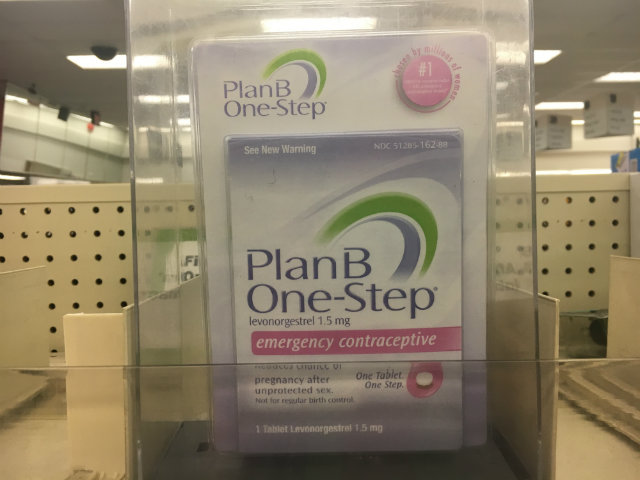 Plan B for sale on the shelves of a Van Ness CVS with a plastic box to deter shoplifting. (Photo by Rachel Kurzius)
At around 11:30 p.m. on a Saturday night this December, Hayley began frantically searching online for nearby places where she could buy emergency contraception. She and her boyfriend had been having sex and the condom broke.
“The second that happened, I thought, ‘Oh my god, my entire life could change because of this night,’” she says. “I was just so nervous and very anxious and sort of mad at myself too for feeling like I was being so irresponsible, even though things like this happen.” Hayley asked that we not use her last name out of concern for her privacy.
The two immediately started looking up places where they could buy emergency contraception, often known as the morning-after pill or by the brand name “Plan B.”
Emergency contraception can decrease the chance of getting pregnant by nearly 90 percent, but that likelihood decreases the longer a person waits to take it after unprotected sex.
It is not a medicated abortion—emergency contraception prevents a pregnancy rather than terminating one. About 11 percent of American women between the ages of 15 and 44 have used it, per a 2013 federal report.
The Food and Drug Administration approved the sale of Plan B over the counter in 2013 without age limits or prescriptions. But that doesn’t mean that all of the stores that advertise the treatment offer it on their shelves.
Hayley saw that the Harris Teeter in NoMa, a short walk from where she lives, was open and sold emergency contraception. She and her boyfriend quickly headed over.
But walking through the aisles of the grocery store, she couldn’t find it. She asked an employee for help.
“It shouldn’t be an embarrassing thing to ask, but it is,” she says. “He said you can only get it from the pharmacist and the pharmacy is closed.” While the grocery store is open from 7 a.m. through midnight daily, the pharmacy’s hours are more limited—it had closed hours before Hayley got there and wouldn’t reopen until 11 a.m. the next morning. “I didn’t want to wait until the next day—the whole point is to take it as soon as possible.”
Hayley and her boyfriend went back to their phones, and saw that a Rite Aid on 14th Street NW carried emergency contraception and was still open. They ordered a rideshare there, and were able to make the purchase.
“It just made me think about all of the hoops that I had to jump through just to get this—to make sure I don’t have to jump through the even more hoops of getting an abortion or having a child I’m not responsible enough to care for,” Hayley says. “What about the other women who are put in this position, who either can’t afford it or aren’t near a place where they can access Plan B, or don’t have the support system to help them through the process?”
It’s those women that inspired reproductive justice group Reproaction’s #DontHidePlanB campaign, which includes a petition and a slew of direct action speakouts at Harris Teeter, including one forthcoming on June 28 in Ballston.
Their campaign specifically targets the regional grocery chain, which has more than 240 stores in the mid-Atlantic, including 19 in the D.C. area.
“What makes Harris Teeter unique is that it has a corporate policy that requires all of its stores to keep [emergency contraception] off the shelves,” says Caitlin Blunnie, the Virginia organizer for Reproaction.
Harris Teeter did not respond to multiple requests for comment. Their last official statement appears to be a direct message to Reproaction co-founder Erin Matson in the fall of 2016:
Our practice is that the product will be sold by another pharmacy associate or by the salaried Manager on duty or other [Health Insurance Portability and Accountability Act] trained clerk. The product can be sold through the Pharmacy register or the front checkout. This is why we have the customer go to the Pharmacy for this product, or speak with a member of management, because they are all HIPPA [sic] certified!
The FDA regulation does not specify where in the store emergency contraception should be stocked. But the grocer’s policy seems to put it in the minority of establishments in the District that sell emergency contraception, most of which don’t have an overarching policy requiring that it only be sold by a pharmacist.
Rite Aid stores in D.C. are actually owned by Walgreens Boots Alliance, which keeps Plan B on its area shelves.
“In Washington, emergency contraceptive products are available over the counter in the shopping aisles,” says Walgreens spokesperson Jim Graham. “Our customers do not need to go to the pharmacy counter. In most cases, they will not need the assistance of a store employee other than at checkout. We also have the product at our pharmacy counter for those patients who wish to ask questions of our pharmacist.”
Target also has the pill available over the counter. “I can confirm that we stock Plan B on the shelves within our stores and guests do not need to go through a service desk,” per spokesperson Kate Decker.
CVS, too “has merchandised emergency contraception in our store aisles, not behind the pharmacy counter, consistent with FDA guidelines” since 2013, according to spokesperson Mike DeAngelis.
A 2017 study from the American Society for Emergency Contraception sampled stores across the country and found that 60 percent stocked it on their shelves, though the sample included very few D.C.-area locations.
Of the 60 percent on shelves, 57 percent of them were in a plastic box, 30 percent were on the shelf and not locked up, with the remainder either in a locked case or out of stock.
DeAngelis of CVS, says the store uses the plastic boxes to deter theft, and does the same for razors and other small items with higher price points. “Customers simply bring the item to the front checkout for purchase, and the cashier will remove the product from the protection box as part of the transaction process.”
Kelly Cleland, executive director of ASEC, considers the availability as part of a continuum, with emergency contraception being on a shelf and not locked as the best-case scenario, and not being available at all as the worst, with anti-shoplifting devices like plastic boxes or locked cases in between. She notes that chain pharmacies are more likely to stock emergency contraception on their shelves than independent ones, and people living in cities benefit from a broader array of choices.
“If you live in Washington D.C., it’s a densely populated area and there’s a lot of pharmacies,” Cleland says. “They still may face a lot of barriers for a whole variety of reasons, but hopefully there is at least another store you can go to.”
Even in an area with ample choices, Reproaction sees the #DontHidePlanB campaign as a way to raise awareness and decrease stigma about emergency contraception, in addition to trying to change how Harris Teeter operates.
Co-founder Pamela Merritt says that “in a world where people are still embarrassed to go and get tampons and pads because of the stigma around all women’s reproductive health care, the compassionate lens to apply to this is that people who need access to emergency contraception should not have to explain or pitch their need to a store manager or to a pharmacist.”
Another complication for those seeking emergency contraception is cost. On average, Plan B One-Step costs $49 and generics cost $39, per ASEC.
Mara Gandal-Powers, senior counsel at the National Women’s Law Center, says that in most jurisdictions, insurance is only obligated to pay for it if a doctor prescribes it, so buying it over-the-counter shifts the cost to the consumer.
At the start of 2018, Maryland began implementing a law that required insurance companies to cover over-the-counter emergency contraceptives, among other forms of birth control, like vasectomies. It was the first state to do so.
Gandal-Powers has also heard stories about people seeking emergency contraception and being carded, despite there being no age or gender limits on access. “That’s an issue for younger folks, also for folks who don’t have ID or have an ID that doesn’t conform with gender,” she says.
Months after her own search for emergency contraception, Hayley still doesn’t see why it wouldn’t be stocked on the shelves.
“Other than restricting women’s healthcare, I don’t understand what the point of keeping it behind the counter is,” Hayley says. “This whole experience was embarrassing and anxiety-inducing for me, but honestly, it could have been so much worse and I’m sure it is worse for so many other people.”