Natalie Delgadillo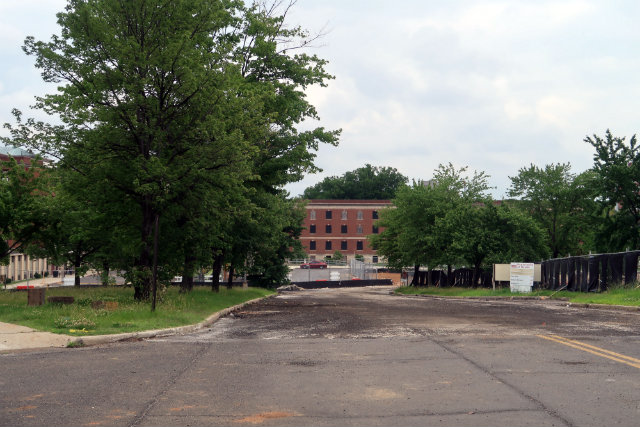
 Hill East residents have been waiting years to see the development of a huge expanse of largely unused land known as Reservation 13. (Photo by Natalie Delgadillo)
On the eastern edge of Capitol Hill, 67 acres of land sit more or less unused, an expanse of parking lots and abandoned buildings stretching all the way from 19th Street SE to the western banks of the Anacostia river. The existence of this place in a city like D.C.—where developers unceasingly trawl for the next pocket to flip—boggles the mind.
Reservation 13, as the concrete expanse is known, is ugly and underutilized, but has long been the subject of neighborhood fever dreams: what new treasures could this parcel bring to Hill East, where grocery stores, retail, and housing are badly needed? Unlike the residential area closer to the Capitol, this part of the neighborhood has no restaurants in it. The Safeway grocery that served the area recently closed down for two years of construction, forcing people to travel further to the Harris Teeter near Potomac Ave.
“We need a grocery store. Older people can’t walk all the way to the Harris Teeter,” says Francis Campbell, a former ANC Commissioner who has lived in Capitol Hill all his life and was heavily involved in efforts to develop Reservation 13. “We need a nice café…we need local businesses. Affordable businesses,” he specifies.
It’s a common refrain around the neighborhood.
“We need housing and retail. We are short affordable housing, for teachers and firefighters and people who don’t make six figures,” says Denise Krepp, an ANC commissioner for Hill East. Indeed, housing prices in what was once the affordable part of Capitol Hill have doubled and tripled since the early 2000s. Home flippers have peppered the neighborhood in signs; “WE BUY HOUSES FOR CASH,” they shout to would-be sellers.
“A new neighborhood should be built with retail, with the ability to go to a supermarket, the ability to go get a cup of coffee. We have need,” Krepp says.
That was once the direction the area seemed headed for.
Until somewhat recently, Reservation 13 (whose name is a vestige of the L’Enfant Plan, which enumerated hundreds of reservations throughout the District) was federal land. In 2002, though, residents and the city approved a master plan for the parcel, calling for a “vibrant, mixed-use waterfront community” that would connect Hill East to the river. Congress handed over the land to the District in 2006, and the city commissioned a developer to start the work in 2008. It was short-lived; D.C. officials drastically scaled the project back amid the economic downturn.
Two parcels, F-1 and G-1, just north of Massachusetts Ave SE, are still slated for the development of two mixed-use buildings with 353 housing units and more than 25,000 square feet of retail across two acres of land. The original groundbreaking was supposed to happen two years ago, but instead happened just a few months ago.
“Yes, the market tanked. But then [the city’s inaction] was a slap in the face to the residents who worked so hard to get this whole thing developed,” Campbell says.
The city’s dragging feet became a core part of the story of Reservation 13, at least to hear some impatient residents and neighborhood commissioners tell it. But the original plan—the master plan enshrined in law by the D.C. Council—never seemed to be in question.
Imagine some residents’ surprise, then, when the city appeared to be thinking up an entirely different use for the land. In its October 2017 response to Amazon’s request for proposal for its second headquarters, D.C. included Reservation 13 as one of four possible locations for the massive offices, to some consternation (and no shortage of outrage) from Krepp and fellow ANC commissioner Dan Ridge.
Krepp asserts the city baldly lied to her at a meeting concerning the the F-1 and G-1 parcels, when she specifically asked if the city had plans for the rest of the parcel and officials told her they didn’t. Brian Kenner, the Deputy Mayor of Planning and Economic Development, later told Hillrag that the Amazon RFP is a competitive process and the city did not want to go public with information about it before it had even been submitted.
Now, both Ridge and Krepp think the city is sitting on the land in anticipation of what Amazon might decide about its headquarters—a position Kenner strongly refuted to DCist. He says the city has not told any private developers to hold anything for Amazon, nor has it resolved to do so with any of its own land. “We are moving forward full-steam ahead with all of our projects, and have encouraged others to do the same,” he says.
So, what gives? What are the city’s actual plans for this plot of land? Why has it taken so long to get anything done? And what do neighbors think of a potential Amazon move here?
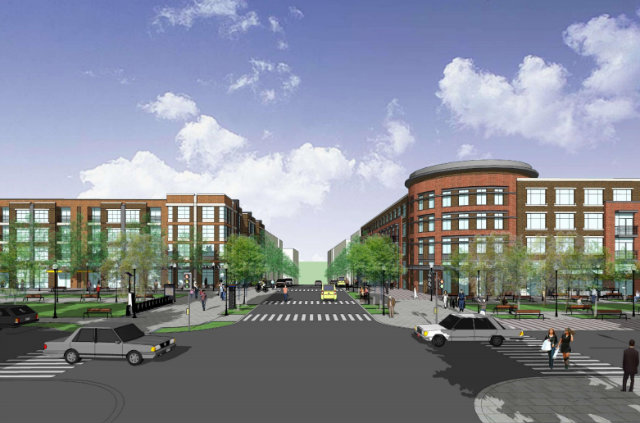 While much of Reservation 13 continues to sit vacant, two parcels of land are in the process of being developed as mixed-use buildings. (Rendering courtesy of the D.C. Office of the Deputy Mayor for Planning and Economic Development)
According to Kenner, the city is focusing its energy on the F-1 and G-1 developments, and there are no current plans for any of the rest of the land. Chanda Washington, DMPED’s spokesperson, said that the office is “working to issue solicitations for the remaining parcels in the future.” But the city has not yet developed a timeline for doing so.
Right now, there’s construction happening on the two approved parcels, and some deconstruction, too: the crumbling family homeless shelter in the former D.C. General Hospital is being torn down, part of Mayor Muriel Bowser’s plans to replace it with smaller shelters around the city (though even that is not without controversy; some homeless advocates allege that the administration is moving families out prematurely).
But the surprise Amazon announcement has destroyed Krepp’s faith in the administration. “I think they’re lying sacks of shit. That’s what I call them,” she says, referring to city officials.
Ward 6 Councilmember Charles Allen, who used to preside over Reservation 13 before the 2011 redistricting into Ward 7, says he’s also firmly against the Amazon proposal. “The communities of Ward 6 and Ward 7 spent a lot of time trying to develop a shared vision. They want a lot of new housing, a substantial amount of affordable housing, green spaces, retail,” he says. “Not a giant office park.”
Other residents, though, think an Amazon headquarters might be a fine use of the land, if it also comes with some publicly available amenities. Paul Williams, the president of the Congressional Cemetery located adjacent to Reservation 13 and a resident of the neighborhood, says he’s neutral about the idea of Amazon and believes any development would be better than the site now.
“It’s been idle for so long and such an eyesore for so long that it impacts the visitors to the cemetery, especially the ones coming out of the [Stadium Armory] Metro. People don’t feel safe coming out of the Metro on that side,” he says. Williams would welcome Amazon on the site on the condition that there are restaurants and retail that is also available to neighbors and visitors. “As long as it’s more than just an office building,” he says.
Others are less willing to entertain the notion. “What I think about that the [Amazon] proposal, you can’t put in print,” says Campbell. “The less I say about that the better, but that proposal is a crock. It disregards us and tells us that our feelings don’t matter.”
Larry Frankel, a resident of the neighborhood for 42 years and retired D.C. taxi driver, agrees. “I hate the idea, I absolutely hate the idea. Amazon will destroy the continuity of our neighborhood,” he says.
But Frankel is also wary about any development at all—he worries the new housing will be expensive and contribute further to the displacement of the area’s longest-standing residents. “[City projects] always displace lower income individuals and long-term residents,” he says. “I just see this as another example of how [Reservation 13] is being used to gentrify and change this neighborhood, and I don’t think it’s for the better.” He prefers that the site feature smaller scale development—single family homes and small retail establishments instead of the apartment buildings and shopping complexes that have mushroomed up in other neighborhoods (Frankel minces no words in calling the redeveloped Southwest Waterfront “the ugliest thing I have ever seen in my life”).
As for why the city has taken so long to develop the plot, everyone has their opinions. Reservation 13 has long been the site of crucial, if not always glamorous, city services: it’s adjacent to the D.C. Jail and has housed D.C. General as a hospital and a homeless shelter. An STD clinic used to be located there. Longer ago, it was the site of a contagious disease ward, an almshouse, a smallpox hospital, and a pauper’s cemetery. The existence and location of the shelter, particularly, has presented an obstacle.
For his part, lifelong resident Campbell thinks that the city has been slow to take action because his neighborhood has been slower to gentrify than others. He says as ANC commissioner he fought for many years to get something done, and they got nowhere.
“We’re looking at a black neighborhood. Our area has not been as gentrified. Or at least it wasn’t,” he says. “You watch how properties in my neighborhood, in the space of six years, jumped to $400,000, and then four more years up to $800,000. And now you see this big push to get something done, now you see this big push to close the shelter.”
Whichever way things go, the city’s decision about what to do with Reservation 13 will determine how Campbell’s neighborhood looks—how expensive it is, who lives there, how many more residents like him end up pushed out—for a long time to come.