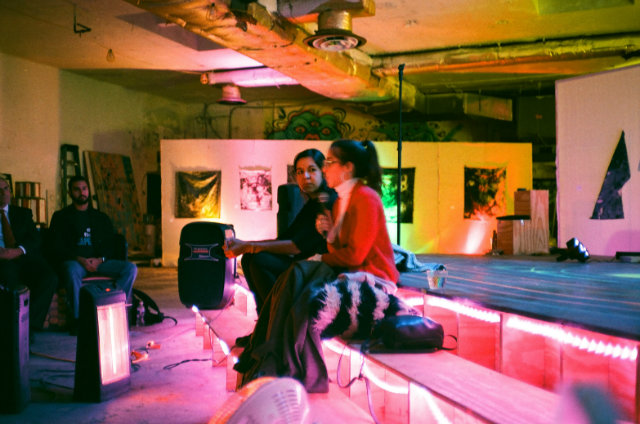
 Nidia Olvera-Hernández, an anthropologist who teaches about the history of drugs in Mexico City (left), and Natalie Ginsberg, policy and advocacy director for the Multidisciplinary Association for Psychedelic Studies, speak at a D.C. Psychedelic Society event at Uptown Art House on Dec. 6, 2017. (Photo by DeAndre Miller, courtesy of the D.C. Psychedelic Society)
A man who looks to be around 30—let’s call him Anthony—and his father have come to the U Street corridor on a recent Sunday night. They’re here to talk about drugs. But not in the way one might assume.
Anthony wants to hear from some seasoned users about whether a psychedelic experience might be able to help him work through his disorders, which include ADHD, PTSD, and addictions to alcohol and other substances.
“I’m using it not recreationally, but to try to treat something,” says Anthony, who declined to give his real name for privacy reasons. “I want to do as much due diligence as I can.”
Anthony’s search for guidance has brought him to a monthly meeting of the D.C. Psychedelic Society, a collective where locals convene to discuss their appreciation for psychedelic drugs, research about their therapeutic potential, and the role they play in religion, art and medicine, among other topics.
At the gathering on U Street—the group requested that we omit the name of their host venue for fear of unwanted attention from law enforcement—18 people are seated in a circle, sharing tales of trips and discussing the benefits of microdosing, or taking psychedelics in small doses.
The group gathered there is fairly diverse, with less than half of attendees appearing to be white men. Many are regulars, and have met through the society’s events. Conversations arise organically about the latest news in scientific research about LSD, the chemical composition of plants with psychedelic properties, and the medicinal benefits of non-hallucinogenic compounds such as cannabidiol, or CBD.
In response to Anthony, a few members suggest psychedelics could help. A seasoned lawyer notes that he was able to kick addictions to alcohol and freebase cocaine in 1995 after taking LSD, and also endorses “developing relationships with plants” like morning glory, which can be consumed in seed form to achieve a psychedelic high, by taking small amounts over time. A naturopath of more than 22 years chimes in, preaching the benefits of psychedelic natural herbs like Syrian rue.
Vince Rado, the group’s founder, says the D.C. Psychedelic Society draws “a wide spectrum of people.” Many are 9-5ers, including attorneys and bureaucrats, who get to speak openly about their drug use in a confidential setting.
“Most people who use psychedelics are in the closet about it,” Rado says in an interview. “I think why people gravitate toward the group is because they have never really felt comfortable talking about these things, and then all of a sudden here’s a room full of people and a safe space where that’s all that we’re talking about.”
D.C.’s chapter is part of an evolving global network of psychedelic societies. They’re digitally connected via Psychedelic.Community, which lists 80 such groups around the world. The first known modern psychedelic society was founded in 2012 in San Francisco.
“This generation is shaping up to be the one that brings psychedelics into the mainstream,” wrote the San Francisco society’s founder, Daniel Jabbour, in 2014, shortly before he passed away of what the society later said was a heroin overdose. “It’s an exciting time to be a part of the community.”
Jabbour was on to something. Once widely used in the 1960s, before the federal government banned LSD and psilocybin in 1968, psychedelics are again entering the popular imagination. Perhaps the most mainstream example is Michael Pollan’s book “How to Change Your Mind,” in which the widely read food and science writer dives deep into psychedelia as a novice.
Per a review in The Guardian, “the book makes clear that it’s no mere hippy cliché to say that LSD and psilocybin were banned because of the threat they posed to the established social order.” But Pollan asserts that with “safeguards in place” for those who opt to trip, “usage could be on the verge of more widespread acceptance,” notes another review in The New York Times.
Microdosing in particular has been well-covered, with a variety of outlets running pieces about the practice and more than 31,000 Reddit users now subscribing to the platform’s devoted community. In another high-profile example, the prominent novelist and former federal public defender Avelet Waldman published a memoir, “A Really Good Day,” last year in which she details how taking small doses of LSD helped save her marriage and improve her overall mental health.
Rado launched the D.C. Psychedelic Society in March 2017, after more than a year of attending talks from Psychedelic Seminars in Baltimore, a series started by Mike Margolies, who helped found a society chapter in his hometown 35 miles north of D.C..
Rado decided to found a dedicated D.C. group during an event at Rhizome in Takoma Park, where psychedelics educator and advocate Paul Austin was speaking. Austin asked his audience whether there were any psychedelic clubs in the area, Rado says. When no one raised their hand, he spoke up and asked the crowd if they wanted to start one.
Rado and a friend got a Facebook group going within a day. He planned meetings and events with help from Margolies, who Rado says “knew a bunch of trippy people in D.C.”
Among their first speakers: Local cannabis activist and Capitol Hemp co-owner Adam Eidinger; Dr. Jerry Brown, author of “The Psychedelic Gospels”; and Katherine McLean, who helped conduct groundbreaking research into psilocybin at Johns Hopkins University School of Medicine in 2015.
“I was really happy to do it because Vince is the kind of guy where you give him a couple leads and he takes the ball and runs with it,” Margolies told DCist.
Still, the society’s rapid growth caught Rado off-guard. “I had no idea, but within a month it turned into a full thing. We had things on the calendar and hundreds of people involved,” he recalls. By the end of the summer, Rado says he had 600 or 700 people on his email list.
The D.C. Psychedelic Society exists primarily for education and a sense of community, and explicitly not for users to partake together or share where to find illegal drugs. At the meeting, Rado abruptly halts a conversation broaching the topic of how one might find LSD, saying, “we do not discuss how to obtain anything that is illegal.”
“We can talk about [drugs] as much as we want, but we cannot actually directly source anything that is prohibited,” he tells the room.
As Rado pointed out, a number of mind-altering drugs—LSD, ketamine and MDMA, for example—remain illegal. This can present risks with obtaining them on the street and knowing their true contents or potency.
For users, a common issue with psychedelics is how to handle a “difficult experience”—what many refer to as a “bad trip.”
For this, the Multidisciplinary Association for Psychedelic Studies, a nonprofit research and education organization, and smaller groups like the D.C. Psychedelic Society emphasize harm reduction, which entails creating a “safe space” and “sitting, but not guiding” a user through their so-called bad trip to help them achieve a therapeutic result. MAPS’ Manual of Psychedelic Support notes, “our intention is not to impose our beliefs on those in distress nor guide them to any particular outcome.”
Margolies says his mission is not “telling everyone to go do LSD because that’s gonna save the world.”
“If I’m an advocate for anything, I’m not an advocate for doing psychedelics,” he says. “I’m an advocate for honest conversations about psychedelics, which includes the benefits and the risks.”
For the D.C. collective, Rado hopes to broaden the focus of discussions beyond trippy encounters to areas like political advocacy and social activism relating to food and drug policy. “There’s more to it than just the psychedelics,” he says.
He’s also “very, very concerned about the lack of women and people of color in the psychedelic space. One upcoming talk dubbed “Dismantling Psychedelic Patriarchy,” scheduled for July 21, will be led entirely by women of color, Rado announced at the meeting in early June.
But he’s encouraged by what he’s seen in just over a year of leading the group.
“The time is ripe right now for psychedelics. I think that there are more people tripping right now than there were in the ‘60s,” Rado says. “I think the influence right now is more tangible than it ever has been.”