Exploring an empty, abandoned space has always been a meditative experience for me. It may be the only place I can leave worry and anxiety behind, the only place where my head feels truly clear.
For years, my “Abandoned States” series has been bringing you the stories behind these spaces, humanizing them, turning the lights back on, and getting a good look at their history.
Decay never stops, of course, and over the years I’ve re-visited some of the sites we’ve profiled. This is rarely a moment of joy, as very few of these places get saved, or re-developed. But there is value in going back. The husks of these once-grand places serve as an ever-changing memento mori, more often than not forcing us to contemplate how it all happened, and how we could’ve keeped it from happening in the first place.
We’ll take you to more new places very soon. But for now, let’s revisit some of our old favorites and find out how they’re holding up.
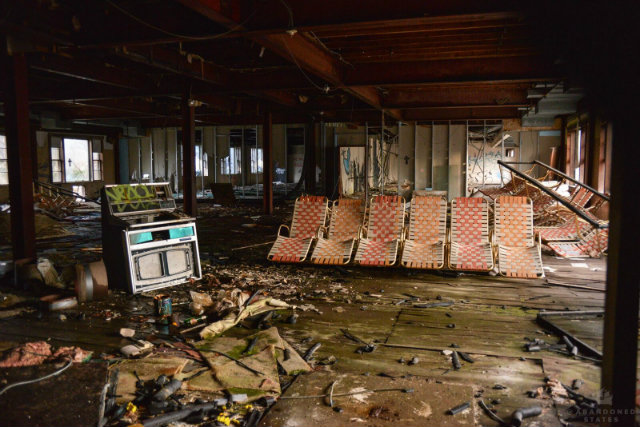 Grossinger’s Resort in the Catskills. (Photo by Pablo Maurer)
Our feature on a handful of abandoned resorts in the Poconos and Catskills last year began with a passage about trudging through an old office and indoor pool at the Penn Hills Resort in Analomink, Pa. Three days after our story ran, that building burned to the ground. Grossinger’s, the once-palatial Catskills resort that’s said to have inspired Dirty Dancing, remains standing, though maybe not for long. Its long-time owner has sought state funds to clean the place up, the first step towards razing the place and replacing it with a more modern resort. In the meantime, the property has largely been fenced off and regularly policed.
After my last visit a few weeks back, I edited together drone footage I took with an original ad for the Penn Hills resort. You can watch it here:
DCist Penn Hill Ad from DCist on Vimeo.
 The 43 presidential busts that sit on a farm near Williamsburg, Va. (Photo by Pablo Maurer)
I had the chance to catch up with Howard Hankins—the Williamsburg-area business owner who owns the heads—about a month ago. After our piece ran in 2015, the old busts became a bit of a sensation, drawing attention from a ton of other outlets and becoming a magnet for curiosity-seekers.
It’s something that’s caused a huge headache for Hankins and the employees who work at the farm where they’re situated. On any given weekday, he tells me, he has to chase a handful of explorers off. On the weekends, it becomes a never-ending stream of visitors, who all get turned away. Those who manage to enter without permission end up dealing with the local police.
Hankins didn’t have long to chat with me. He was headed to D.C. the following day, to a reception at the Trump International Hotel. He tells me the event is another opportunity to find a potential home for his collection. While some investors have expressed interest in preserving the busts, most of that interest cools when they find out that purchasing, restoring, and moving the collection will cost more than a million dollars (the statues cost some $6 million originally).
Other ideas have been tossed around as well. Hankins says there’s a potential development outside of D.C. that would include the busts, a water park, and hotel. But for now, George, Abe, and company seem content to sit idly on the farm, soaking up the summer sun.
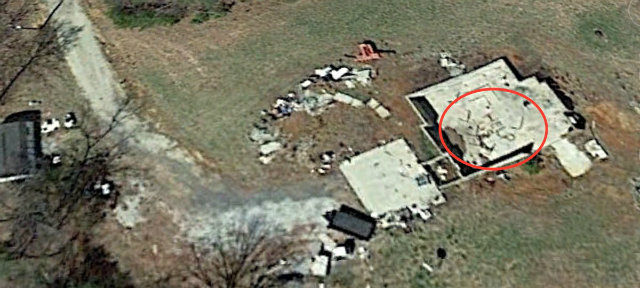 “HELP US” written on the roof of an abandoned house near the mine in Spec. (Photo via Google Earth)
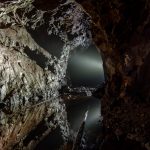
The old iron ore mine in Spec, Virginia isn’t going anywhere anytime soon. Tucked away in George Washington National Forest, it remains out of reach to all but the dumbest of us. I’ve revisited in recent years and it is as unsafe as ever. Partially caved in, this place is a literal death trap.
Just before a recent return to the mine, I sat down and scanned the area on Google Earth, hoping to find another hidden gem. My eyes were drawn to what looked like an abandoned house on top of a hill a few miles away. Zooming in on its foundation, I could hardly believe what I’d found. Two words, painted crudely:
“HELP US.”
I jogged back to a satellite photo taken a few months earlier and there was no trace of the words. I assumed this was some sort of a prank, but the mind tends to wander when you see something like this. Via a friend, I got Reddit on the case. They got a hold of the local authorities, who cruised up and had a look around. Nothing to be found.
Or maybe they were just too late …
(On an unrelated note, a local band told me via Twitter that our article inspired them to drive to Spec and record a song and accompanying video about it. Cool!)
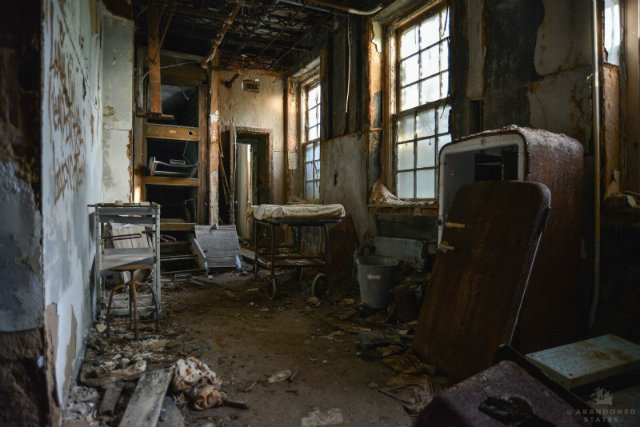 An interior shot at Forest Haven. (Photo by Pablo Maurer)
There’s not a whole lot left of the D.C.-area’s most infamous ruin, Forest Haven Asylum. In the years that followed our 2012 feature on the place, it’s only grown more notorious. In 2016, I teamed up with former DCist Editor-in-Chief Martin Austermuhle for his spectacularly well-researched deep dive into the place.
Some months later, a pair of buildings on the campus were badly damaged in an apparent case of arson. It may be a blessing in disguise. During my wanderings at Forest Haven, I frequently ran across patient records and sensitive data that the District had failed to dispose of properly.
In 2017, Evans v Washington, the four-decade-old lawsuit which led to Forest Haven’s eventual closure, was dropped. There are still no plans to demolish or redevelop the site, which remains full of lead paint, asbestos and other hazardous materials.
EVERYWHERE ELSE:
 The ruins of the old Virginia Renaissance Faire. (Photo by Pablo Maurer)
I visited the Silverdome in 2015. Once a marvel of modern technology, the 82,000-seat stadium had sat abandoned for years and mercifully met the wrecking ball just last December. It took more than one try: a first attempt at imploding the stadium failed, but it gave way a day later.
The Huber Coal Breaker in Huber, Pa., is gone—it was demolished just months after our piece in 2014. But Paselo Logistics, the company which purchased the remains of the breaker and tore it down for scrap, did a sub-par job of cleaning the site up. In March of this year, a judge forced them to put the land up for sale after Paselo claimed it didn’t have the financial resources to properly maintain it.
Rolling Acres Mall is mostly a hole in the ground after its demolition, though nearly all of its steel has been recycled and will live on.
Glenn Dale Hospital continues to waste away while local residents and lawmakers struggle to figure out what to do with the place.
The ruins of the old Virginia Renaissance Faire are still around and yes, the site is still rented out to a hunting club who will happily scare the shit out of you if you choose to trespass there.