Rachel Kurzius
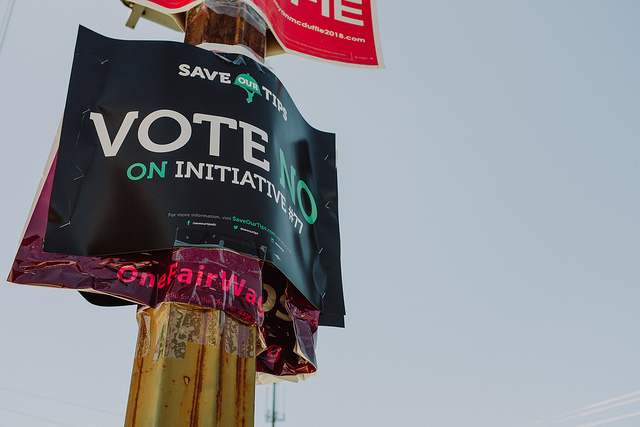 A sign urging voters to reject Initiative 77 is tacked up over one calling for “one fair wage.” (Photo by kelly bell photography)
Jairo Valencia worked as a pizza deliveryman two years ago.
He received a base salary of $4 an hour, and was supposed to make the rest of his wage with tips.
“Many times you don’t get tips,” says Valencia, though on the weekends and during big sporting events, the tips were better. “Those good days are supposed to cover the days you don’t receive any kinds of tips.”
After six months, he quit. “You cannot survive as a delivery person with a family to support,” he says.
Now Valencia is a community organizer with Many Languages One Voice, an organization that has come out in support of Initiative 77, a ballot measure to get rid of the tipped minimum wage. Most of the people talking about 77 are servers, bartenders, and owners, and he does not fit that mold.
Right now, the minimum wage for hourly tipped employees is $3.33. Tips from customers are supposed to get them to the full minimum wage, which is currently $12.50, and employers are supposed to pay the difference if they don’t earn it through tips. (The tipped minimum wage will increase to $5 in 2020, when the full minimum wage will rise to $15.)
The passage of Initiative 77 would eliminate the tipped wage entirely by 2025 through an annual increase of $1.50.
There’s been a fierce battle playing out among those in the restaurant industry over the measure. The local chapter of Restaurant Opportunities Centers United got Initiative 77 on the ballot and says it would ensure that workers earn a living wage. They argue the current system is too unpredictable and its complexity leads to wage theft.
The Restaurant Association of Metropolitan Washington vehemently opposes it, claiming it will lead to restaurant closures and a loss of jobs. Wage theft is already illegal, they say, so why not just crack down on bad actors? (D.C. Attorney General Karl Racine’s office got the authority to enforce wage theft in October 2017 and has pursued a slew of cases, though none of the publicized settlements involve tipped workers.) Mayor Muriel Bowser, Racine, and 10 councilmembers have all said they’re voting “no.”
But what of all of the other tipped workers, like nail salon employees, car washers, bellhops, parking attendants, delivery drivers, and more?
Valencia has been canvassing work places in support of the measure. “There are many people that dont know the initiative is happening,” he says. “I was talking to ex-coworkers and they didn’t know what was going on.”
DCist visited a few nail salons to see how workers felt about the measure, but employees declined to talk. Unite Here Local 25, which represents D.C. hotel workers, has not officially waded into the debate. Many of the other professions don’t have associations like the restaurant industry.
It’s difficult to determine how many tipped workers are in D.C., and what share of them are in the restaurant industry. Part of that is because the federal government categorizes anyone who receives more than $30 per month in tips as a tipped worker, whether or not they’re paid with the tipped minimum wage. And just because they’re paid a tipped wage doesn’t necessarily mean their hourly base is $3.33 an hour.
“This is an incredibly hard nut to crack because the data are extremely limited,” says David Cooper, a senior economic analyst at Economic Policy Institute who has written reports in favor of eradicating the tipped minimum wage.
Data from the Bureau of Labor Statistics in 2016 indicate that D.C. has 28,980 tipped workers. Of that pool, 23,650—or almost 82 percent—work in the restaurant industry. They’ve been some of the most prominent opponents of 77, though some restaurant workers in favor say they fear retaliation for speaking up.
How should we interpret the relative silence from the other 18 percent? Depends who you ask.
Mark Lee is a Washington Blade columnist, small business advocate, and former executive director of the D.C. Nightlife Hospitality Association. An opponent of 77, he says that their lack of visibility on the issue “could indicate that they like the current economic structure of their compensation just fine.”
But Ed Lazere, who is challenging Phil Mendelson to be council chair in the same election as 77 and favors the measure, takes a different tack. “The reason you’re not hearing from others is those folks are typically immigrants and people of color who may not know their rights,” says Lazere. “These are workers who are getting screwed on the job but just don’t have the power to speak up.”
If early voting is any indication, a vast majority of Washingtonians are not speaking up. D.C. Board of Elections figures show that 14,492 people voted early in the 2018 primaries. That number equals about half of D.C.’s tipped workers.
This post has been updated to reflect that Local 25, not Local 23, represents hotel workers.