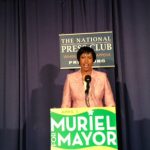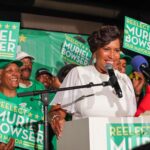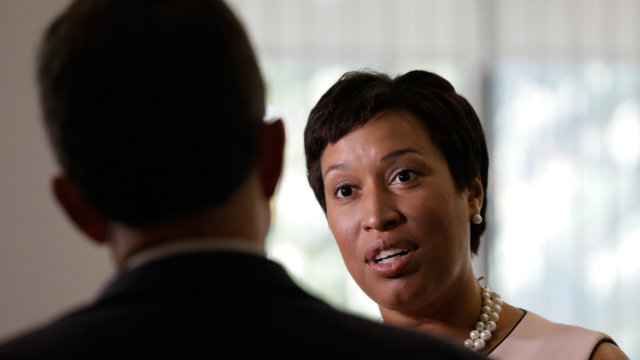
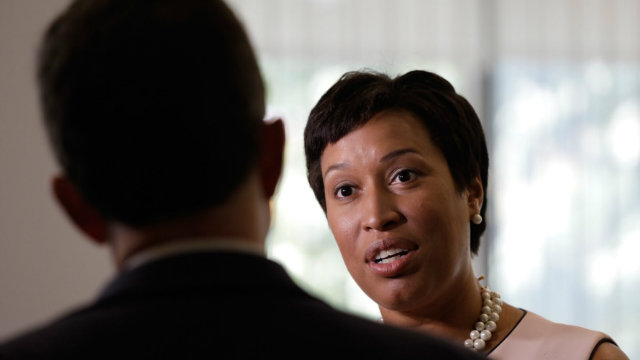
 D.C. Mayor Muriel Bowser easily won the Democratic primary on June 19th. She next faces voters in November’s general election, for which no credible challenger has yet emerged. (Photo by Tyrone Turner / WAMU)
By WAMU’s Martin Austermuhle
D.C. Mayor Muriel Bowser easily cruised to victory in Tuesday’s Democratic primary, taking advantage of a significant fundraising and name-recognition advantage over two lesser-known challengers. The same fortune held for D.C. Council Chairman Phil Mendelson, who handily defeated challenger Ed Lazere.
And in another big-ticket contest, D.C. voters approved Initiative 77, which will slowly phase out the tipped wage paid to workers in restaurants, nail salons, and parking lots.
Incumbents Brianne Nadeau (D-Ward 1, Kenyan McDuffie (D-Ward 5), Charles Allen (D-Ward 6) and Anita Bonds (D-At Large) also defeated their respective challengers, and D.C. Del. Eleanor Holmes Norton won another term as the city’s non-voting member of Congress.
Attorney General Karl Racine and Council member Mary Cheh (D-Ward 3) claimed victory in their respective races, in which they faced no challengers.
With all precincts reporting, Bowser had claimed just shy of 80 percent of the vote. Her two challengers, Ernest Johnson and James Butler, combined for just over 16 percent. In the Council chairman’s race, Mendelson had received 62 percent of the vote to Lazere’s 37 percent.
Turnout was low, with only 17.62 percent of resident casting votes. The percentage of voters was worse than in 2016 and 2014, but better than in 2012, when only 16.98 percent of D.C. residents went to the polls.
Despite a number of recent scandals involving D.C.’s public schools and a spike in homicides in neighborhoods east of the Anacostia River, voters who pulled the lever for Bowser on Tuesday gave her credit for the city’s financial stability, population growth and fast-paced development.
“I think she’s doing a reasonable job,” said Celeste Woolfork, who voted at Shepherd Elementary School in Ward 4. “I think that she’s had some obstacles not of her making. She had some growing pains, but she does seem to care enough about the community and I see her out and about activity involved.”
Bowser also benefited from an ample campaign war chest—she raised $2.5 million—and no real challengers in the Democratic primary, which in the past has served as the city’s de facto mayoral election. Although Butler and Johnson appeared on the ballot, neither raised enough money to be competitive citywide.
But some voters did express reservations about Bowser’s leadership and the rapid pace of change in the city, which has resulted in a spike in housing prices and homelessness, which Bowser has had to weather during her first term.
“I would like the cost of living to change. I know a lot of people are coming in, but also it’s pushing a lot of people out, and I would like a little bit more balance in that area,” said Portia Quarles, a Ward 5 voter who said she voted for someone other than Bowser—but did not volunteer who.
Those same concerns over gentrification were a central element of the race between Mendelson, who has served on the Council for two decades and as chairman since 2012, and Ed Lazere, who for 20 years led the liberal-leaning D.C. Fiscal Policy Institute. During the campaign, Lazere said Mendelson wasn’t thinking big enough in tackling the city’s most pressing problems, while Mendelson argued that he was not only a progressive politician, but also one that could get bills passed into law.
“He has a long political record. And he has done a lot of legislation in the past, so he gets the nod,” said Daesh Kiridena, a Ward 4 voter.
Bowser next faces voters in November’s general election, but much like the primary, no credible contender has yet stepped up to challenge her. If she’s re-elected in November, she will be the first mayor to serve consecutive terms since Anthony Williams in 1998 and 2002.
This story originally appeared on WAMU. This post has been updated.