 Rachel Sadon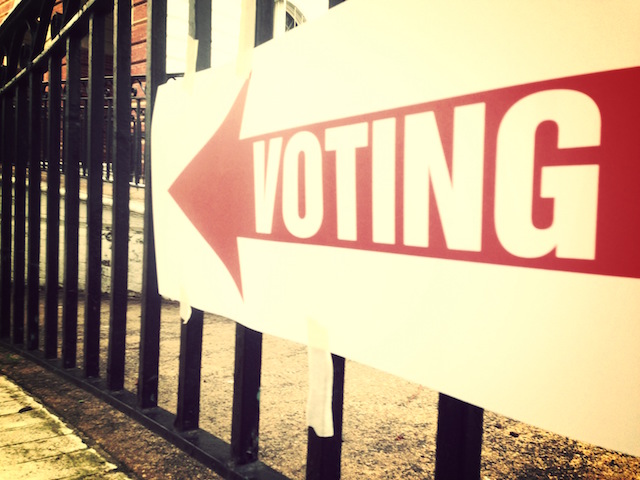
 Photo by Jacques Arsenault.
Technically speaking, the general election is in November. But in a city made up of 76 percent registered Democrats, the primary is where the real action lies. Here’s what happened.
It was a really good night for incumbents
A total sweep, in fact. Mayor Muriel Bowser, Ward 1’s Brianne Nadeau, Ward 5’s Kenyan McDuffie, Ward 6’s Charles Allen, At-large Councilmember Anita Bonds, and D.C. Del. Eleanor Holmes Norton won handily. Attorney General Karl Racine and Ward 3 Councilmember Mary Cheh didn’t even face challengers.
Turnout was low
Out of the city’s 479,723 voters, just 84,517 cast a ballot—or 17.6 percent of the electorate. Still, that’s not terribly uncommon for a primary.
As WAMU’s Martin Austermuhle notes, 2012 only saw 64,361 votes or 16.98 percent of the electorate at the time.
Initiative 77 passed, but the wealthiest parts of the city voted against it
Easily the bitterest fight of the primary was over a ballot initiative seeking to eliminate the tipped minimum wage for restaurant workers, delivery drivers, nail technicians, parking attendants, and others who primarily earn their living from tips.
A brief bit of backstory. Labor activists attempted to pass a $15 minimum wage for all workers—tipped and non-tipped—back in 2016, also via ballot initiative. They withdrew the measure, however, after the mayor reached a deal with a diverse coalition and passed it through the legislative process. Her original proposal raised the tipped minimum wage to $7.50 by 2020, which was later revised downward by the D.C. Council to $5 by 2020.
The way it currently works is that the combination of that wage (currently set at $3.33 an hour) and tips must equal the current minimum wage (currently $12.50) over the course of a week, otherwise the employer has to make up the difference.
The Restaurant Opportunities Center of DC said it isn’t enough and vowed to get what they call “one fair wage” on the ballot. Proponents of the measure cite statistics from the seven states that don’t have a seperate minimum wage, saying that overall poverty rates are lower and restaurant in states like California remain thriving.
Opponents, led by the Restaurant Association of Metropolitan Washington, countered that it would be a potentially business-breaking burden on restaurants that already have thin margins, and enlisted a vocal group of servers and bartenders to speak out against the initiative.
Both sides spent hundreds of thousands of dollars on the hard-fought campaign, with each accusing the other of being funded by out-of-state interests. The truth is that both “Save Our Tips” and “Yes on 77” had local and national support.
In the end, the voters of D.C. sided with the latter, voting 55 percent to 45 percent in favor of the measure.
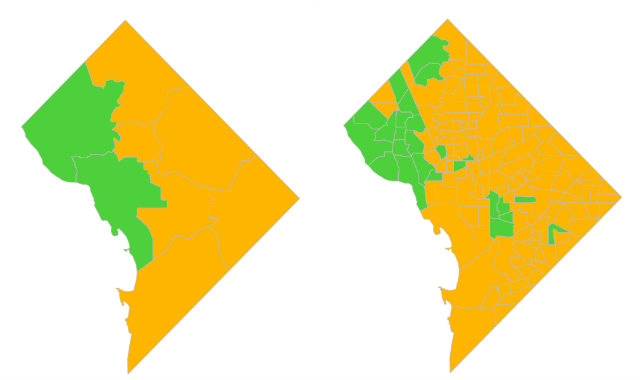 The breakdown of who voted for Initiative 77 by ward and by precinct. Yellow areas voted in favor; green against. (Maps courtesy of the D.C. Board of Elections)
The geographic breakdown of who voted for and against the measure is striking
This isn’t the first we’ve seen an issue get divided on similar geographic lines and it won’t be the last—the wealthiest and whitest parts of the city came out against Initiative 77 in much higher numbers than the rest of the District.
With nearly 64 percent against the initiative, precinct 5—which sits in Georgetown—saw the highest level of opposition.
Initiative 77 is still facing a fight
The post-election battle over the measure has already begun. The D.C. Council has the power to change or overturn laws passed by ballot initiative, which they have done before (in 2001, they reversed the term limits that had been voted in overwhelmingly at the polls seven years earlier). Prior to the primary, the mayor and 10 councilmembers said they were opposed to Initiative 77.
Restaurant Association of Metropolitan Washington President and CEO Kathy E. Hollinger has pledged to take the fight to their doorsteps. “We shall continue to make our case with those who have ultimate responsibility for the District’s laws,” she said in a statement after the results came in.
On the other side, the One Fair Wage campaign celebrated on the steps of the Wilson Building Wednesday morning, vowing to “dedicate significant resources to working with local restaurant owners and the restaurant association to ease the implementation of Initiative 77. We ask Council to work with all stakeholders to ensure a smooth and gradual transition,” the coalition said in a statement.
Initiative 77 opponents are making hay of the fact that the primary occurred in the summer. But there’s nothing suspicious about the date
Hollinger, the Restaurant Association of Metropolitan Washington president, opened her statement by saying “We cannot accept as final a vote in a primary election, in the middle of the summer, on a ballot measure the language of which was, at best misleading.”
Historically, and by D.C. law, primaries took place on the first Tuesday in September. But since 2012, city officials designated dates in April and June to stay in accordance with federal law, which mandates that overseas voters get their general election ballots at least 45 days ahead of election day.
Charles Allen introduced legislation permanently moving the primary to the third Tuesday in June, and it was enacted last year.
The city’s elected leaders haven’t said much about their plans for Initiative 77
As Chairman Phil Mendelson and Mayor Muriel Bowser celebrated their victories, they demurred when asked about what they plan to do next. “I want to really sit down and evaluate its impact with restaurant workers and people affected and see if they will be able to afford a quality of life in the city,” Bowser told the Washington Post. Mendelson said he is waiting for the “dust to settle.”
With the general election still to come and plenty else on the D.C. Council’s docket, it might be a little while before Initiative 77 gets addressed at the dais, if at all.
And I doubt the Council would want to revisit Initiative 77 in the next few weeks, since non-Democratic challengers could use it as an issue ahead of November. And: 2-month summer recess starts in a few weeks.
— Martin Austermuhle (@maustermuhle) June 20, 2018
In other races, Anita Bonds won easily, but she might have had a harder time with only one opponent
As so often happens in D.C. elections, challengers in the At-large race split the vote—paving the way for incumbent Anita Bonds to handily win the nomination. But Jeremiah Lowery, Marcus Goodwin, and write-in candidates combined were less than 3,000 votes away from Bonds’ total.
As Washington City Paper’s Andrew Giambrone notes, a number of people suggested that Ed Lazere should have taken on the more vulnerable Bonds instead of running against the popular chairman.
One other takeaway from last night: If @AnitaBondsDC had been facing a single, strong challenger, she might have been in trouble pic.twitter.com/tJGU9iIzRV
— Rachel Sadon (@Rachel_Sadon) June 20, 2018
Mayor Muriel Bowser had an easy victory, but plenty of people aren’t happy with her
Facing two weak challengers—one of whom didn’t even have a campaign website, the other of whom was disbarred from practicing law after receiving more than 100 ethics complaints—there was never any real question that Bowser would clinch the nomination for the Democratic party. But voters unhappy with her handling of crime, policing, education, and other issues still managed to register some opposition.
James Butler, the candidate who was disbarred, managed to crack more than 10 percent of the vote.
And activists with Black Lives Matter and Black Youth Project 100 showed up to Bowser’s election night party at Town Danceboutique, some of whom were wearing t-shirts drenched in red paint that read “Muriel’s murder months.” They also managed to interrupt her victory speech.
.@MayorBowser we’re outside and we brought you a tombstone for every Black life lost to police brutality by the @DCPoliceDept since your first term as DC’s mayor.
19 tombstones. 19 too many. #BlackLivesMatter #StopMPD #BounceBowser pic.twitter.com/2VtMel86E1
— BlackLivesMatter DC (@DMVBlackLives) June 20, 2018
Last night Activists interrupted @MayorBowser election party to raise awareness of the role she has played in 19 state sanctioned murders of black people in DC since 2015. She must be held accountable to do her job,protect and serve all Black Lives in Washington D.C. #StopMPD pic.twitter.com/CdXaVZnXdw
— BlackLivesMatter DC (@DMVBlackLives) June 20, 2018
The only squeaker of a race was the shadow senator
Incumbent Michael D. Brown (not the Michael A. Brown who went to prison, but still remains popular) beat out first-time candidate Andria Thomas in the only race that came close. Less than 3,000 votes separated the two for the Democratic nomination.