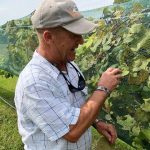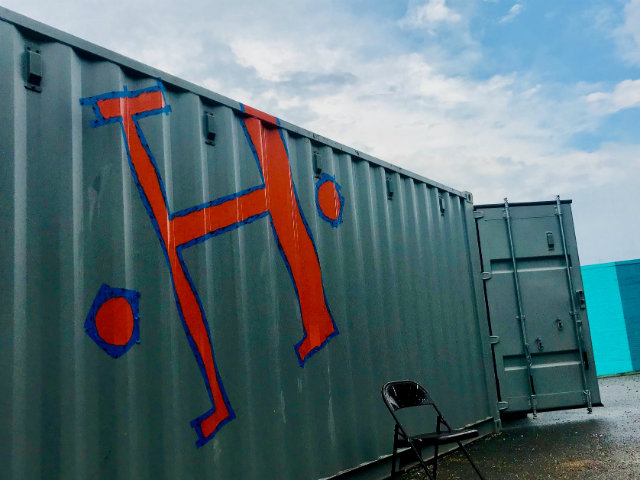
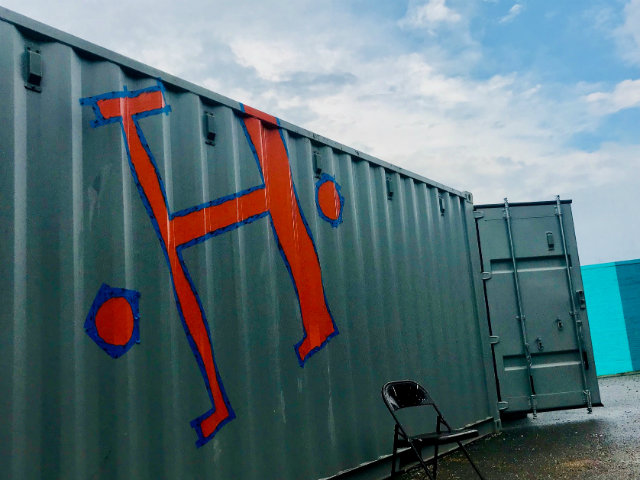
 Hibernaculum will operate at Distillery Lane Ciderworks in Jefferson, Md. (Photo Courtesy of Hibernaculum)
By DCist Contributor Michael Stein
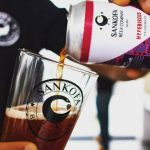
Nathan Zeender, head brewer and co-owner of Right Proper Brewing Company, is crowdsourcing a solar-powered mobile winery to make low-intervention wines and ciders. If funded, his Hibernaculum will be the first roving winery in Maryland.
Hibernaculum is a repurposed shipping container with epoxy flooring that will hold three 550-gallon stainless steel tanks (just over 35 kegs-worth of liquid in each). The box is being constructed in Hyattsville by Zeender’s oldest and closest friend Bret Stevenson. Upon completion, the 20-foot winery-in-a-box will head northwest on a truck to Distillery Lane Ciderworks in Jefferson, Md., where it will turn grapes into the nectar of the gods.
Low-intervention wines have not been shelf-stabilized with sulfites and throw common wine wisdom out the window. Just as his funky and tart Right Proper beers are the only ones with his house culture (a combination of brewer’s yeast, Brettanomyces, and Pediococcus) his wines will use native yeasts from the skin of grapes and apples and from the fields. He plans to work with Jasper Yeast, a lab in Virginia, to use these naturally occurring and unique yeasts to ferment his wine.
Many winemakers strive to keep wild yeast and microorganisms out of their products, in favor of adding separate yeast to the wine. The notion of wild yeast getting into the cellar and interfering with fermentation is most winemakers’ nightmare. For Zeender, it’s a dream.
“There are so many terms you could use [to describe the product] but the most instructive is ‘living wine’ because the average bottles you find at any retailers, 99.9 percent are stabilized wines with no real life energy.” Zeender says. Using naturally-occurring yeast, he says, will create flavors that are unique to this region.
Zeender aims to utilize methods from ancient winemaking traditions of the Republic of Georgia, including the handling of the grapes. While the majority of the world’s wine is pressed, separating the grape’s flesh from the juice, Zeender plans to leave his grapes, skins, and seeds intact, as in Georgian wine. “My idea with this would be to have free-run wine that flows freely from the fermentation, doesn’t need any pressing, [and] would just be blended and bottled.”
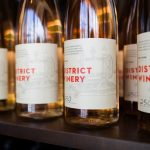
Zeender says he’s obtaining a Class 4 Maryland wine license that will allow him to sell wine in Maryland, and to ship to states that allow for wine shipping.
As of Friday, Hibernaculum’s Kickstarter—which will fund construction of the facility—is about a quarter of the way to its $20,000 goal. Zeender’s passion is like his love for native yeast: He wants it to grow organically. “Not sure what future years will hold. I want the project to grow up to be what it wants to be.”