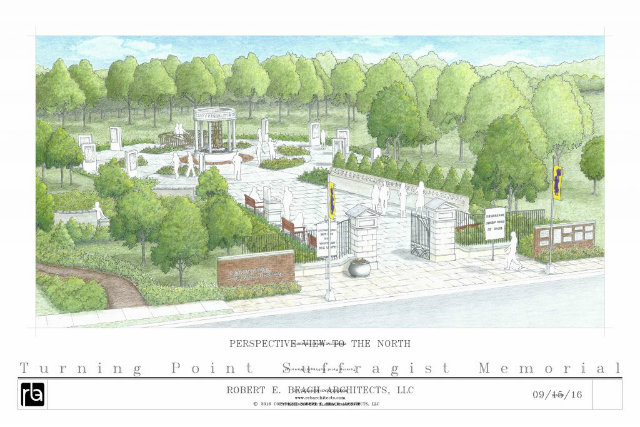
 Visitors would enter the monument through a replica of the White House gates where suffragists once protested. (Courtesy of the Turning Point Suffrage Memorial)
Unless you’re a historian, a fan of cheesy time-travel procedurals, or particularly interested in women’s suffrage, your knowledge of the 19th Amendment might start and end with Susan B. Anthony. Maybe you also remember some other names: Elizabeth Cady Stanton, Sojourner Truth, Ida B. Wells.
What you may not know, because the movement took place before television and (for the most part) radio, is how hard suffragists fought for the vote—and how often they were physically beaten or abused.
“What these women accomplished was the greatest expansion of democracy on a single day,” says Patricia Wirth, executive director of the Turning Point Suffragist Memorial, an association dedicated to building a women’s suffrage memorial in Occoquan, Virginia by 2020. “Five million women fought for 72 years to get the vote,” and very few people know the story, she says.
Marsha Weinstein, president of the National Collaborative for Women’s History Sites, agrees. “Most people learn their history by visiting museums and historic homes and Civil War battlefields and all that,” she says. “The problem is, at those sites, it’s not interpreted to tell the story of what the women were doing there. All the statues, public art, recognizes the contributions of men—mostly white men.”
The Turning Point Suffragist Memorial group wants to change that (it is not affiliated with the conservative non-profit Turning Point USA.) They need to raise $2 million—a fairly modest amount, by memorial standards—to get their plans in place by August 18, 2020, the day the 19th amendment was ratified.
The story might have been different without Occoquan.
In early 1917, a group of women led by Alice Paul began to picket the White House—they were out there six days a week, in all weather. “They put the post office to shame,” Wirth says. The women were called the Silent Sentinels, because they didn’t shout, they just stood there holding banners.
A few months later, the U.S. entered World War I. By June 1917, the suffragists had changed their banners to become more pointed, complaining that Wilson was willing to fight for democracy in Germany while U.S. women were disenfranchised, and President Wilson was starting to get upset. “He put the word out that he wanted the women arrested,” Wirth says. “The police started arresting the women on bogus charges of obstructing traffic—it was total B.S.”
Some of the women arrested were sent to the Occoquan Workhouse, which later became the Lorton Correctional Complex (the former prison is now an arts complex), where they were kept in “inhumane conditions,” though in a separate building from the main complex due to their sex, according to Wirth.
But it got worse. On November 14, 1917, another train came in with 32 new women prisoners. When they demanded to be treated as political prisoners, the warden “began screaming at them, told them to shut up, and dragged them across the street and threw them into punishment cells in the…facility where women weren’t even normally housed,” Wirth says. “One woman was thrown so hard against an iron bed that she was knocked unconscious; her roommate thought she had died and had a heart attack. A suffragist named Lucy Burns was shackled to a door and left there all night, where she almost died.”
A prison guard helped a suffragist smuggle out an account of the abuses written on a scrap of toilet paper. When the media got hold of it, it went the early 20th-century equivalent of viral. Headlines blared across the New York Times and in the international press. “It became the turning point in forcing the president’s hand to do something,” Wirth says.
Historians differ as to whether Wilson actually changed his mind on suffrage or if he felt compelled to act to avoid a political disaster. Either way, soon after the so-called “night of terror,” Wilson made his first public statement in favor of women’s suffrage. By mid-June 1919, the amendment was sent to the states to be ratified and a year later, women could vote.
Of course, it wasn’t that easy. Wirth is the first to point out that poll taxes and Jim Crow laws made it difficult for African-American women (and men) to vote; immigrants from China and Japan were not allowed to naturalize, and so they could not vote; Native Americans living on reservations weren’t considered citizens and also couldn’t vote. Oh, and after Tennessee became the thirty-sixth state to ratify the amendment, which was the last needed to make it official, a bunch of states, mostly Southern ones, waited decades to sign on. Mississippi didn’t ratify the amendment until 1984.
The history of the “night of terror” at Occoquan is why the Turning Point Suffragist Memorial believes that Occoquan is the right place for a memorial to women’s suffrage. And local officials agree. NOVA Parks, the authority that manages parks in Arlington, Fairfax, and Loudoun Counties and Alexandria, Falls Church, and Fairfax, has promised to give the group land for free and provide maintenance in perpetuity. All the nonprofit has to do is raise $2 million dollars. They are currently 25 percent of the way to their goal, thanks mostly to donations from individuals and $200,000 from Fairfax County.
The plans for the memorial include a replica of the White House gates, honoring the Silent Sentinels, and within, a series of 19 “information stations” with information on the history of suffrage (whether they’re plaques or digital screens depends on how much money the group raises). In the center of a plaza, there will be a statue, though its design is still pending.
The group has promised to open something on the site by the 100th anniversary of the 19th Amendment. That means that if they don’t reach their goal, they’ll have to scale back their modest plans. Wirth, who also oversees the fundraising, says that the financial uncertainty is “just overwhelming. I don’t want to see these women who never made it into the history books get shortchanged by not having the whole damn memorial. It’s just not right.”
It’s been an uphill battle for the memorial association, but if Weinstein’s experience at the National Collaborative for Women’s History Sites is any indication, things may change. “Basically nobody’s really cared about suffrage…but now that it’s going to be the 100th anniversary [of the 19th amendment], people are really excited about it. I think also in light of current political situations—the #MeToo movement, the Women’s March, people are going, ‘What’s going on here?’ It’s been hard, but now we have to strike while the iron is hot,” she says.
When the memorial opens in 2020, whatever form it takes, it will be a long-awaited tribute to the millions of women who fought for the vote.