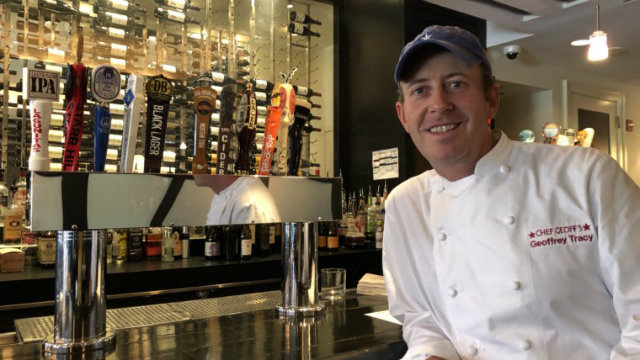
 Chef Geoff Tracy says that advertising happy hour specials at his restaurants in D.C. and Maryland has never caused any problems. (Photo by Esther Ciammachilli / WAMU)
By WAMU’s Esther Ciammachilli
At Chef Geoff Tracy’s eatery in Tyson’s Corner, a menu on the bar tells customers that happy hour includes “so many bottles” of wine at half price. But Tracy can’t advertise this special outside the building. A Virginia law bans restaurants and bars from posting their prices outside, and from using clever slogans to attract customers. Tracy thinks that law violate the First Amendment, and he’s suing the Virginia Alcohol Beverage Control Board to change it.
“We’re talking about something that Virginia has agreed is a perfectly fine thing to have, which is a happy hour. But they’re restricting our ability to give pertinent, truthful information,” Tracy says.
Outside the restaurant, he can tell customers that happy hour is during certain times, but he can’t say what specials he offers during that time frame, or how much drinks cost. He also can’t use phrases other than the basic “happy hour” or “drink specials” to attract business. And he’s only been able to use those phrases since 2014. Before that, a 1934 law made it illegal to advertise happy hour at all in the commonwealth.
“Every restaurant operator in the [Commonwealth] of Virginia has a lot of things that they’re doing on a daily basis, and worrying about whether they’re in compliance of frivolous regulation shouldn’t be one of them,” Tracy says.
The Virginia Alcohol Beverage Control Board declined to comment on Tracy’s lawsuit, but it did say in an email that the happy hour restrictions are meant to preserve public safety by preventing the overconsumption of alcohol.
Chris Konschak of Mothers Against Drunk Driving Virginia likes the law. He says that the more bars and restaurants advertise drink specials, the more they run the risk of encouraging people to drink too much.
“Certainly people know that bars sell alcohol, and that alcohol is going to be there,” Konschak says. “So, the reality is they don’t need to know upfront exactly what the pricing is going to be. They know that the product is there.”
Tracy counters that advertising happy hour prices at his D.C. and Maryland restaurants has never caused problems.
Commercial Speech And The First Amendment
Marc Sorini, a D.C.-based lawyer at McDermott, Will & Emery who focuses on issues facing the alcohol beverage industry says the law supports Tracy’s position.
“What [Virginia] is saying is, ‘Well, we’ll let you go ahead and have lower pricing, just don’t talk about it. That’s when the courts start saying, ‘Look the whole point of the First Amendment is regulating speech should be the last resort, not the first resort,’” Sorini says.
When courts take up cases dealing with commercial speech and the First Amendment, they apply what’s called the Central Hudson test, according to Sorini. The test comes from a 1980 U.S. Supreme Court case, Central Hudson Gas and Elec. Corp. v. Public Service Commission. Sorini says that happy hour advertising passes the first question of the test, which is “does the speech represent lawful and non-misleading activity?”
“Selling drinks is lawful. There’s nothing misleading about a clever name for a happy hour,” he says.
The second question in the Central Hudson test is whether the state has a compelling interest in applying the restrictions on speech. Here, Virginia officials say that the happy hour price advertising ban prevents people from drinking too much and strengthens public safety.
Tracy’s lawyer, Anastasia Boden, cites another Supreme Court precedent, 44 Liquormart Inc. v. Rhode Island, to bolster her case. In 1996, a unanimous Court ruled in favor of a Rhode Island liquor store that claimed its First Amendment rights were being violated by a state ban on alcohol price advertising.
“There’s no vice exception to the First Amendment. Censorship is not in the public interest,” Boden says. “It’s against the public interest. And it actually empowers consumers to have information about the marketplace.”
“People have choices”
Other Virginia restaurateurs agree that the regulations are frivolous. Mark Handwerger, who owns The Board Room in Arlington, says posting happy hour prices would allow him to provide truthful advertising to the public.
“All that would happen is all the consumers out there would then know what’s going on. So, why are we being muzzled?”
Handwerger says what the commonwealth should consider is the loss of business that can happen when consumers don’t have enough information to make decisions about where to spend their leisure time and their money.
“We are a drive and five-iron away from Washington, D.C., where they can advertise. And so, if I’m not able to say that I have whatever my special happens to be, all these commuters going up and down these roads who may or may not be going into Washington, D.C., they can just cross these bridges because people do have choices,” Handwerger says.
The Virginia Alcohol Board tried to have the case thrown out, arguing that Tracy failed to prove the advertising ban hurts his business. A federal judge recently denied that request, allowing the lawsuit to go forward.
This story was originally published on WAMU.