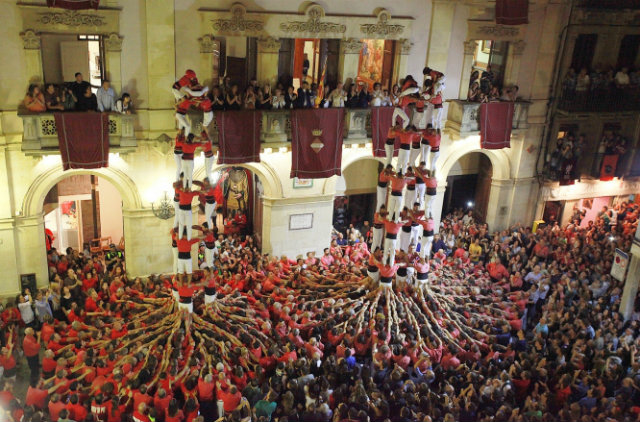
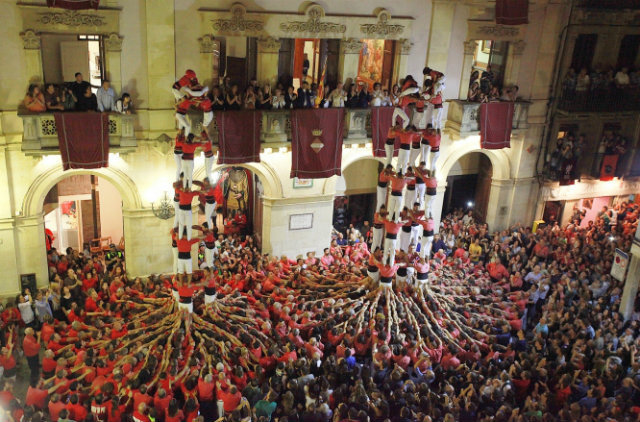
 The Smithsonian Folklife Festival will include demonstrations of the Catalan human towers, traditionally performed at festivals. (Photo by Pere Toda, courtesy of the Smithsonian)
By DCist Contributor Michelle Goldchain
One of the city’s most beloved summer festivals returns to the National Mall this week, and there is so much to look forward to that your head might just spin. At the Smithsonian Folklife Festival, running June 27-July 1 and July 4-8, visitors will be able to experience food events, performances, a marketplace, and workshops centered around the fest’s main themes this year: Catalonia and Armenia.
It marks a return to geographic exhibitions after exploring the circus arts and migration last year during the festival’s 50th anniversary. This year’s festivities will take place from 12th to 14th streets on the National Mall.
This year, the Folklife Festival is offering sessions and workshops on the dishes and art that shape the Catalan and Armenian cultures, along with programming around migration and creativity and African fashion. Note that the food workshops are for the eyes and ears only: Health regulations on the National Mall prohibit sandwiches, cheese, sweets, and other delicious things made at the demonstrations from being offered to the public.
Here are our picks, but head to the Smithsonian Folklife Festival website here for the full schedule.
WEDNESDAY, JUNE 27
What foodies would love: A Zaytinya & NAHA collaboration
Hatsatoun stage, 1 p.m.
James Beard award-winning, Armenian-American chef Carrie Nahabedian and Michael Costa, the head chef of José Andrés’ Mediterranean restaurant Zaytinya, will show attendees how to prepare sou boureg, a noodle dish.
What performance to see: Make mosaic street art
The Workshop stage, 3 p.m.
A group of young artists founded the initiative Gyumri Is Our Home to beautify their city of Gyumri, Armenia. At this event, create a mosaic-like mural similar to the ones made in Armenia.
Which speaker to check out: Examining traditions in craft
Hyurasenyak stage, 1 p.m.
Potters, carpet weavers, and scholars will host the narrative session, “Fading Traditions: Accept or Resist?” that will focus on how globalization, migration, and policy change can cause cultural traditions to revitalize or cease to exist.
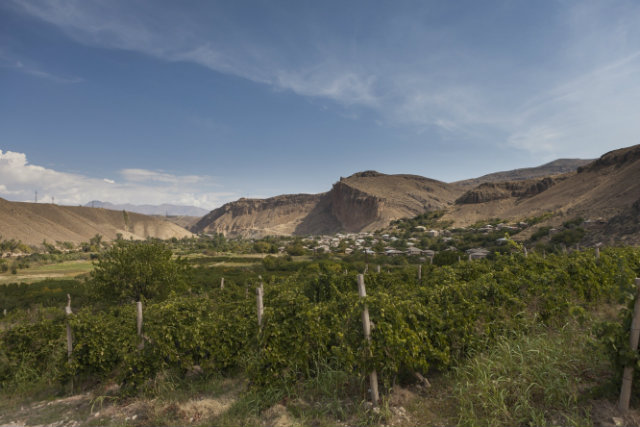 Learn about Armenia’s rich wine history at a pair of sessions on Thursday (Photo by Sossi Madzounian, courtesy of the Smithsonian)
THURSDAY, JUNE 28
What foodies would love: Wine tasting and a toast
Ginetoun stage, 12 p.m and 3 p.m.
Learn about the Armenian toasting traditions and the history of Armenian winemaking with two wineries: ArmAs Winery and Van Ardi Winery. Unlike with foodstuffs, samples are available.
What performance to see: Yacine & The Oriental Groove, Panali
Rinzler stage, 6:30 p.m.
Catch Grammy-winning Arto Tunçboyaciyan, an avant-garde folk artist who has performed with Chet Baker, and Yacine & The Oriental Groove, a high-energy Algerian-Catalan group that has performed around the world. A Catalan fireworks display will follow the performances.
Which speaker to check out: On transnational experiences in music
Atenu Exchange stage, 2 p.m.
In this discussion, Catalan and Armenian musicians will discuss how their transnational experiences have shaped them. Moderating this narrative session is Betto Arcos, independent radio producer of the podcast “The Cosmic Barrio.”
FRIDAY, JUNE 29
What foodies would love: Cheese-making
Hatsatoun stage, 1 p.m.
Love string cheese? Learn how to make the Armenian version called chechil, from the Shirak region in northern Armenia. Stick around for later demonstrations: At 3 p.m. to learn how to make Armenian-style omelettes and at 4 p.m. for pakhlava, a sweet treat topped with chopped nuts and honey.
What performance to see: Design techniques from Morocco and Ghana
The Marketplace stage, 1 p.m.
For creative types seeking new skills, this demonstration by textile designer and dyer Cynthia Sands will teach surface design techniques used in Morocco and Ghana.
Which speaker to check out: Discuss the healing power of craft
Hyurasenyak stage, 2 p.m.
Co-presented with the American Anthropological Association, this narrative session will focus on how traditional craft can play a role in healing trauma for those displaced by genocide, war crimes, or other violence. The discussion, moderated by Adam Gamwell, host and producer of the podcast, “This Anthro Life,” will include a discussion between Syrian-Armenian embroiderers Maral Shohmalian-Berberian and Ayda Sandourian.
SATURDAY, JUNE 30
What foodies would love: Making Armenian bocadillos
Hatsatuon stage, 11:30 a.m.
Sandwich lovers are sure to salivate at this panel featuring Catalan baker Angel Zamora and Syrian-Armenian chef Antranik Kilislyan. These two will create bocadillos, a type of sandwich made with Spanish bread. This preparation will include Armenian basturma, or cured beef, and sujuk, or a dry, spicy sausage.
What performance to see: Les Anxovetes, Zulal and Alidé Sans
Rinzler Stage, 6:30 p.m.
See three groups of female singers in one performance. From 6:30 to 8:30 p.m., the Rinzler Stage will feature Les Anxovetes, Zulal, and Alidé Sans in that order. The first performance is a group of singers from Girona who sing about the sea and Spanish sailors. Zulal is an a cappella trio with lyrics that recall Armenian rural living. The final act, Alidé Sans, sings in the Occitan language. Expect another Catalan fireworks display at the end.
Which speaker to check out: “Wearing Wakanda: Global African Identities and the Crafts of African Fashion”
National Museum of African Art, 2 p.m.
Moderated by Smithsonian curator Diana N’Diaye, this narrative session all about the fashion of Black Panther will feature designers and others who are masters of textiles. Panelists include Cynthia Sands, Kwasi Asare, Soumana Saley and Victor Ekpuk, on hand to discuss African heritage in costumes. Snacks from Nando’s will be available.
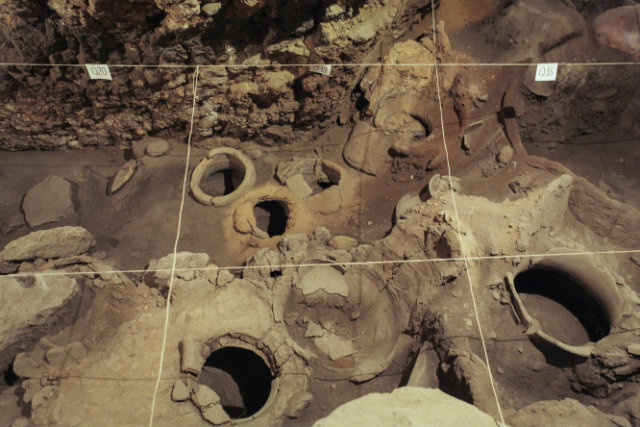 The oldest known winery in the world was discovered in an Armenian cave in 2011. (Photo by Sossi Madzounian, courtesy of the Smithsonian)
SUNDAY, JULY 1
What foodies would love: Discuss Armenia’s wine renaissance
Aygi stage, 2 p.m.
Learn about the world’s oldest winery, discovered in 2011 in a cave near Areni village. Wine experts will discuss the ancient history—and recent renaissance—of wine in Armenia.
What performance to see: Catalan folk dancing
Dance workshop stage, 1 p.m.
The Spanish dance school Esbart Ciutat Comtal presents its Catalan traditional folk dance at this performance.
Which speaker to check out: Discuss Armenia’s diasporas
Hyurasenyak stage, 5 p.m.
Armenia is known for its massive displacement and shifting borders. Questions like “How are diasporas represented in Armenia?” and “How do they serve as Armenia’s doors to the West and the East?” will be answered in this narrative session. This panel will be composed of scholars, journalists, and community leaders.
WEDNESDAY, JULY 4
What foodies would love: Make some lavash
Hatsatoun stage, 2 p.m.
Lavash, one of Armenia’s staple foods, can be used in many ways—and this food demonstration is sure to prove that. The unleavened flatbread is also found in Iran, Turkey, and Azerbaijan. You’ll learn about how to prepare and serve it at home.
What performance to see: A gigantic performance
Imaginary Figures on Parade stage, 2 p.m.
At this play, performed by Geganters of Oliana and the Agrupació de Geganters, “giants” will teach legends and battle songs to people of all ages.
Which speaker to check out: Discuss music and migration
Hyurasenyak stage, 2 p.m.
Armenian music is under the microscope at this conversation featuring Washington, D.C.-based musician, youth educator, and community organizer Kumera Genet; composer and leader of the Armenian Navy Band Arto Tunçboyaciyan; and Nairi Khatchadourian, curator of Armenia’s Komitas Museum-Institute. They’ll discuss Armenian musical traditions and how they have both been influenced and been influenced by the country’s diaspora.
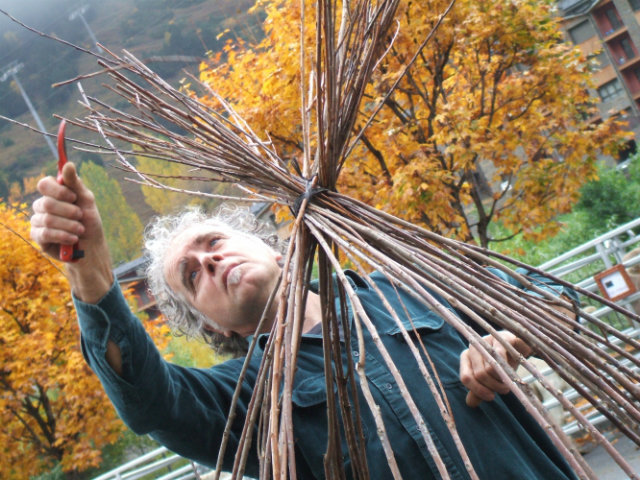 Explore traditional Catalan basket weaving at a session on Thursday. (Photo by Joan Farré, courtesy of the Smithsonian)
THURSDAY, JULY 5
What foodies would love: Discussing migration’s effect on food enterprises in D.C.
Hyurasenyak stage, 2 p.m.
D.C. faces at this discussion include Busboys & Poets owner Andy Shallal and Noobtsaa Philip Vang, founder of D.C. food delivery service Foodhini. They’ll join Armenian- and U.S.-based food entrepreneurs to discuss how their businesses have been affected by contemporary migrations.
What performance to see: The Secret Trio, Maria Arnal and Marcel Bagés
Rinzler stage, 6:30 p.m.
Starting the night is The Secret Trio, whose members blend Middle Eastern improvisation with Balkan dance beats. Following this group is vocalist Maria Arnal with guitarist Marcel Bagés, who have performed in several venues throughout Catalonia. If you miss them, be sure to see them on July 6 at the Kennedy Center or listen to their panel discussion at 4 p.m. at the Ateneu Exchange stage.
Which speaker to check out: Learn about mosaics and basket weaving
Ateneu Exchange stage, 5 p.m.
For crafty people in search of a new DIY, head to this narrative session on the traditions of mosaics and basket weaving.
FRIDAY, JULY 6
What foodies would love: Fish + wine
Hatsatoun stage, 11:30 a.m.
Catalan fishers and Armenian chef and winemaker Vahe Keushguerian will create a fish dish.
What performance to see: Spy a human tower in action
Rinzler stage, 4 p.m.
Look up at the sky and you’ll see a human tower. Traditionally assembled at Catalan festivals, these human towers, or “castells,” can include more than 100 people and reach heights of more than 30 feet .
Which speaker to check out: Learn the history of human towers
Ateneu Exchange stage, 12 p.m.
A narrative discussion on the history of those famous human towers.
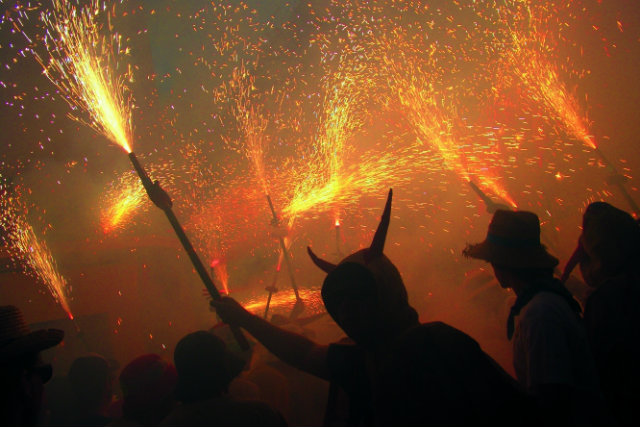 Catalan festivals often feature costumed devils and other creatures. (Photo courtesy of Servicios Editoriales Georama)
SATURDAY, JULY 7
What foodies would love: Learn about nettle soup
Hatsatoun stage, 5 p.m.
Nettles, a backbone of Armenian cuisine, grow all over the country’s mountains and hillsides. At this session, learn to make nettle soup, traditionally made to celebrate the beginning of spring.
What performance to see: Watch a parade
Plaça Major stage, 5 p.m.
In the style of Catalan festivals, costumed devils, giants, and other creatures will march in a joyful parade.
Which speaker to check out: “Soviet Memories and Post-Soviet Practices”
Hyurasenyak stage, 4 p.m.
Learn more about Armenia’s 70-year period as a part of the Soviet Union, and the development and decline it experienced during that time.
SUNDAY, JULY 8
What foodies would love: Make “Armenian Snickers”
Hatsatoun stage, 3 p.m.
Why not end the festival with something sweet? Learn how to make sujukh, a.k.a. “Armenian Snickers,” a sweet snack involving walnuts dipped in fruit syrup.
What performance to see: Sisterfire concert
Rinzler stage, 6:30 p.m.
The festival celebrates the 40th anniversary of Roadwork, a social justice group that promoted the work of female artists, with a concert featuring performances from Alexis DeVeaux, Alexis Pauline Gumbs, Roya Marsh, and Venus Thrash.
Which speaker to check out: Learn about Cameroonian design
Marketplace stage, 1 p.m.
Designer Kibonen Nfi’s designs have been featured in Vogue Italia and on Humans of New York, and worn by Lupita Nyong’o and Gayle King. She’ll discuss Cameroonian design at this session.