Rachel Kurzius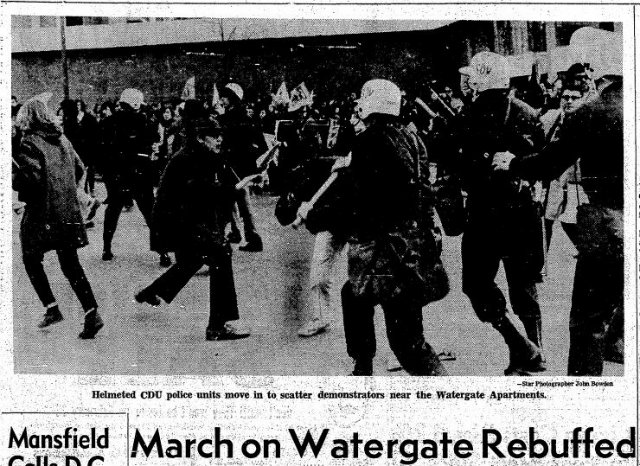
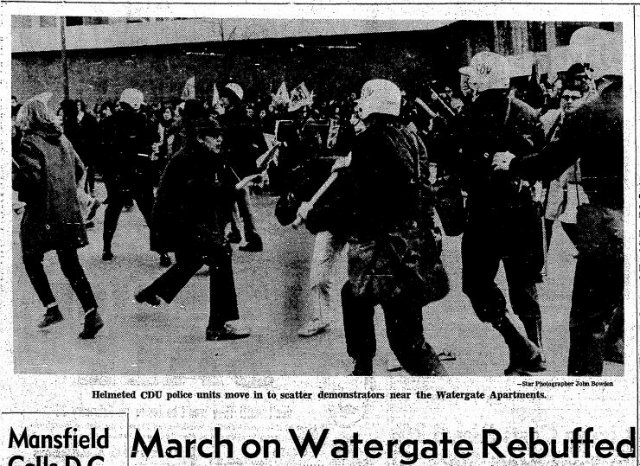 The front page of The Evening Star on February 20, 1970. (Courtesy D.C. Public Library, Star Collection, © Washington Post)
Protesters frustrated with a court verdict took to the streets around a Republican administration official’s home, resulting in more than 140 arrests as law enforcement officials used billy clubs and deployed tear gas.
Haven’t seen photos on Twitter? That makes sense—it happened in 1970.
There’s a lot of hand wringing about the current spate of demonstrations in the D.C. area, in which protesters have voiced their ire at the Trump administration’s “zero-tolerance” immigration policy. Small groups of activists have marched and chanted outside the homes of Department of Homeland Security Secretary Kristjen Nielsen and White House senior adviser Stephen Miller, among others.
But so far, none of them rival in size or intensity the large crowd who marched from the George Washington University campus towards the Watergate complex on February 20, 1970 around 3:30 p.m. Attorney General John Mitchell lived at the luxury apartment building, though according to the Washington Post, he was at his downtown office until about 6:30 p.m.
That day, five members of the “Chicago Seven” were sentenced to five years in prison and fined $5,000 after they were convicted of crossing state lines with the intent to start a riot at the 1968 Democratic National Convention.
According to The New York Times, the march had been promoted for weeks as a “people’s tour” of the Watergate, slated to happen when the Chicago Seven verdicts came down. Demonstrators numbering between 600-700 gathered on GW’s campus.
They chose the Watergate because the luxury complex “symbolizes the ruling class,” according to literature passed out at the protest, per The Washington Post. A 1969 Life Magazine article said that, when only counting Republicans, the Watergate housed “three Cabinet members, two senators, Nixon’s chief of protocol, and more than a dozen White House aides,” including Attorney General John Mitchell.
But six busloads of police officers wearing white helmets and full riot gear prevented the protesters from getting closer than about a block away. The demonstrators, which the Post described as mostly student-age, were chanting “Two, four, six, eight, liberate the Watergate!”
Police officers managed to push protesters back towards GW’s campus, and that’s where the violent clashes occurred.
Per The Post:
… the line of policeman pushed forward against the crowd and a demonstrator threw red paint over Capt. Earl Drescher.
“Get that one,” Drescher shouted to his men. At this point policemen waded into the crowd and began making arrests.
Drescher collared the man who threw the paint while one of several other officers who also grabbed the youth struck the youth on the head with a baton.
A young woman, standing to the side of the area where police were making arrests, was hit on the top of her head by an officer who came up from behind. As she fell to the ground screaming and bleeding, another demonstrator jumped the officer who struck her.
The demonstrator was wrestled to the ground by one of several officers dressed to look like demonstrators.
According to The Evening Star’s story about the events, “Reporters who had covered similar protests here said that police seemed more impatient and rougher in handling the demonstrators yesterday than in the past.”
Police told The Washington Post on February 21 that 141 people were arrested, most of them charged with disorderly conduct or parading without a license. At least one police officer and six demonstrators were injured, including a former American University chaplain arrested after police charged at students who had taken down an American flag.
The Evening Star describes the American flag laying behind protesters who put on “a guerilla theater presentation representing the rights of the citizens being ‘raped.'”
According to the book The Watergate: Inside America’s Most Infamous Address, Watergate residents were instructed to stay inside.
A Washington Post article with the headline “Watergate Residents Happy” describes how residents provided hot coffee, fig newtons, and lemon wafers for police officers protecting the building, some of whom were still there the following day to ensure protection should the protesters return.
But not all residents were pleased. The protest “inconvenienced me,” Mrs. Alfred Messore told The Post. “I had to cancel my plans for the afternoon.”
Courtesy DC Public Library, Star Collection, © Washington Post by Rachel Kurzius on Scribd
Courtesy DC Public Library, Star Collection, © Washington Post by Rachel Kurzius on Scribd