Natalie Delgadillo
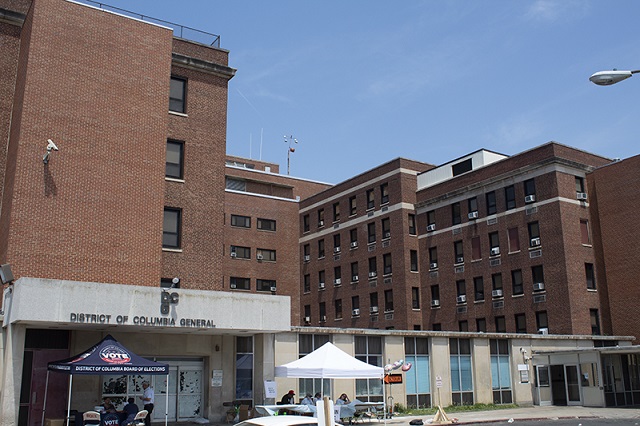 (Photo courtesy of the Homeless Children’s Playtime Project)
Ikea Hunter has been homeless for almost three months. The 24-year-old mom lives at the D.C. General homeless shelter with her 4-year-old son Giovanni, who has special needs. They’re one of the last families to get in before the shelter stopped accepting new residents in May, a precursor to its final closure in September.
Like all residents of this place, she does not want to be here. The building is stuffy, she says, and she fears it’s making her child’s asthma worse. More than that, she fears he’s losing out on crucial resources. Giovanni is nonverbal and autistic, and the shelter doesn’t allow for home health aides to come in and provide him with needed services, she says. “We have paperwork from his school showing how you can see the change in his behavior from April [when we moved in] to now. He hit a kid at school,” she says.
But even though she doesn’t want to live here, Hunter says she is angry about feeling shoved out. She motions around her to the fencing closing in on the children’s playground, mounds of dirt piled where construction crews have started digging. She points in the distance to a building on campus that will be torn down soon, with residents of the shelter living right next door.
“I think it’s very disrespectful that they’re doing this [construction work] before everyone has moved out,” says Hunter.
If the city had decided to wait, it wouldn’t have been long; by September, all of the families living here will be gone. The echoey, rat-infested former hospital, which has been used as a family homeless shelter since 2001, will be torn down to make way for new development on the campus. The plan is to replace the sprawling shelter, which currently houses around 170 families (but which has routinely housed around 270), with smaller shelters throughout the city. Mayor Muriel Bowser campaigned on the its closure four years ago and released a plan to replace it in February 2016, which underwent changes at the D.C. Council. Still, residents of the shelter expressed surprise this January when they were told it would be closing down definitively in the fall.
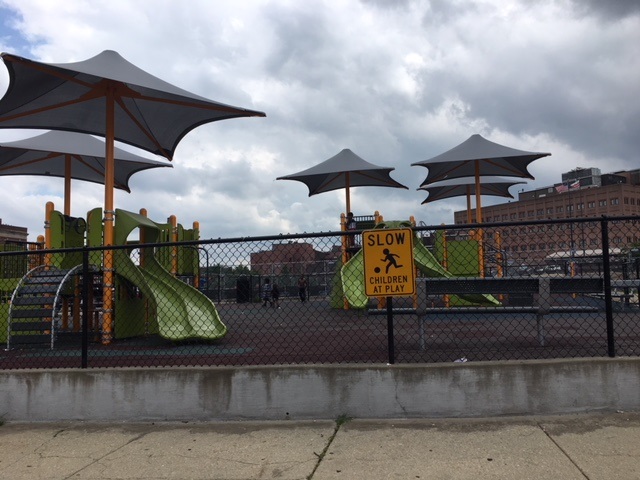 The playground on the shelter site. Currently there is fencing jutting up against the playground, big mounds of dirt on the other side. (Photo courtesy of the Homeless Children’s Playtime Project)
In general, homeless advocates and residents themselves have been in agreement with the decision to close the shelter. D.C. General is utterly dilapidated. It’s also the site of tragedies and abuse. In 2014, the place became infamous as the place where 8-year-old Relisha Rudd disappeared. Also in 2014, The Washington Post uncovered 14 reports of sexual assault by shelter workers, constant bug bites, and other poor conditions for the children living at the shelter. Just last week, a baby died at the facility.
But as much as residents and their advocates have wanted this place to close down, something about the way it’s happening has rubbed some of them the wrong way. Residents have two months left before they get moved out of the shelter for good, but already the construction crews have descended, erecting fencing that cuts the parking lot in half and putting up signs advertising fancy new development near where the shelter currently sits.
“It’s really blocked off everywhere. The parking lot is smaller. You can only walk certain ways,” Hunter says. Before the crews erected fencing next to the playground, Hunter says she liked to sit in the grass and let Giovanni run barefoot in the field. Now that area is gated off. “You just have nothing to do,” she says.
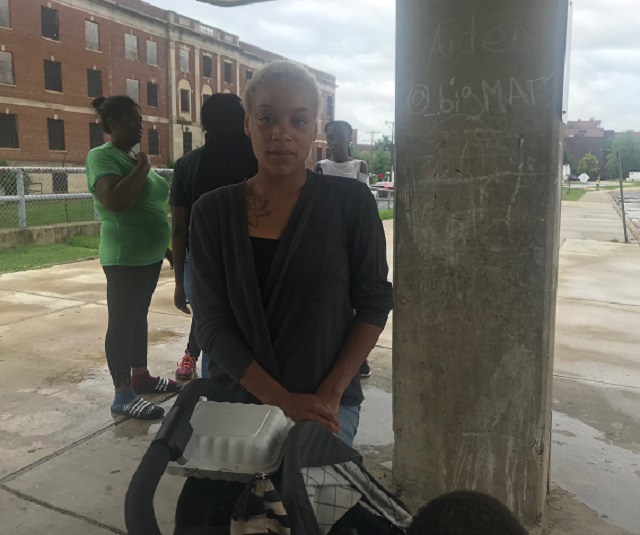 Ikea Hunter, standing by her son Giovanni’s stroller outside D.C. General. (Photo by Natalie Delgadillo)
Advocacy organizations share her concerns. Amber Harding, of the Washington Legal Clinic for the Homeless, says her organization’s position has always been that the shelter should close, but only when the smaller replacement shelters being built were fully ready. As it stands, only one, in Ward 4, will be ready by the time D.C. General closes. Two more, in Ward 7 and 8, should be open about a month later, though construction is experiencing delays. (There have been mutterings that the Bowser Administration is rushing to close the shelter in a bid to make the land more attractive to Amazon. The city offered up D.C. General’s land and nearby plots to the tech giant as a possible site for its second headquarters. The administration has denied that this is the motivation).
Harding also says she does not find it appropriate for the city to have started deconstruction with residents still living on site. “The construction is really up against the playground. We were told that families were told they shouldn’t let their kids play on the playground,” she says.
Laura Zeilinger, the director of D.C. Department of Human Services, told DCist that the playground remains operational.
Lead and asbestos abatement has already begun on a couple of the buildings on the campus, and demolition of one building is slated to begin in the next couple of weeks.
“Any time you do a demolition like that, it releases a lot of rodents. I spoke to families last night who told me they’re really worried about that,” she says. Families are also worried about the possibility of lead in the dust that will get kicked up during demolition. Harding says the city has promised to do a “wet demolition” on a “closed site,” which would reduce the dust in the air.
The building slated for demolition—Building 9—is not directly next to the shelter, but around 250 feet away. It will be what’s known as an “interior demolition,” or one that begins slowly piece by piece on the inside of the building, avoiding all the dust kick-up of a demolition involving a bulldozer or dynamite.
“It comes down to what amount of risk is D.C. willing to take for the health of homeless children and families and women when there’s no reason, no legitimate reason that I’ve heard, for why this has to happen now,” says Harding.
Some of the families I spoke to for this story expressed mild annoyance with the fencing, but otherwise said they care little about the physical changes to the space around them in recent months. All of them, though, were immediately and viscerally angry about what the construction crews represent: new development that excludes families like theirs and makes room for a wealthier kind of Washingtonian.
“See, I’m pissed off about that. Now this is when you’re going to hear my mouth,” says Carlena Durbin, a 31-year-old who lives at the shelter with her 10-year-old son and her spouse. “[Mayor Bowser] is foul for doing that. D.C. has money. Y’all going to tear down an overflow for the homeless just to put the rich right here. Why?”
Durbin is referring to the development going up adjacent to the hospital site, which will consist of two mixed-use buildings with 353 housing units and more than 25,000 square feet of retail across two acres of land.
It was a common refrain. A 33-year-old woman who didn’t want her name used in this article said she believes the shelter will be torn down to make room for other “kinds of people” in this space. “I’m not going to say what kind of people, because I don’t want to seem quote-unquote racist,” she says. I ask her if she thinks the city is clearing this space out for white people to live in, and she smiles and nods.
Hunter is also angry about the fancy-looking development shown in the photos around the construction site. “I’m livid, very livid [about the new development here],” she says. “I know one thing they’re going to do, they’re only going to do a percentage [of affordable housing]. So it’s not even going to be for the people they’re kicking out. They’re not saying, oh let us close this down to fix the shelter up. No, they’re closing this down to make this area up and make it condominiums.”
Zellinger says that the city is “providing opportunities for residents to express concerns not only about construction but also about their transition. Families have a mix of emotions, but also many have expressed a sense of encouragement at the broad array of resources available to them.”
But Jamila Larson of the Playtime Project, an organization responsible for bringing D.C. General its playground and other services for children and teens, says that she’s concerned about the sense of alienation some residents have expressed.
“The biggest thing that I’ve noticed is the feeling on campus that the construction is kind of looming, closing in on them. It gives you the feeling that ‘we’re here, this is ours now, we’re taking over,’” Larson says. “One thing that really stood out to me is the banner facing Massachusetts and 19th, that has this photo of a really beautiful-looking development with a picture of a fountain.”
Larson told me a story that had been relayed to her by one of her volunteers on site. The volunteer overheard a preteen child exclaim, as they were passing the banner of the fountain, that construction crews would be “putting a pool here.” Another child corrected him: “That’s not for us.”
Hunter, standing outside the shelter in light rain with her baby this week, put it succinctly: “Construction has been going on for like four months and it’s getting to the point where this is what we have to look at every day,” she said, motioning around her. “Does it make me angry? Yes it does.”
DCist is one of eight D.C.-based news outlets dedicating a portion of our coverage on June 28 to collaborative news coverage about ending homelessness in the nation’s capital. See more at DCHomelessCrisis.Press