Natalie Delgadillo
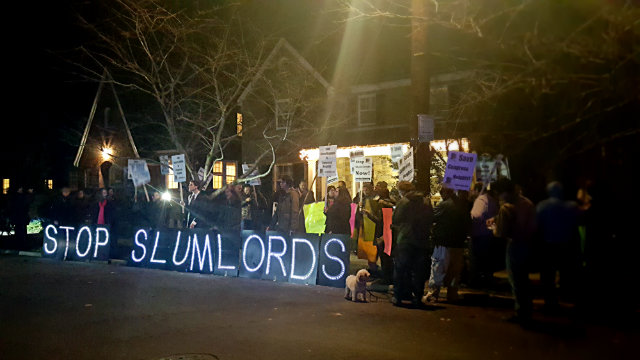 Activists and residents took their complaints about the conditions at a Congress Heights apartment complex to a developer’s doorstep in December 2015. (Photo by Rachel Sadon)
The D.C. Council discussed a trio of proposed bills meant to deter slumlords and streamline the process to remedy housing violations for tenants in the District on Tuesday.
The bills come in the wake of high-profile cases of repeated violations in D.C. in which tenants were living in squalid conditions. Sanford Capital, which at its peak owned more than 65 buildings in D.C., is perhaps the most well-known offender: tenants have described mold, broken refrigerators, vacant, vandalized units and no heat or air conditioning at Sanford properties. This year, the D.C. Attorney General’s office worked out a deal with the firm to renounce all its properties and exit the D.C. market. To date, the city has levied $752,000 in fines on Sanford Capital, but the slumlord has paid only $158,000.
In another notable case, residents at Brightwood Park have been engaging in a rent strike for the last few months to protest what they say are awful living conditions in the building, including mold and vermin infestations.
Advocates at D.C. organizations that often represent tenants, including the Children’s Law Center and Legal Counsel for the Elderly, say that the D.C. agency tasked with addressing housing violations—the D.C. Department of Consumer and Regulatory Affairs—does not do an adequate job of protecting tenants.
The three bills before the council would, respectively, deny landlords basic business licenses and building permits when they neglect their buildings; create a new housing condition abatement fund and mandate referrals of repeat offenders to the D.C. AG’s’s office; and require that the mayor’s office repair serious violations that remain unfixed six months after DCRA gets involved and charge the property owner.
Representatives for the Children’s Law Center and Legal Counsel for the Elderly testified at Tuesday’s hearing, expressing both serious concern with DCRA and general support for the measures before council, with some amendments.
Anne Cunningham of the Children’s Law Center stressed that the organization favors splitting DCRA up into smaller agencies: one for buildings and construction, one for permitting and licensing, and a new “Tenant protection agency” that would address violations and enforcement. (Council Chairman Phil Mendelson has already proposed a bill that would split the agency up into separate building and licensing factions).
Cunningham also pointed out that the bill which would take away business licenses, At-large Councilmember Elissa Silverman’s Slumlord Deterrence Amendment Act, would only bar the specific LLC involved in the violations from obtaining or renewing a business license. Building owners often create a separate LLC for every building they operate, which would make this enforcement mechanism more or less moot.
“Unfortunately, there is no current mechanism for determining who owns an LLC in D.C. So, this bill must include a component mandating disclosure of all individuals
and businesses with an ownership interest in an LLC,” Cunningham said in her testimony.
The director of DCRA, Melinda Bolling, said in her testimony that the agency is currently in the “final testing stages” of two new algorithms created in partnership with The Lab at D.C., which are meant to better prioritize tenant complaints and the dispatch of inspectors to properties.
Among her concerns with the proposed bills, Bolling said in her testimony that Silverman’s legislation on business licenses “might cause severe unintended consequences for tenants” because landlords with no business license do not have the ability to collect rent, which could cause them to allow their properties to fall into further disrepair.
Chairman Mendelson disputed that, saying landlords would still legally be able to collect rent. Silverman said they would have to get “lawyers to huddle” on that question after the meeting.
Bolling also had concerns about the bill requiring referrals to the D.C. AG’s office if a violation remains unfixed after six months. She said some landlords are trying in good faith to fix violations, but cannot do so within six months.
Bolling added that requiring DCRA to abate all violations not fixed within six months, as another of the bills would do, would “incur significant upfront costs to the agency, which would only be reimbursed much later through property taxes … it could take an extended period of time before the agency is reimbursed.”
After the hearing, Silverman said that DCRA needs “clear leadership to address what has been a historically dysfunctional agency. I like Director Bolling personally, but I just don’t see the clear, decisive leadership to address what are just systemic issues. And what really bugs me about that agency is people keep testifying about the same problems again and again and again and I just don’t see a sense of urgency from Director Bolling on them.”
Reporting contributed by WAMU’s Martin Austermuhle.