Rachel Kurzius
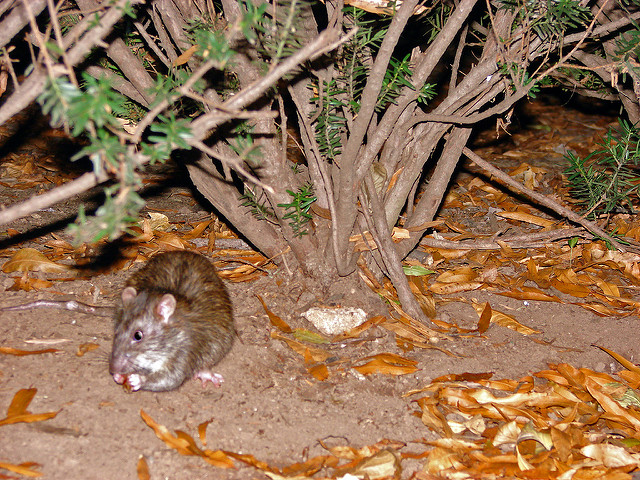 Photo by Steve Fernie.
A woman was walking in Dupont over the weekend when she suddenly felt a heavy weight on her ankle. She looked down, horrified, to find that a rat had latched onto her leg.
“I freaked out and just jumped up and down,” says Sophia (that’s her middle name—she doesn’t want the story of a rat attack to haunt her Google results as it has her dreams). “It made a horrific noise and scattered into the bushes.”
The interaction occurred on Sunday night on 18th Street NW, in between R and Riggs streets, near Sophia’s home. She had a “very slight” scratch on her ankle, upon which she immediately put hydrogen peroxide and antibiotic cream.
She also made an appointment with her doctor, who told her it was healing fine. While there, she got a tetanus shot, since rat bites can make humans more susceptible to tetanus, according to Orkin. “I needed one anyway,” she says.
She’s not quite sure what attracted the rodent to her ankle, which was bare. Rats, like other small rodents, have not been known to transfer rabies to humans, according to the Centers for Disease Control.
Sophia’s story comes at a time when we’ve seen the circulation of photos of especially large rats on Popville (Washingtonian discovered that the creature in question was an exotic breed rather than the typical D.C. street rat), and complaints about rats have more than doubled since 2015.
Some ideas for quelling the tide of the growing rat population in the city include a bill that would require businesses to have rodent prevention plans, a “blue collar cats” initiative from the Humane Rescue Alliance, and computer modeling technology.
But what happened to Sophia is “not typical behavior” for the rodents, says Bruce Colvin, an ecologist and international expert on rats.
He has a couple of potential ideas for why the rat latched onto Sophia’s ankle, though cautions that there are many variables that could have affected the circumstance.
“Normal behavior is running away from people,” says Colvin. “If a rat is disturbed or displaced it will try to run for a secure location and, in doing that, it can sometimes run into a person.”
But that doesn’t hold true if the creature in question was an escaped pet rat, because they “will run to people and will try to climb,” says Colvin. “It could be attracted to a person because pet rats will function like dogs.”
While Sophia felt shaken up the next day, she has largely recovered. But even before the attack, she had rats on the brain.
“What’s terrible is for weeks I’ve been having dreams and nightmares about mice and rats,” says Sophia. “It’s not great to have that culminate into an attack … the taunting noise it made is reverberating in my brain.”