 Rachel Sadon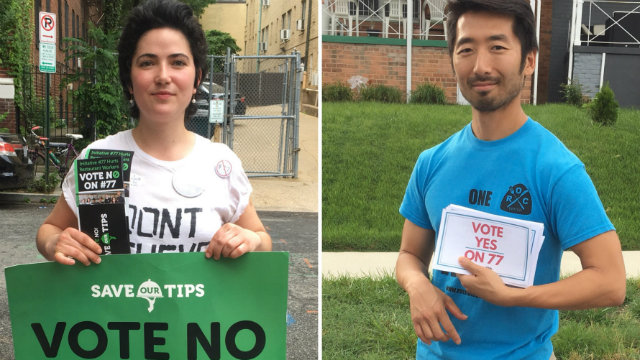
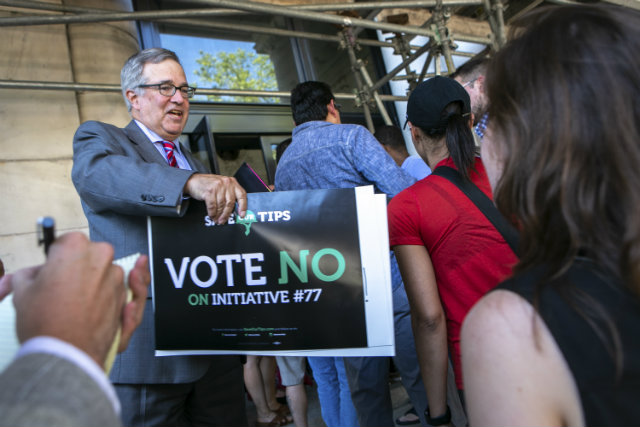 Andrew J. Kline, general counsel for the Restaurant Association of Metropolitan Washington, gathers protest signs from demonstrators as they enter the John A. Wilson building on July 9, 2018. Demonstrators were not allowed to bring their signs into the building. (Photo by Becky Harlan / WAMU)
Less than a month after 55 percent of D.C. voters approved a ballot initiative to increase the minimum wage earned by tipped workers, several D.C. councilmembers are expected to introduce legislation on Tuesday that would repeal the measure.
After initially saying at a legislative briefing on Monday morning that “no expected action” on Initiative 77 was planned, Chairman Phil Mendelson confirmed that a bill is in the works and expected to be introduced at the final Committee of the Whole meeting before the D.C. Council goes on recess.
Several councilmembers will co-introduce the non-emergency legislation, according to a spokesperson for the chairman.
A crowd of more than 100 restaurant workers and owners gathered outside the Wilson Building this morning to pressure the D.C. Council to take action against Initiative 77, which would gradually raise the tipped minimum wage until being phased out entirely in 2026.
Currently, the combination of the tipped minimum wage (now set at $3.89 per hour) and tips must equal the minimum wage (now $13.25 per hour). Otherwise, the employer has to make up the difference.
Labor activists argue that this process is too convoluted and can lead to wage theft. They point to statistics from the seven states that only have one minimum wage showing lower overall poverty rates.
Restaurant owners counter that rising labor costs could destroy already thin margins. In the lead-up to the primary, opponents in the industry rallied around a cry of “save our tips” (Initiative 77 wouldn’t actually bar tipping, but many fear that the possible addition of surcharges to diners’ bills would effectively do so in practice).
A large group of people carrying “No on 77” signs came to the Wilson Building to lobby against the measure, handing out buttons with a red slash through 77 on them. They squeezed into councilmembers offices, sharing personal stories and detailing how it would affect their livelihoods.
“We’re not a city that’s full of chain restaurants. I do think this initiative would change that dynamic,” said Ana Reyes, the owner of El Tamarindo. “I don’t believe that small operators would have the same access to the industry because of the cost of labor.”
They already have some support on the D.C. Council.
“I stand with you to make sure that Initiative 77 does not become law,” Ward 2 councilmember Jack Evans told the gathered group of opponents through a bullhorn on Monday before announcing that a bill will be introduced to repeal the measure. Before the vote, a supermajority of councilmembers and Mayor Muriel Bowser all came out against Initiative 77.
“Overwhelmingly, tipped workers do not like the initiative. They believe—strongly—that the unintended consequence of the initiative will be to reduce their pay,” Mendelson said in an emailed statement. “The phrasing of the initiative on the ballot unquestionably was misleading. And every contested incumbent on the same ballot opposed the initiative, yet won their primary. So it is not a surprise that a bill would come forth.”
A hearing will be held “early” in the fall, according to the chairman. If a repeal bill passes, it wouldn’t be the first time that the D.C. Council overturned the will of voters.
In 2001, lawmakers overturned a ballot initiative that had instated term limits seven years earlier.
This post has been updated. Reporting contributed by WAMU’s Martin Austermuhle, Dani Matias, and Ally Schweitzer.
More:
10 Things You Should Know About Initiative 77 And The 2018 D.C. Primary
Initiative 77 Doesn’t Just Affect Servers. Why Haven’t We Heard From Delivery Drivers, Nail Technicians, Bellhops, And Others?
You’ve Heard Of Initiatives 71 and 77. What Happened To 72-76?