 Lori McCue
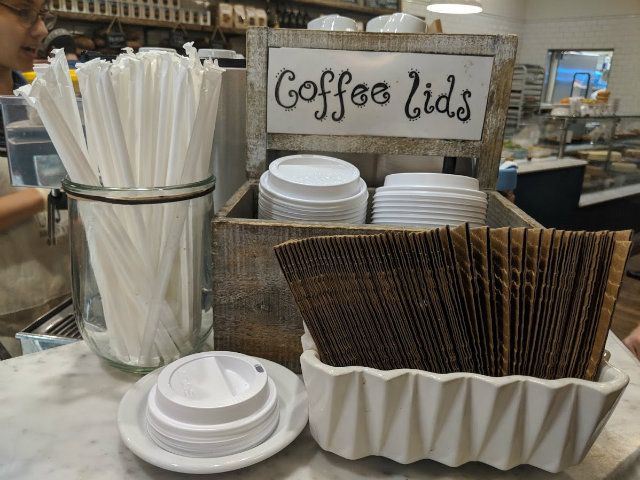 A bill introduced this week at the D.C. Council would clarify that plastic straws are banned. (Photo by Rachel Sadon)
The D.C. government took aim at plastic straws this week. On Tuesday, Ward 2 Councilmember Jack Evans introduced a bill that would ban the sale, use, or provision of non-compostable straws and stirring implements by 2019. Mayor Muriel Bowser released a statement on Wednesday encouraging residents to “say no to plastic straws.”
But plastic straws are technically already banned in the District.
Ward 3 Councilmember Mary Cheh, the co-sponsor of Evans’ bill, was among the first to point this out Tuesday on Twitter.
We have not seen any enforcement against disposable plastic straws (which are technically already banned in the District). This legislation is needed to raise awareness and codify our commitment to phasing-out plastic and phasing-in compostable, reusable, or recyclable products! https://t.co/Bz45kr7soc
— Mary M. Cheh (@marycheh) July 10, 2018
She’s referring to legislation passed in 2014, which banned polystyrene and non-recyclable disposable food service as part of the Sustainable DC Omnibus Amendment Act. The ban, which took effect in 2017, included non-compostable one-time use items, specifically listing containers, bowls, plates, trays, cartons, cups, lids, forks, spoons, knives, napkins, and yes, straws.
But according to Cheh’s policy recommendations published May 4 of this year, the D.C. Department of Energy and the Environment’s natural resources division, which enforces the ban, did not include straws in its public guidance on the bill.
“DOEE has not yet started to enforce the ban on plastic straws, and in fact, its educational materials for food service providers explicitly say they are allowed,” Cheh wrote.
Guidance on the DOEE website says plastic straws are compliant under the legislation because they are “smaller than two inches in two dimensions.” Small utensils, coffee stirrers, and condiment lids are also listed. Why the size specification? According to the guidance, items smaller than two inches are not accepted by the District’s recycling program. DOEE recommends that plastic straws be thrown away after use. The recent recycling guide, released in October, also does not include plastic straws.
The legislation proposed Tuesday would specifically address plastic straws, hence the name: the Sustainable Straws and Stirrers Amendment Act of 2018. It proposes a ban on non-compostable, one-time-use straws and stirring implements that would take effect in 2019. A “stirrer” here is defined as “an implement designed for one-time use to mix or blend a liquid or other substance, including a beverage stick, swizzle stick, or cocktail stirrer.”
According to Cheh, the bill reminds people that there’s a ban in the first place.
“As we were thinking about this as a piece of legislation, I wanted to make sure that the implication it carries is not that there’s no ban now,” Cheh tells DCist. “There is a ban now, we’re just making it very, very explicit and capturing the attention of the moment about the issue.”
Indeed, straws are having a moment: Seattle officially banned one-time use straws this month, and this week Starbucks and American Airlines announced they would phase out straws. These moves come amid increasing scrutiny on straws’ environmental impact. The Anacostia Watershed Society claims to have removed more than 1,800 of them from the river during an Earth Day cleanup this year.
“If you’ve ever been along the Anacostia there are these eddies where water gets collected in almost like a cul de sac,” Cheh says. “Take a close look: You’ll see plastic straws.”
She notes that though she wants the bill to pass quickly, promising to move it “as a rocket docket,” she wants people to start cutting out straws now.
“What I want residents to understand is I don’t want them to wait for this bill,” Cheh says. “Carry a reusable straw with you if you like a straw.”
Mayor Bowser on Wednesday echoed those sentiments, in a statement offering support for the Our Last Straw coalition, led by Dan Simons of Founding Farmers. The coalition includes nearly two dozen local restaurants that have pledged to phase out plastic straws.
“Mid-way through the Year of the Anacostia, there is no better time for our community to double down on efforts that protect our waterways and help us meet our waste diversion goals,” the statement reads. “Residents and businesses are eager to be part of the solution, and through the Our Last Straw coalition, it’s going to be easy to do just that.”