Jacob Fenston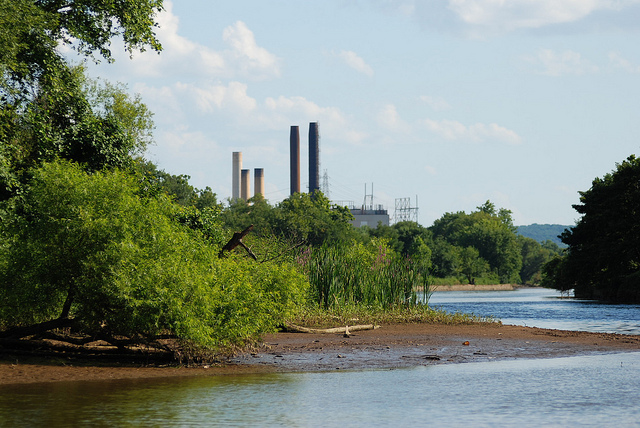
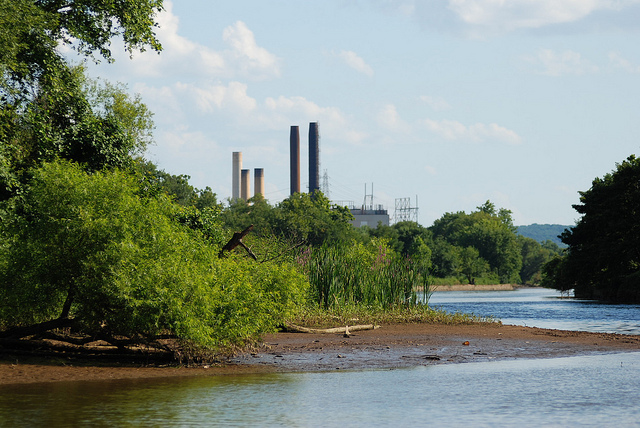 A decommissioned Pepco power plant on the Anacostia River. (Photo by Kamweti Mutu)
A majority of the D.C. Council is supporting a bill that aggressively targets climate change and includes the most ambitious renewable energy standards in the nation. But the measure falls short of what some environmental groups were pushing for.
More than a year ago, a group of activists came to Ward 3 Councilmember Mary Cheh with a proposal: a tax that would make polluters pay for greenhouse gas emissions. The proposal would start with a fee of $10 dollars per ton of carbon dioxide emissions, rising $10 per year to a cap of $150.
“It would really become painful to continue to use fossil fuels,” said Cheh.
That pain was the whole idea. By making fossil fuels more expensive, people and businesses would be nudged toward cleaner technologies.
Cheh was intrigued. D.C. would have been the first jurisdiction in the nation to implement such a tax. She spent months in weekly meetings with activists and industry working out a plan. Several other council members got on board. But in the end, Cheh, who chairs the council’s environment committee, decided against the tax.
“I wasn’t sure, given the other kinds of burdens we’ve been putting on businesses, particularly small businesses, the hefty kind of carbon tax they were suggesting was the best way to go,” she said.
Instead, she put forward a clean energy bill that would do a lot of other things. It would establish the most aggressive renewable portfolio standards in the nation, requiring 100 percent of electricity in the District to come from renewable sources by 2032. It would also phase in new building energy performance standards, and help fund energy efficiency upgrades by increasing a fee on utility bills — about $1 on the average electric bill and $2 on the average gas bill. It would also encourage people to buy fuel-efficient vehicles by tying the vehicle excise tax to fuel efficiency.
Some environmentalists lauded the legislation.
“Through this bill, D.C. can lead the nation on climate protection legislation that can benefit D.C. families and businesses,” Mark Rodeffer, D.C. Chapter chair of the Sierra Club, said in a statement.
Others had a less enthusiastic response.
“Disappointed and surprised,” said Camila Thorndike, who headed up the carbon tax campaign for the Chesapeake Climate Action Network.
She said it’s unclear whether Cheh’s proposal would be as effective.
“There’s been no analysis done on this package,” Thorndike said. “That was one of our points of frustration, is that we’ve provided so much modeling, and consideration of what the economic impacts, what the emission impacts, what the equity impacts were going to be of what we were putting forward.”
The legislation is likely to become law in some form; seven of D.C.’s 13 councilmembers support it.
This story has been corrected. Had the tax passed, D.C. would have been the first jurisdiction to implement such a tax, not introduce one.
This story was originally published on WAMU.