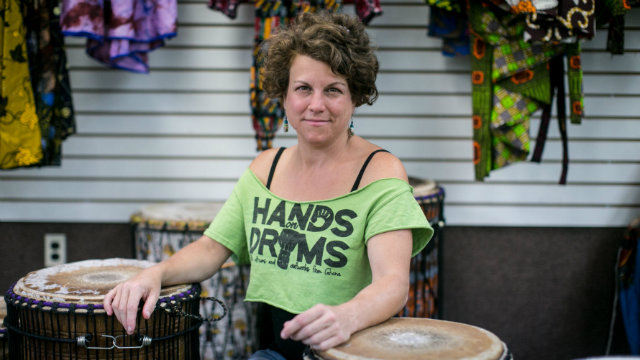
 Kristen Arant calls herself “the drum lady.” She runs various programs, including the Young Women’s Drumming Empowerment Project, out of Hands on Drums. But the future of those programs will be in doubt when the space closes in August. (Photo by Becky Harlan / WAMU)
By WAMU’s Avery Kleinman
On a recent Saturday, the Bele Bele Rhythm Collective gathered to bless the temporary home of arts space Hands On Drums near the Rhode Island Avenue Metro stop.
The all-women drumming group practices at the space, which will soon have to move or close permanently. Developer MRP Realty is clearing the location for a new mixed-use housing and retail project.
“We’re sort of just scrambling, getting everything out,” says Kristen Arant, the co-founder of Hands On Drums. “Then I don’t know where we’re going.”
“I believe in the power of what we’re doing, especially with the drumming and the music and how it makes a difference in people’s lives.” Arant says. “A space is really a necessity.”
Hands On Drums is one of many arts spaces struggling to survive as development spreads across the city.
A representative from MRP Realty declined to be interviewed for this story, but did provide a statement about the closing: “We’ve enjoyed having Hands On Drums pop-up at the site and even re-accommodated them here through August 30. They are a great community and cultural asset, and we plan to seek similar tenants once we reach that point for such opportunities in the development build-out.”
Arant hopes Hands On Drums can stay in D.C, but says rents that fit her needs are out of reach — about $6,000 a month.
“It’s such an uphill battle,” she says. “The price ranges of properties in D.C. are ridiculous.”
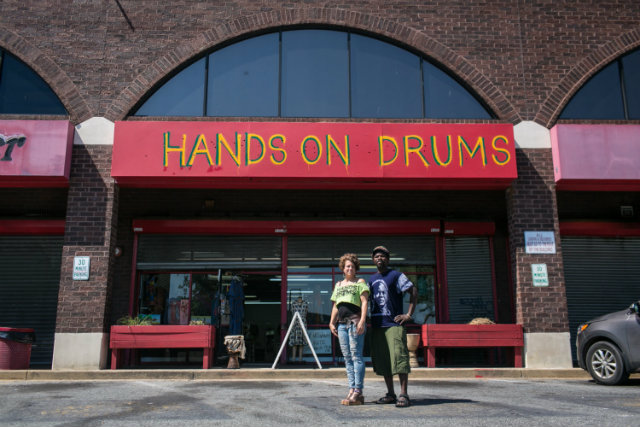 Kristen Arant and her husband Michael Kweku Owusu co-founded Hands On Drums, which is currently occupying a temporary space in the Rhode Island Avenue Shopping Center. (Photo by Becky Harlan / WAMU)
A wave of gentrification
The spaces that artists can afford—with the room they need to make their art—are often in lower-cost neighborhoods. But the arrival of artists can make those neighborhoods more appealing to outsiders. Soon, developers start investing, yoga studios and gourmet coffees shops arrive, and artists are priced out.
“It’s almost a cliché at this point, that that’s sort of one of the first things that you might notice in terms of a neighborhood gentrifying or redeveloping,” says Blair Murphy, the curator of exhibitions at the Arlington Arts Center.
Murphy has seen the process happen first hand since she began working in the area in 2006. She also researched how the artists who worked in downtown D.C. in the 1970s and 1980s were pushed out when the arrival of the MCI Center (now Capital One Arena) transformed Chinatown.
“Historically over the last few decades, [it’s] kind of just been this rolling wave across D.C. as different neighborhoods are developed,” Murphy says.
That wave has arrived in the Northeast D.C. neighborhood of Ivy City. It’s losing the screen printing studio Open Studio DC in October.
Studio founder Carolyn Hartmann says that in the last four years, her property taxes went up more than 700 percent — a testament to how quickly real estate values in that area have risen.
“We just can’t afford to keep doing it at that rate,” she says.
Encouraging artists to come, and stay
In October, Hartmann is planning to move her studios to Baltimore, which has invested in several initiatives aimed at sustaining affordable arts spaces. The city created arts and entertainment districts Station North, Bromo and Highlandtown, where artists receive tax breaks to live and work.
Prince George’s County established The Gateway Arts District in 2001, which similarly offers tax breaks to artists.
Hartmann says D.C. needs to step up and do the same, otherwise artists will keep leaving.
“D.C. doesn’t really do a lot to encourage artists to stay in any one place and if we don’t stay in place we lose our community every time we move around,” she says.
For it’s part, the District government says it is working to keep artists in place.
“We’re looking at ways maintain not only creatives being in the city but thriving in the city,” says Angie Gates, who leads the D.C. Commission on Arts and Humanities.
D.C released a draft in mid-January of its first-ever Cultural Plan, which identified the lack of affordable spaces as a substantial challenge for artists. It points out that more than 70 galleries have closed in the last decade.
The plan does offer broad strategies on how to move forward, it but lacks specifics.
Many artists, including Kristen Arant, have benefited from city grants to subsidize her projects. She says she’s received more than a dozen over the years.
But according to curator Blair Murphy, those grants often aren’t enough to keep artists in town.
“I think the hard thing in D.C. is there really isn’t enough support to make up for the increases in terms of cost of living and in terms of real estate,” she says.
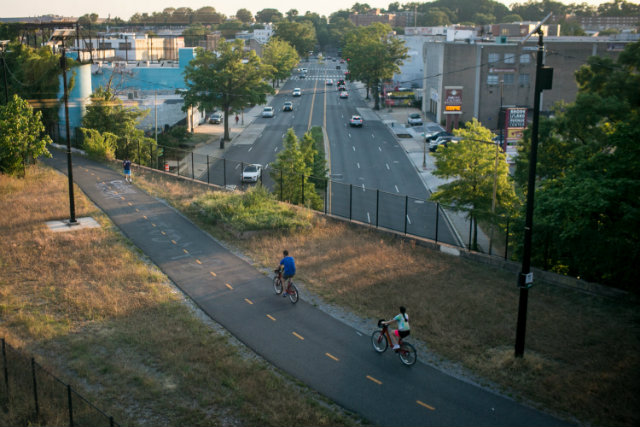 MRP Realty will break ground on a development project this year that will transform the area near the Rhode Island Avenue metro stop in D.C.(Photo by Becky Harlan / WAMU)
Partnering with developers
Some D.C. artists are choosing to partner with those who are pushing forward neighborhood change — developers.
A new studio space called STABLE will open later this year thanks to one such partnership in D.C.’s Eckington neighborhood — a place where in the past 15 years, lower income residents have been replaced by wealthier, younger newcomers.
And in Crystal City, developer JBG Smith worked with the Arlington Artists Alliance to develop five blocks of underground retail space that includes galleries and studios.
But Carolyn Hartmann of Open Studio DC is wary of relying on developers to keep artists in the District.
“Anytime you’re beholden to a developer that way, you lose your voice,” she says.
Hands On Drums’ Kristen Arant has similar concerns about relying on developers to keep the city’s culture intact, but without support, a long-term space may be out of reach. Still, she’s continuing her search for a new home.
“It’s needed so badly in this culture because of just how breakneck it is,” she says.
For Hands On Drums to make it, Arant says, it might mean looking outside of D.C.
This story was originally published on WAMU.