Matt Blitz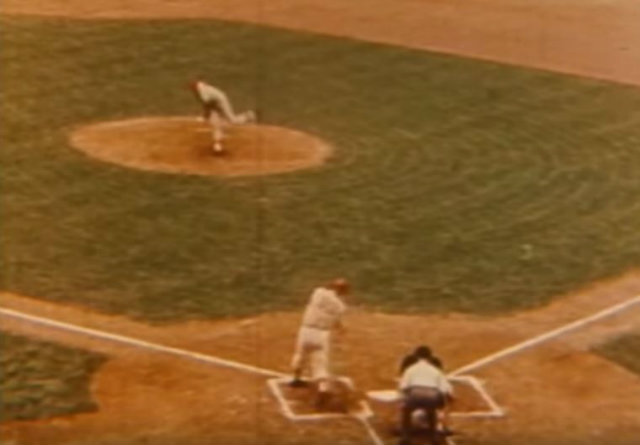
It was a hot, muggy July day when the slugger strode to the plate. Surrounded by other greats of the game, he wanted to give the hometown D.C. fans something to remember. With a mighty swing of the lumber, the slugger did just that by launching the baseball deep, deep, deep over the right-center field fence. The fans in the nation’s capital erupted with a roar.
This isn’t some fan wishful thinking for when Bryce Harper takes his cuts at the All-Star Game at Nationals Park on July 17. This is the scene from the last time Washington, D.C. hosted Major League Baseball’s All-Star Game.
On July 23, 1969, Washington Senators outfielder Frank “Hondo” Howard connected on a long home run in the bottom of the second inning. “It was one the biggest thrills… in [my] lifetime,” 81-year-old Howard tells DCist. “Being able to represent my team… and Washington D.C. like that, it was unbelievable.”
The game’s announcer, Charlie Brotman, got caught up in the moment himself. “The emotion got to me,” says Brotman, now 90 years old. “I’m a homer, born and raised in D.C… and I was just so excited.”
In July 1969, D.C. was still reeling from the riots that had rocked the city the year before. Animosity was rising toward the Vietnam War, which would culminate in the largest anti-war demonstration in the nation’s history on the National Mall a few months later. On a more hopeful note, Neil Armstrong had just taken “one small step for man, one giant leap for mankind” on the moon.
Major League Baseball’s All-Star Game is the annual celebration of the sports’ greatest players with stars from both leagues gathering to play an exhibition game. At a time when there was no interleague play, free agency, or cable television, fans of an American League team (including the Washington Senators) rarely got a chance to see players from the National League.
“The neatest thing was getting to see these guys in person,” says Ben Walker, a baseball writer for the Associated Press who attended the game as an eleven-year-old with his dad, mom, and best friend. “[There was] Hank Aaron, Willie Mays, Roberto Clemente, Tom Seaver. And there were all live, in person, and in D.C..”
It’s not like baseball wasn’t being played in Washington on a regular basis. The Senators had called the nation’s capital home for decades. But thanks to the franchise’s long-time failure to field a winner, the team wasn’t a hit with many Washingtonians.
“Attendance [at games] was always very poor,” says Fred Frommer, author of the book You Gotta Have Heart, a history of baseball in Washington. ”Fans weren’t really drawn to the games, mostly because they were always a pretty bad team.”
Although 1969 was a better year than others for the Senators (51 wins and 50 losses at the All-Star break), with the team managed by Hall of Famer Ted Williams, it wasn’t enough to avoid being moved to Texas less than three years later.
Even Howard, consistently their best player, admits that the Senators teams in the 1950s and 60s weren’t very good. “We just didn’t have enough quality players to compete. America loves a winner,” he says.
As the famous saying went, Washington was “first in war, first in peace, and last in the American League.”
At least the stadium was a draw. Opening in 1961 as D.C. Stadium, the Senators’ home field was renamed Robert F. Kennedy Memorial Stadium earlier in 1969 in honor of the slain attorney general and presidential candidate (and much to the chagrin of President Johnson). While RFK Stadium is now a rusting steel hulk with a murky future, it was once a futuristic-looking state-of-art sports facility.
“It was like a flying saucer, a spaceship with its curved roof,” says Bethesda-born Tim Kurkjian, who attended games there as a kid and is now a baseball writer and analyst for ESPN. “It was different and unique. [RFK Stadium] was actually ahead of its time.”
The All-Star Game was set for a Tuesday night, July 22, with President Richard Nixon to throw out the first pitch. Earlier in the week, he had invited a group of players and sportswriters to the White House for dinner and told them: “I like the job I have, but if I had to live my life over again, I would have liked to have ended up as a sports writer.”
But as it happens, sometimes the best laid plans get rained out.
“Oh man, it poured. The dugouts were flooded,” remembers Howard, “There was water four feet high in the tunnels leading up to the dugouts. You couldn’t have played that night.”
Walker was on the Beltway with his dad when it was announced on the radio that the game was being called off. “I was so upset… because I was going to miss my chance to see my favorite players,” he says.
The game got rescheduled for Wednesday afternoon, making it a rare daytime All-Star Game. President Nixon could no longer throw out the first pitch due a previously scheduled world tour that included visiting the Apollo 11 astronauts who were stuck in quarantine after their trip to the moon. So, Nixon’s Vice President Spiro Agnew was given the gig.
As the game got started, hometown hero Howard immediately made an impact, but not a good one. He dropped a Hank Aaron fly ball in the first inning that allowed a run to score. By the second inning, the National League was already up three to nothing.
In the third inning, the bespectacled Howard stepped to the plate against future Hall of Famer Steve Carlton, with the fans cheering Brotman’s introduction of the Senators’ star player.
“[Carlton] knew full well we were playing in Washington and Howard was the hero,” remembers Brotman. “He laid one in there for him.” And Howard hammered it.
“It wasn’t a cheap home run,” says Walker, who was able to make the next day’s game. “My dad [said to me], ‘That will teach them to pitch to Big Hondo!’”
Kurkjian was watching and celebrating in his Bethesda home. “I’m pretty sure we had color TV by then, which made it even better.”
The player himself remembers the fans going nuts as he rounded the bases, but says he was just focused on the game. “Any time you can help your club win a ball game, it’s a bonus, Howard says.”
His team didn’t win the game. While Howard’s homer did put the American League on the scoreboard, they lost the game to the National League by a score of nine to three. But that didn’t diminish the special moment.
Now, nearly five decades later, the All-Star Game is coming back to Washington D.C. With one swing of the bat, perhaps the Nats’ own home-run hitting star can also leave a whole new generation of D.C. baseball fans with a life-long memory.