 Jordan Pascale
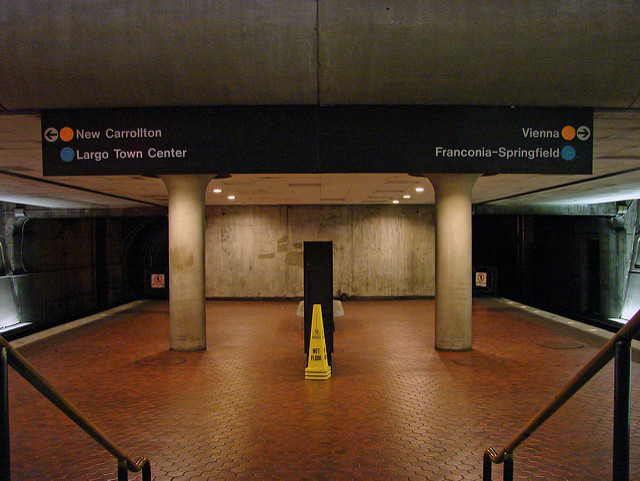 (Photo by Steve Fernie)
Frontline workers in Metro’s largest union voted overwhelmingly Sunday night to allow its leadership to call for a strike.
But that doesn’t mean a strike will happen.
So far ATU Local 689 President Jackie Jeter is playing coy on if or when a strike may occur.
“The union has no plans to make its timeline of events public, but will share developments at the appropriate time,” a union release said Monday morning.
ATU’s executive board will likely meet this week to talk next moves.
Under the current union contract, it’s illegal to strike, so courts could step in to demand workers return to their jobs.
About 94 percent of those voting wanted to allow a strike. The union represents nearly 9,000 of Metro’s bus and train operators, maintenance workers, and station personnel, but the union would not say how many voted Sunday.
As to what a strike would look like for D.C.?
“If we don’t move, this region doesn’t move,” union vice president Carroll Thomas said after Sunday’s meetings.
Virginia House Republicans, including Speaker Kirk Cox, condemned the strike threat Monday. He asked that the state challenge the strike to “protect the thousands of Virginians who rely on Metro every day, and ensure the Northern Virginia economy does not come to a standstill because of this irresponsible move.”
Virginia, Maryland and D.C. signed on to give the system $500 million in dedicated funding this year.
“The ATU’s action threatens not only to cripple the region, but also to do significant damage to the political progress we’ve made over the last year,” Virginia House leadership said in the release. “We will not write a blank check to a dysfunctional organization.”
Virginia House Republican leadership wants Gov Northam, AG Herring to challenge proposed strike from @ATULocal689. VA General Assembly signed on for dedicated funding, but not this, release says.
“We will not write a blank check to a dysfunctional organization.” pic.twitter.com/o03bX3VLQW
— Jordan Pascale?️ (@JWPascale) July 16, 2018
The union has not made any specific demands of Metro to avoid a strike, but union workers have complained about the transit system’s leadership.
Jeter said she wants General Manager Paul Wiedefeld to respect the collective bargaining agreement. Most recently, Metro hired private contractors for custodial work, Jeter said. Workers are also upset about a change to the sick leave policy and random criminal background check policy.
The union has been without a new contract since July 2016. Binding arbitration on a new contract is expected before the end of summer.
Tensions have increased in recent weeks as union workers showed up to work two hours late on July 4 and 12. The strike talk came after Wiedefeld said those workers would be punished.
“We are prepared to pursue all remedies to protect service for our customers, including seeking relief from the courts and progressive discipline up to, and including, termination,” Wiedefeld wrote to employees on July 13. “To be clear, this is the last thing I want to do, and I am hopeful that no further action is necessary.”
ATU Second Vice President Raymond Jackson said that workers “have reached that point where enough is enough.” He said while the strike would violate the contract, Wiedefeld has violated the contract on his end many times.
“[Thousands] of members don’t show up on a Sunday if there’s not a problem,” Jackson said.
Disputes between the union and management are supposed to be settled by third party arbitration, according to the contract.
Jeter said it’s unfortunate the public gets stuck in the middle of the fight.
“This is not against the public,” Jeter said. “We’re all on the same side and I wish the public would come out and tell management to treat workers right as (Metro) should treat the public right.”
Metro spokeswoman Sherri Ly said Monday morning that Metro doesn’t have any immediate plans to comment on the proposed strike.
Monday morning’s commute was mostly on schedule, Metro tweeted.
Some have speculated that the union may try to capitalize on a big spotlight on D.C.—the MLB All-Star Game that is set for Tuesday. Jeter did not respond to a question about striking during the event. Metro plans to stay open an hour later for Monday’s Home Run Derby and Tuesday’s All-Star Game.
The last major D.C. transit strike was in 1978.
This post has been updated. The story first appeared on WAMU