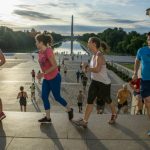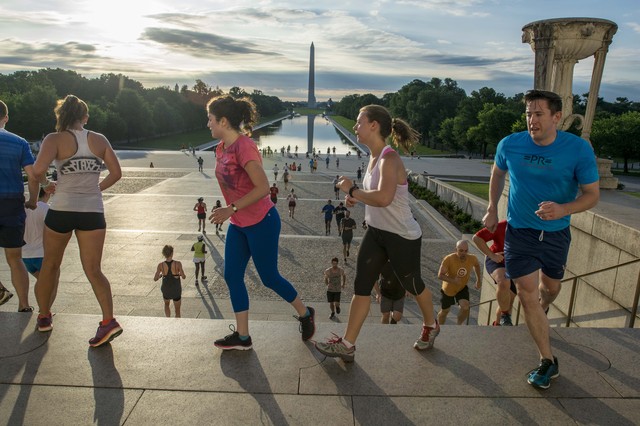
 November Project D.C. members work out at the Lincoln Memorial. (Photo courtesy of Steve Christensen)
By DCist contributor Mikka Macdonald
It’s 6:30 a.m. on a Monday, and a crowd of 60 people is doing squats while playing rock-paper-scissors in Malcolm X Park.
I end up losing the game to my partner (never choose “paper”), and I jog to a corner of the park to do push-ups. Suddenly, November Project D.C. co-leader Steve Christensen whispers, “Chaos!” and all of us jump up to run the length of the park before returning to our squatted battle positions.
People offer each other encouragement—in hushed voices to avoid waking any neighbors—and I need to duck to avoid the high fives. It’s sweaty, it’s empowering, and it’s worth the early alarm clock. Monday workouts begin at 6:30 a.m., and that time slot is the latest November Project D.C. starts.
Although I can’t get my skill to match my enthusiasm, to say that I am an avid runner would be an understatement. I’ve run multiple ultramarathons. I have belonged to gyms. I have gone to workout classes. I have been on more athletic teams than I can count, and I have tried almost every fitness app that advertises on my Instagram feed.
But this workout was different.
November Project is a free exercise group that meets three mornings a week in cities across the globe, with the aim of creating a space where exercise is accessible, community-based, and (believe me here …) fun. Their only—but oft-repeated—requirement: just show up.
“We’re making a space where people feel like they are wanted, appreciated, and included,” says D.C. co-leader Maria Randazzo. “And we try to make the barriers to entry as low as possible.”
The group began in 2011 in Boston by two 20-somethings as a way to stay in shape during the New England winters. The two Northeastern Crew alumni made a promise to work out with each other every day at 6:30 a.m. for the entire month of November.
Less than a year later, their free workouts were attracting upwards of 300 people. Today, thousands of people participate around the world every week, and their chapters include groups in Britain, Malaysia, and Hong Kong.
“You can’t escape us,” one participant remarked as I stopped to catch my breath.
November Project reached D.C. in 2013, and the chapter is currently led by three affable and seemingly-tireless co-leaders: Randazzo, Christensen, and Jake Lloyd.
Washington D.C. continues to rank among one of the most fit cities in America (even though we recently slipped from our number one spot), but the cost of getting in shape can be steep.
Many of the multiplying workout classes around the District cost around $30 for a single forty-five minute class. Race entries for D.C.’s Rock and Roll Marathon are currently at $90 (and the prices may rise), the Army Ten Miler costs $79.
And while working out for free cuts out the cost, it can be exclusive in a different way.
Ask any longtime runner, and they’ll probably have uncomfortable stories of going out for a run with a group, only to realize that the group was running far too fast for them to keep up. It’s not fun, and—as someone who has often become lost after trailing the main pack—it’s also not always safe.
November Project leaders in D.C. say that’s why they make inclusivity one of their highest priorities.
The bummer of being left behind is largely avoided by making the workouts more interval-based. Instead of going out for a longer, extended cardio session (like a run or a bike ride), the group uses a smaller section of real estate to work out in short spurts. Think: hill repeats, strength circuits, or shorter laps by the Reflecting Pool on the Mall.
And they mix up the workouts to keep attendees entertained. On one Monday, the workout was based on rock-paper-scissors. Two days later, on the anniversary of Alexander Hamilton and Aaron Burr’s duel, the workout was centered on a system where exercises—like sit-ups or pushups—was one of “10 Duel Commandments.”
My favorite part: you do whatever amount of the workout you want to do. There’s no pressure to complete the extra push up or run the hill if you’ve had enough for your morning.
“This movement and these workouts are for any person,” says Randazzo after a Monday workout. “No matter your athletic ability, we want you to come here and feel like there is a place for you. Just come once. Now is the perfect time.”
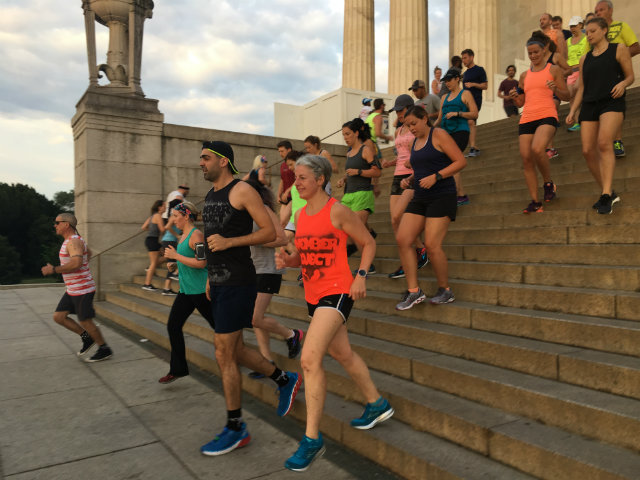 Mary Kusler, a member of November Project D.C. for four years, takes part in a workout at the Lincoln Memorial. (Photo by Mikka Macdonald)
Mary Kusler of Northern Virginia is a mother of two, and she has been coming to November Project D.C. for four years.
Through wind, rain, and snow, she is a regular at the dawn-breaking workout on Wednesdays because it is the earliest meetup, and usually the closest one to her house. Every Hump Day, she heads to November Project between 5:25 and 6:25 a.m., sweats, then returns home to get her kids ready for the day before driving back into the city for work.
The day I spoke with her, she was somehow able to also fit in a three mile run on the Mall before heading back to Virginia.
“For me, it’s more than a workout. It’s a community,” said Kusler, sitting on the Lincoln Memorial steps after the 5:25 session was over. “In a city like D.C., you tend to meet people in your line of work. And [November Project] is an opportunity to meet a cross-section of people who you wouldn’t have the opportunity to.”
Like many members, Kusler joined November Project after seeing their posts on social media, and soon, she was hooked. Today, she has visited November Project chapters from San Diego and London, and the ritual of meeting up at sunrise has become a part of her weekly life.
It has become a way for her to connect to the city and to start the day with a feeling of gratitude.
“We just watched an incredible sunrise over our nation’s capital, and that moment of seeing the sun rise, it’s hard not to smile. To feel appreciated,” says Kusler, nodding out towards the mall.
“[Washington] is a city with an intentional speed about it, and taking a moment to appreciate each other, and the amazing place that we live, is something that you can carry with you throughout the day,” she says.
Creating a space for inclusion, peace, and positivity is exactly the environment that the group is aiming for.
“November Project is bigger than fitness,” said Christensen. “Are we sweating it out and getting faster and stronger with every workout? Yes. But November Project infiltrates every aspect of your life. Basic principles like accountability, motivation, positive energy, and laughter start to permeate your workouts and subsequently your work, family, play, etc.”
When I told my friends that I was going to go to check out November Project, the word “religion” was used to describe the scene I was entering. And my peers weren’t too far off. At early hours in the morning, three days a week, a congregation of local residents gathers at a designated space. They greet each other with hugs, hand hugs, and high fives. They listen to an instructor who offers them direction, and they create a community based on a shared joy.
“It’s sometimes intimidating to join [November Project], and people think that they are not fit enough,” said Kusler. “But it really is for everyone.”
On Mondays the D.C. chapter meets at 6:30 a.m. at Meridian Hill/Malcolm X park. On Wednesdays they meet at 5:25 a.m. or 6:20 a.m. at the Lincoln Memorial. On Friday the 6:30 a.m. meetup is at a new location every week, which leaders announce during Wednesday workouts, as well as on the chapter’s Facebook, Google calendar, and blog.