 Mikaela Lefrak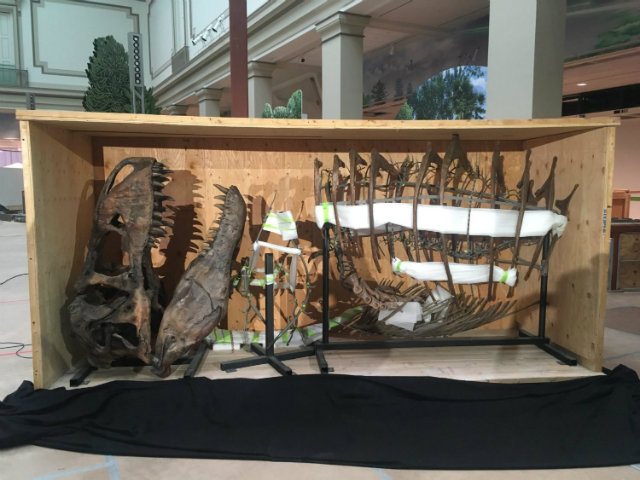
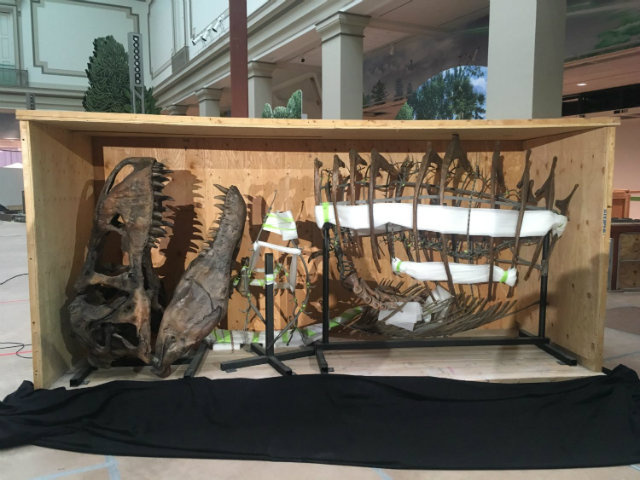 How do you ship a dinosaur? By Fed Ex, of course. (Photo by Mikaela Lefrak)
When the Smithsonian National Museum of Natural History’s new fossil hall opens on June 8, 2019, it will have a new name, a new layout and a new—but very old—T. rex.
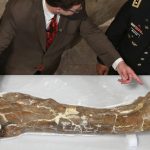
Museum director Kirk Johnson unveiled two boxes worth of Tyrannosaurus rex bones on Tuesday, after announcing the opening date of the new hall.
“The nation’s T. rex,” as the museum calls the skeleton, has had quite the journey to Washington. It was about 18 years old when it died 66 million years ago. Its skeleton was discovered in Montana in 1988 and loaned to the museum by the U.S. Army Corps of Engineers in 2013. The dinosaur was then shipped to Ontario, Canada, where its bones were posed and secured for display. It’s the first significant dinosaur to be added to Fossil Hall since 1981.
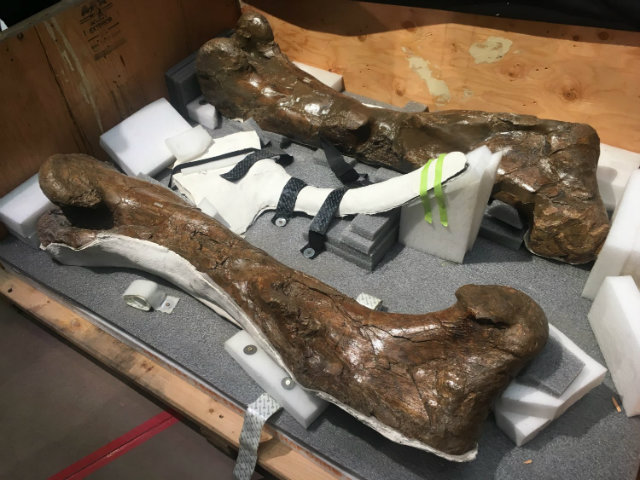
When the bones are shipped, they’re dressed in plaster jackets, surrounded by foam, and packed securely into wooden crates. But the process isn’t flawless. “Occasionally, we’ve all done it. We’ve all broken fossils,” said Johnson, a paleontologist by training. “Fortunately there’s a substance called glue.”
One of the boxes of bones contained two thigh bones, and the other held a skull and ribs. Dinosauria curator Matthew Carrano estimated that there were about 100 bones in total. A complete T. rex skeleton is made up of about 450 bones, but the paleontologists who uncovered the Natural History Museum’s specimen were only able to retrieve about half the original bones. The museum reconstructed the rest by referring to other T. rex skeletons on display around the globe.
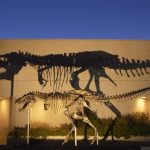
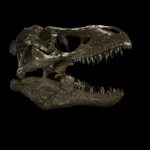
The curators have decided to position the 40-foot-long T. rex in eternal snacking mode: It will be chewing on an unlucky triceratops skeleton trapped under its feet. The skull on display will be a reconstruction, due to the fragility of the original skull.
 (Photo by Mikaela Lefrak)
“It’ll be in the drawers where it’s a little more protected and not getting breathed on by six million people every year,” Carrano said.
Johnson sounded more than happy with the decision to mount a reconstruction rather than the real thing. “Very rarely do you actually mount the real skull,” he said. “If you did that, you’d have this incredible artifact balanced on a small piece of steel. You wouldn’t want to be the museum director whose T. rex skull fell off.”
The hall will be renamed the David H. Koch Hall of Fossils after the businessman and philanthropist. He donated $35 million towards the $129 million project in 2012; it was the largest single donation in the museum’s history. Koch, who co-owns the Kansas-based fossil fuel corporation Koch Industries, has been criticized by scientists for his stance on limiting the government’s role in address climate change.
 (Photo by Mikaela Lefrak)
“We’re here for all of America,” said Johnson. “We don’t vet our donors about their politics, and we don’t let our donors have any impact on the contents of the exhibits.”
Koch’s name is already included in the official name of the museum’s Hall of Human Origins.
The Museum of Natural History opened in its current location on Constitution Avenue in 1910. Since then, Fossil Hall has become the most visited room in the most visited natural history museum in the world. Johnson called the old, pre-renovations Fossil Hall “a disaster — like being in Dupont Circle during rush hour.”
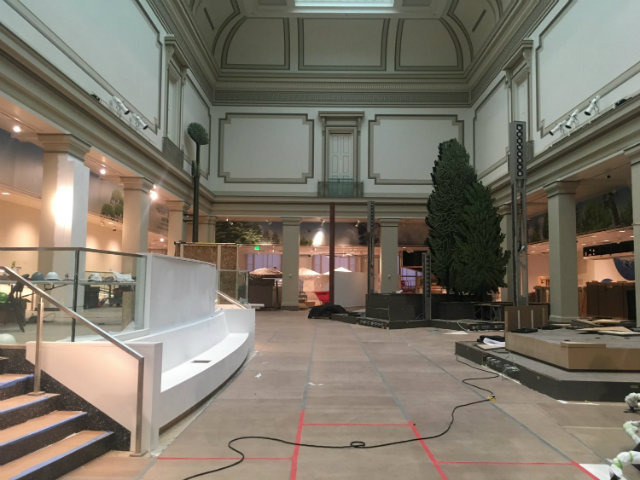
There is still a lot of work to be done before the hall is ready for the influx of visitors to come, but Johnson said there was plenty of time to clean things up.
“You’re seeing the bare bones of the exhibit,” he said, before apologizing for the pun.
This story has been updated to reflect the correct spelling of Matthew Carrano’s name. The story first appeared on WAMU.