Jacob Fenston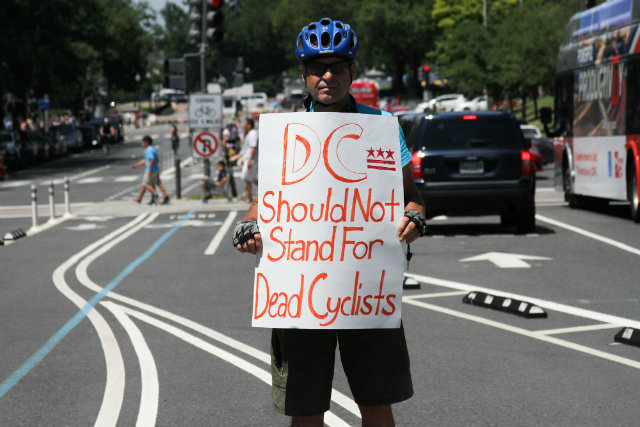
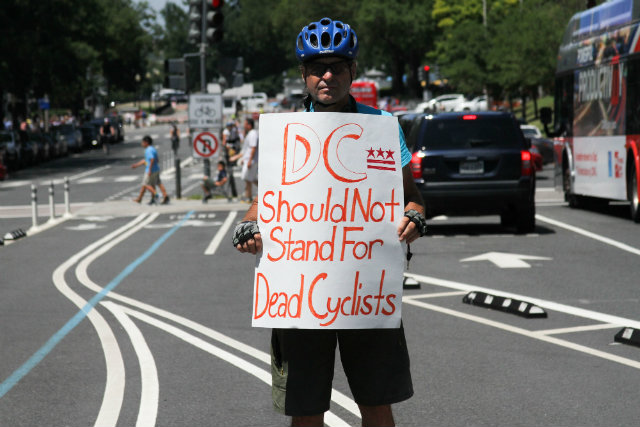 Cyclist Rod Smith protests outside the Wilson Building on Thursday, July 19. (Photo by Jacob Fenston
Malik Habib was working the night of June 23rd. So was his brother, Cyrus.
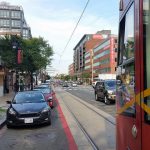
“Yeah, we were just riding our bikes, doing a food delivery service on our bicycles,” recalls Cyrus. He says he was just 10 feet from his brother, when Malik’s tire got caught in the streetcar track on H St., Northeast. Malik, who was 19, was hit and killed by a charter bus.
Cyrus says for a long time he avoided reading news stories or online comments about the crash. When he finally did, he was disturbed by the blame flying.
“People will speculate and judge so quickly,” he says. “And they were going back and forth about entitlement. ‘Why do bicyclists have to be entitled?’ It’s not about entitlement. I’m trying to get home just like you are.”
Cyrus and his mother, Laura Montiel, spoke publicly about Malik’s death for the first time at a protest organized by the Washington Area Bicyclist Association outside the Wilson Building. Addressing a crowd of several dozen people, Montiel held a sign with Malik’s photo, “My son did not have to die! Safety now.”
“I am not an avid cyclist,” said Montiel, as she took the microphone. “I am a mother who lost her child.”
“No more deaths” chants the crowd in front of the Wilson Building. Mother and brother of killed cyclist Malik Habib just spoke. pic.twitter.com/zHXXp0X12w
— Jacob Fenston (@JacobFenston) July 19, 2018
Cyclists and pedestrians say D.C. isn’t doing enough to make streets safe. Less than two weeks after Habib’s death, another man was killed. Jeffrey Long, 36, was in the protected bike lane on M St., Northwest, after being hit by a truck turning right. Cyclists say District leaders aren’t moving fast enough responding to complaints about unsafe intersections and streets, and installing new bike infrastructure.
Three years ago, the District launched a campaign called Vision Zero, with the goal of eliminating all traffic fatalities by 2024. But since it was launched, the number of deaths has been going up. There were 26 deaths in 2015, while last year there were 30. There have already been 21 deaths in 2018, three more than this time last year.
“We’re listening to the concerns of the community” says Jeff Marootian, director of the District Department of Transportation. “We grieve alongside the community, whenever there’s a life lost.”
DDOT has been working to improve safety on M Street since Long’s death, removing several parking spaces to improve visibility for turning cars and adding safety bollards to block cars from parking illegally. And the department has put up educational material warning cyclists about biking near the streetcar tracks since 2014.
But small changes like this may not be enough to end traffic deaths.
“Vision Zero is a radical vision,” Jacob Mason, with the pedestrian group All Walks DC, told the crowd. “To make that happen requires a radical shift in how we do things.”
“We have to prioritize life over parking spaces, over car speeds. And until we do, Vision Zero doesn’t mean anything,” he said.
This story originally appeared on WAMU