Natalie Delgadillo
 (Courtesy of CitySwing)
Tari Cash’s favorite part of golf is how she’s able to measure her own progress. “I can actually recognize when I advance at something [in golf]. It’s nice to have that positive reinforcement sometimes in life. I get addicted to that,” Cash, the founder and CEO of CitySwing indoor golf center, says.
I wouldn’t know.
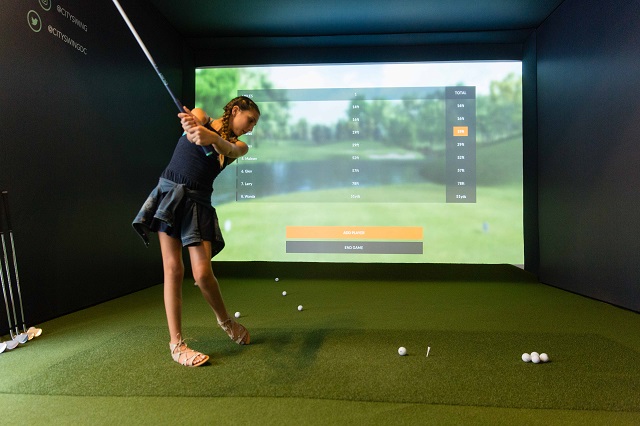
I went to the CitySwing launch party this week and tried out the center’s golf simulator, which uses TrackMan technology to accurately track the flight of a golf ball you hit at a screen. It tells you how far you hit it, and the screen shows you where it went: down the fairway, into a bunker, into the water.
I got four shots, and each was worse than the last, if you don’t count the fact that I entirely missed contact with the ball my first try.
But that’s more or less the point, Cash says: Golf is hard. You have to practice a lot if you ever want to be any good. And in D.C., that can be difficult— traffic separates would-be players from the fairways in Virginia or Maryland, and bad weather makes outdoor play unfeasible for a chunk of the year.
“I’m a passionate golfer, and I talk a lot of trash,” Cash says. “But my game doesn’t live up to my trash talk yet.” CitySwing is, in some ways, a solution to a personal problem Cash was facing, living in downtown D.C. and struggling to find the bandwidth to practice as much as she wanted to.
But Cash says she also has a personal mission to make the game feel more accessible to those who may feel excluded from more traditional golf spaces, especially women and people of color. “I want to reach people who maybe have felt excluded from country clubs and other traditional places. I want them to have a safe place to go and practice and get better and have fun,” she says.
To that end, CitySwing fosters a laid-back vibe: There’s a lounge area with seating and loud music playing from the speakers. At the launch party, with wine or beer in every hand and hors d’oeuvres circling the room, it feels a lot like the launch of a restaurant or a club, except with some athletic people hitting golf balls at one end of the room.
The space is pretty small, with just one “suite” at the front with a TrackMan simulator. If you want to drop by, Cash says they take walk-ins, but it’s probably better to reserve the space online beforehand. You can reserve CitySwing by time: $35 for 15 minutes of play, $60 for 30 minutes, and $110 for an hour, though you can split those costs up among as many people as you want.
Cash says the current iteration of CitySwing is a pop-up; she’s currently working to get retail space that would allow her to have six to eight simulators, a full bar, and a restaurant. For now, there are no food or drinks available, though you can reserve the space for a private event and get it catered, Cash says.
I’m really not the best person to tell you if the golf simulator replicates actual golfing effectively. So take it from Toks Pedro, a recent college grad and professional golfer who’s competing in the Minor League, and who showed up at the CitySwing launch event on Thursday.
“This has value. You can really visualize it better, you can see where the ball is going. It’s better than just hitting at a blank screen,” Pedro says. “I would use it when I had to, like in the winter.”