Natalie Delgadillo
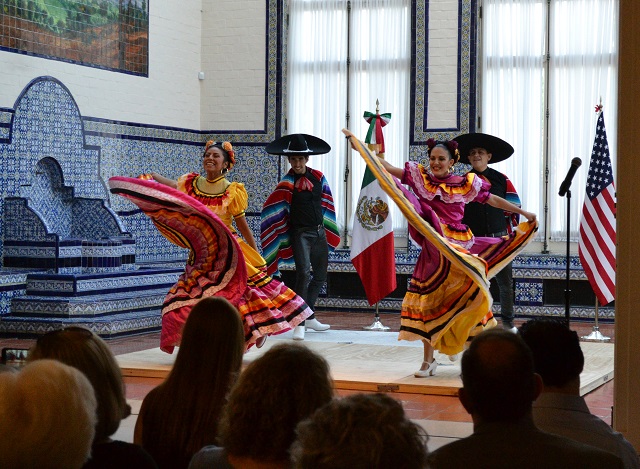 Alejandro Góngora (back left) performing with other members of his dance company at the MexicanCulture Institute. (Photo Courtesy of Corazón Folklorico)
Every Tuesday and Thursday, 20 to 30 people gather in a Petworth basement, pull on clomping black dance shoes and colorful skirts, and dance baile folklorico, keeping elegant postures as their feet tap across the floor. Some of them are experienced dancers. Others just started doing this less than nine months ago. At a recent practice, less than a week out from the Corazón Folklorico Dance Company’s debut performance, the dancers were all good enough that I could hardly tell the difference.
“I always thought Mexican folklorico was way out of my league [as a dancer]. I knew zero when I first came here, I actually started from negatives,” says Marvin Crespin, a 27-year-old Los Angeles native who started dancing with the group in January. “Mexican folklorico is so complicated and beautiful. I was worried for myself.”
Complicated is one way to put it. Sometimes called “Mexican ballet,” baile folklorico is a traditional Mexican folk dance, performed with strict posture and rapid foot stomps. Traditional dress varies from state to state, but the long, colorful skirts involved in the dance are ubiquitous: The women hold them at either end and twirl them around as they move, tapping their heels hard on the floor, making music with their feet.
Video courtesy of Corazón Folklorico.
Since its founding in September, Corazón Folklorico Dance Company has been a place for dancers of all skill levels to find community and practice traditional Mexican folk dance in D.C. Anyone is welcome to join the free classes at any time. The group has performed a couple of times as a part of larger celebrations at the Mexican Cultural Institute and the National Cathedral, but at their sold-out debut performances this weekend at Dance Loft on 14, they’ll be the stars of the show for the first time.
It’s a lot of pressure for a new dancer like Crespin, whose parents are both from El Salvador, but he decided to hang in there anyway. He came to practice two times per week, and in the weeks before their debut performance, he’s been showing up almost every day. To my eye, he looks just as good as anybody else—except maybe Alejandro Góngora, the founder of the dance company and the man at the front of the room teaching everyone the steps.
Góngora founded Corazón Folklorico after seeing a lack of spaces in the District where people could go to learn the Mexican folk dance for free, regardless of their level of experience. Growing up in San Diego, he was used to watching folklorico performances a few times per year.
“I have always known folklorico to be a community bonding activity. It transcends just taking a dance class,” Góngora says. “It’s about learning a culture. It’s about building community with the people around you.”
When Góngora was a child, he says, his parents both worked two jobs, and a lack of money and time prevented him from ever joining a folklorico dance class, though he’d always wanted to. It wasn’t until he was in high school that he managed to find a free folklorico class on his own. That format spurred him to create an accessible class for people of all income and skill levels.
 (Photo courtesy of Corazón Folklorico Dance Company)
Góngora also has training in ballet and West African dance, both of which influence his choreography for Corazón Folklorico. Each dance in the choreography for the debut show is based on a different Mexican state, including Jalisco, Veracruz, Sinaloa, and Baja California. Góngora has tried to choreograph them in a way that showcases what he calls the “three ancestral roots” of Mexico: European, Indigenous, and African. The Veracruz dance, for example, involves a lot of movement common to West African dance styles, he says.
The dances are beautiful, and the dancers have clearly worked hard to perfect them. But the basement room in the Spanish Education Development Center where the group practices does not feel stressful or hectic, even just a week out from the performance. Instead, the mood is casual and friendly. People are still walking in 40 minutes after practice starts, and no one bats an eye: Hugs and kisses are given, Góngora waves hello, and practice continues. Dancers stand off to the side chatting with one another when they’re not dancing, and the room is a din of loud music and laughter and Spanglish.
“The space is my favorite part [of this group.] You can forget about work, about your personal life, about your daily life, and just dance,” Crespin says. “I really wanted to find a comunidad. Being in a Latinx space is really important to me. That’s what I love about this.”
Most of the performers are Latinos from Mexico or Central America, but Góngora says about a third of the group is non-Latino. He says he wants the space to feel open and welcoming for everyone in every community, and he wants to share the beauty of his own culture with a region that might not have exposure to it.
“D.C. is heavily Latino. And realizing that there wasn’t a lot of cultural preservation and promotion of cultural arts for Latinos in the nation’s capital—that made me want to showcase the cultural beauty of Mexico,” Góngora says.
Corazón Folklorico practices every Tuesday and Thursday from 6:30 p.m.-8:30 p.m. in the basement of the Spanish Education Development Center. Their debut performances, at Dance Loft 14 on July 20 and 21 at 8 pm., are sold out.