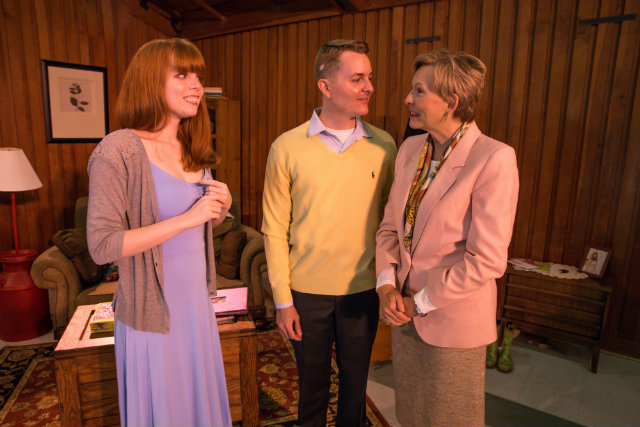
 From left, Ruthie Rado, Nick Duckworth, and Emily Morrison in “Be a Good Little Widow.” (Photo by Rachel Ellis)
By DCist contributor Eric Althoff
The title “Be a Good Little Widow” might lead one to wonder if pure grief or perhaps dark comedy were in store from Unexpected Stage Company co-founder Christopher Goodrich’s latest show, playing at the River Road Unitarian Universalist Congregation in Bethesda through August 5. Indeed, a death will be necessary for the story, from playwright Bekah Brunstetter (a producer on NBC’s “This Is Us”), to live up to its name, but Brunstetter’s modern fable is far less interested in mining humor from the inevitable than in raising questions that it simply cannot answer in 90 minutes.
The curtain rises on uncertain marital bliss for twentysomethings Melody (Ruthie Rado) and Craig (Nick Duckworth), a busy corporate type who seems addicted to both his phone and to the next business trip. Of their courtship we learn little, other than quick later flashback scenes that indicate they came together more out of convenience than genuine bonding. The ennui of realizing that your mate is largely unknown to you is left painfully unexplored here.
The set design by Michael Cherry is meant to evoke a humble and messy New England dwelling, where the young couple has moved from Colorado to be closer to Craig’s mother, Hope (Emily Morrison). Here, the “mother-in-law storming in on domestic bliss” material feels ham-handed and missing out on humor. But Morrison, who boasts a presence that far outshines the rest of the cast, turns the action in unexpected ways after Craig’s tragic death, leaving Melody the titular “good little widow.”
The final member of the cast’s quartet is Lansing O’Leary as Brad, Craig’s corporate underling and supposed friend. O’Leary is terribly miscast in a role that requires the right amount of befuddlement and earnest longing. He seems to be channeling Keanu Reeves from “Bill & Ted,” minus the charm, and his interactions with Melody never ring true.
“Be a Good Little Widow” drags for much of its runtime, and one never quite knows if the housewife Melody is trying to fool her husband and mother-in-law or only herself. Subtlety is absent from Rado’s take on the young wife, and the overly choreographed dialogue written by Brunstetter offers her little assistance from scene to scene.
If Brunstetter’s play has a lesson to impart, it comes late in the story, when Hope shares wisdom about why a widow like herself should be appreciative when another man asks her to dance. It’s the only truly transcendent moment in the runtime, and immediately made me want to run home and hug my fiancée.
In other words, treasure each moment with your loved ones, “Be a Good Little Widow” seems to say, but you can do that well enough by staying home.