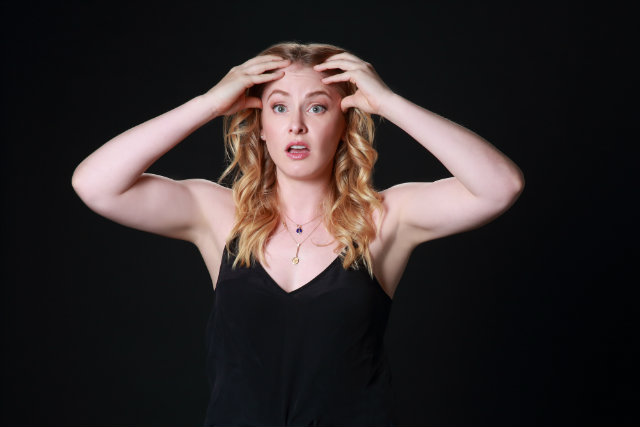
 Kate Robards explores her complicated romantic past in PolySHAMory. (Photo courtesy of Capital Fringe)
When Kate Robards was just starting to learn about polyamory, she assumed—incorrectly—that all her gay theater friends were in open relationships. “And one got mad and said, ‘Kate, my husband and I are in a traditional marriage. We cheat on each other and never mention it,’” she recalls.
Robards is a comedian, so she adopts a similarly darkly comic tone when describing polyamory now: “I call it ‘cheating in front of your face,’” she says. “Because obviously I have a little bitterness toward my scenario, which I feel didn’t go well for me.”
In PolySHAMory, a solo show with three remaining performances at the Capital Fringe Festival, Robards chronicles what happened when she got everything she wanted out of her marriage and—to paraphrase the show notes—so did her husband’s girlfriend. When the now-former couple decided to pursue a polyamorous relationship, Robards was open to it, but the situation invited disastrous results. Still, the experience took her on an unforeseen journey—or sexcapade, as she calls it—of exploration, self-discovery, and love.
“It’s all the salaciousness of life that you’re not supposed to talk about,” Robards says of her show. “Or when you do, it’s behind someone’s back or [in] an intimate conversation with a friend. It’s taking one of the most vulnerable conversations [you can have] and putting it in front of an audience.”
The resulting PolySHAMory, which Robards has already performed in New York, Tampa, and Atlanta, and will next bring to Providence, Rhode Island, and San Francisco, is a sex-positive show, meaning it “promotes and embraces sexuality and sexual experiences,” she says.
The New York-based Robards, who lived in D.C. from 2010-2011 while she worked at Studio Theatre, loves wordplay, as the name of her show suggests. But slipping a “sham” in polyamory isn’t just a nod to how poorly her attempt at it went. “Sham” is also the root of the word shame—something she knows a thing or two about. Robards grew up in a rural Texas town with a deeply Christian family “and very different ideas of what was acceptable, especially around sex,” she says. “There was a huge sense of shame.”
She nods to those family roots in her previous work. PolySHAMory is Robards’ third creative nonfiction show, and her third show at Capital Fringe. Her first, Mandarin Orange, explores her move from tiny Orange, Texas, to Shanghai, one of the largest cities in the world. Her second, Ain’t That Rich, examines growing up with a single mother on the poverty line—and then marrying a one-percenter.
Said wealthy lawyer brings us back to the subject at hand with this show: polyamory. Robards, a child of divorce, says that while married to her ex, she started questioning how she truly felt about monogamy. “It was kind of like, do I really believe in monogamy forever? Why have the rigidity of rules? And these are all things I was taught not to talk about,” she says. “So you go through life and pretend everything is perfect and you don’t have these desires … It felt very phony—like a sham.”
Inspired in part by The Ethical Slut by Dossie Easton and Janet Hardy, billed as a “practical guide to polyamory, open relationships, and other adventures.” Robards decided to explore polyamory, and she quickly found there was a lot to learn. Polyamory has its own language, Robards says. “PP” stands for primary partner; “CC” is condom contract. One of Robards’ therapists at the time (the situation required a few) was a poly-therapist, who specializes in such relationships. “She really set the ground rules of what you need to establish [with your partner],” Robards says. “It was the first time since I started doing therapy that it was just like homework, homework, homework.”
Especially for the uninitiated, misconceptions about polyamory abound. Though Robards is quick to point out she’s not an expert, she’s been asked to speak on an array of polyamory podcasts, and guests often approach her after shows to commiserate about their experiences. One of the most common things people get wrong is “that [polyamory is] like a weird orgy free-for-all, and there are no rules,” Robards says. “And that’s absolutely not the case.”
In some polyamorous relationships, for example, a couple establishes rules about whether and when to introduce each other to new partners, how much to disclose to each other and if it’s acceptable to spend the night with other partners. Just like in any other relationship, communication is key.
PolySHAMory, directed by Maureen Monterubio, starts and ends with stand-up, but there’s more to the show than comedy. Robards has crafted a narrative that explores “love, self-love, and all different types of love—and that journey of finding it,” she says.
“This is what I tell my mom: It’s not just me airing my dirty laundry,” she says. “It’s having autonomy over the relationships in your life. What art does is push us out of our limits and expose us to people who live a different life, and the goal is to realize that it’s not actually as different as you might think.”
Where to See It: St. Augustine’s Episcopal Church.
When to See It: July 25 at 8:45 p.m.; July 27 at 9:15 p.m.; and July 28 at 5 p.m.