Rachel Kurzius
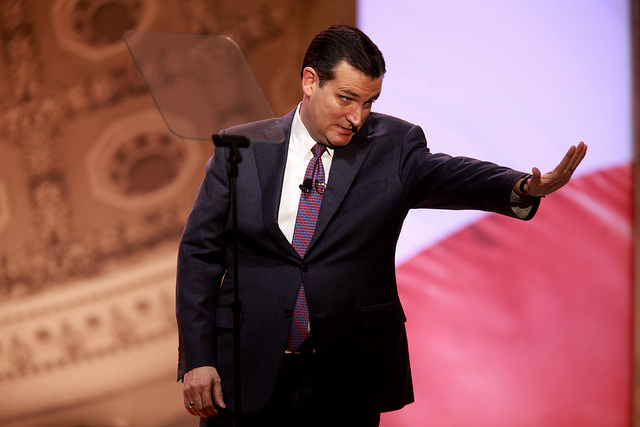 Texas Senator Ted Cruz has introduced a measure in a federal appropriations bill that would block D.C. from enacting a local individual mandate. (Photo by Gage Skidmore)
Update, 8/1/18: Senator Ted Cruz’s attempt to block D.C.’s individual mandate has been scuttled.
On a simple majority, the Senate voted to table his amendment, reports Mike DeBonis of The Washington Post.
The vote is simple majority on a motion to table. Two Republicans have already voted to table — Collins and Graham — so seems D.C. mandate is safe for now.
— Mike DeBonis (@mikedebonis) August 1, 2018
Because a version of the amendment exists in the House bill, the measure could potenitally return if the House and Senate go to conference over the spending bill. However, it is more likely that the attempt to override D.C. officials’ will on the mandate is over for now.
The Senate appropriations bill passed with two riders that specifically impact D.C.: one preventing D.C. from spending its local funds on abortions for low income women, and another barring D.C. from using local funds to tax and regulate recreational marijuana. The former has been in place each year since 1989, with the exception of 2009-2010, and the latter since 2014.
D.C. Delegate Eleanor Holmes Norton said in a release that those are the only amendments she would not be able to remove in a Republican-controlled Congress.
“We continue to work to rid D.C.’s appropriations bill of all anti-home-rule riders, but we are pleased that we were able to prevent any new attacks on D.C.’s local laws and policies in the Senate,” Norton said in the release. “I will be working hard as the House and Senate prepare to go to conference to ensure the House-passed D.C. riders do not make it into the final spending bill.”
Original: Senator Ted Cruz shut down the government in 2013 over the Affordable Care Act, and now he has introduced a measure that would block the District from holding on to a key component of Obamacare.
The individual mandate, a part of the ACA that requires Americans to purchase health insurance or face a penalty, was repealed as part of the tax bill Republicans passed last winter. But some jurisdictions, including D.C., have sought to keep the mandate in place locally.
Mayor Muriel Bowser’s budget for 2019 included $1.1 million earmarked for protecting the mandate in D.C. to keep “Affordable Care Act protections strong in D.C.”
But if Republicans from other states have their way, that measure would be moot. A new amendment introduced by Cruz, with help from GOP senators Tom Cotton of Arkansas, Mike Lee of Utah, Ron Johnson of Wisconsin, Cindy Hyde-Smith of Mississippi, and Marco Rubio of Florida, would block D.C.’s ability to enforce the individual mandate.
“Under Obamacare, millions of Americans have lost their doctors, seen their premiums skyrocket, and have been forced into part time work. Those Americans living in our nation’s capital have not been exempt from those hardships,” said Cruz in a statement. “We need to finish the job on Obamacare, not prop it up with a broken system.”
His measure is identical to a rider inserted in the House’s federal appropriations bill by Representative Gary Palmer of Alabama. There’s also another amendment in the House version from Representative Keith Rothfus of Pennsylvania that blocks implementation of part of D.C.’s law. House Republicans passed those amendments last week.
Thus far, Cruz has introduced the only new, D.C.-specific rider in the Senate’s version of the bill. Old standbys—riders that block the District from using its locally raised funds for abortions or taxing and regulating recreational marijuana sales—are already in the legislation.
Cruz “is stealing precious time and effort from his Texas constituents to abuse congressional power by interfering with the affairs of another Member’s district,” D.C. Delegate Eleanor Holmes Norton said in a statement. “He cannot bear to see health care be offered even at the local level … We will beat his attempts to take out D.C.’s local version” of the ACA.
Defeating the amendment could happen a number of ways. If Senate leadership decides to table it, the amendment would never see a vote and wouldn’t be included in the must-pass bill. Otherwise, it would have to be outvoted on the Senate floor.
Norton points out that Cruz, who calls himself “a passionate and effective fighter for limited government,” has previously tried and failed to block anti-discrimination laws passed and signed by D.C. leaders.
The Washington Post editorial board called upon the Senate to make “clear it won’t go along with this unwarranted and unprincipled assault on the District’s right to self-government.”
There are seven anti-home rule riders in this year’s House bill. In addition to two measures that would block D.C.’s individual mandate and the status quo ban on abortion and marijuana funding, it would also repeal the Death with Dignity Act, end local budget autonomy, and block funding for the Reproductive Health Nondiscrimination Act, which makes it illegal for employers to discriminate against workers based on their reproductive health choices.
As Norton has told DCist: “Basically, the House will always do the bad thing and you have to go to the Senate.”
Previously:
House Republicans Go After D.C.’s Measure To Require Health Insurance