 Mikaela Lefrak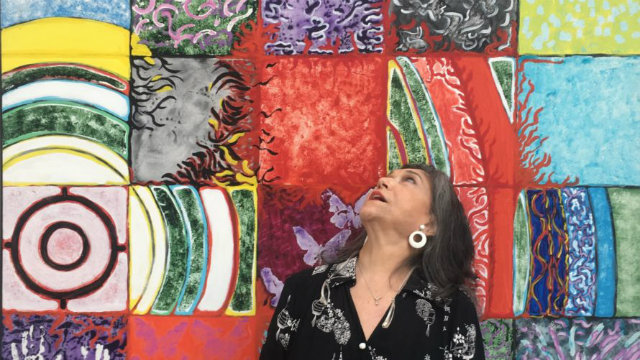
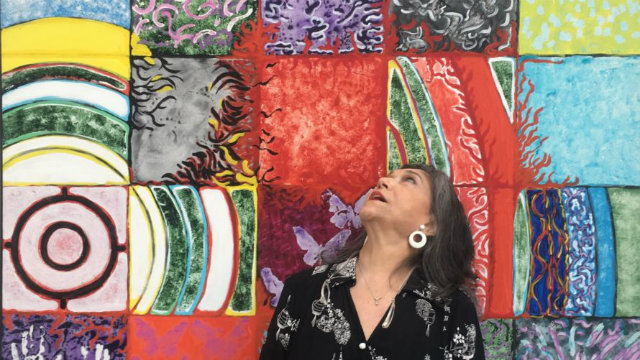 Judith Benderson stands in front of her 1987 painting, “Untitled,” in the AU exhibition. (Photo by Mikaela Lefrak/WAMU)
The work of nearly a hundred local artists from a 1970s-era feminist collective is, for the first time, the subject of a museum retrospective.
The collective — the Washington Women’s Arts Center—only operated from 1975 to 1987, but its legacy continues to influence the D.C. arts scene. The American University Museum’s new exhibition, Latitude, features pieces by 92 former members.
For women in the 1970s, making a living as an artist in Washington was no easy feat. The feminist movement was in full swing, but many women were still expected to be mothers, not breadwinners. Although the D.C. gallery scene was more robust than it is today, curators often only chose to show work by men.
Despite those challenges, hundreds of women artists tried to make it.
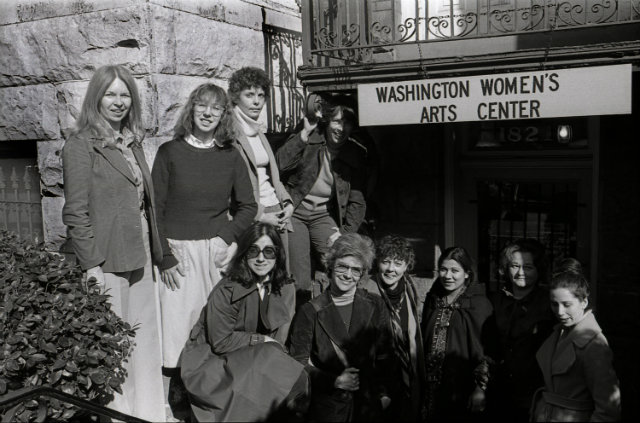 WWAC members stand in front of its original headquarters on Q Street Northwest during the winter of 1978-1979. (Photo by Gail Rebhan courtesy of the American University Museum)
In the early 1970s, Judith Benderson was a young married mother in Potomac, Maryland. She had a master’s degree in painting, but her art career was off to a slow start. Today, Benderson is a retired government lawyer and a grandmother—the funky kind, who wears colorful clogs and big silver rings on nearly every finger. But back then, her career was, in her words, “an uphill battle.”
“I had a small show, I think, at a bank. That kind of thing,” she recalled. “But I have to tell you, I had not a clue on how to do a resume, how to present my work, nothing.”
So in 1976, she enrolled in a class on the business of art at the Washington Women’s Arts Center. A half-dozen women had just established the organization a year prior out of a basement apartment on Q Street Northwest in Dupont Circle.
Benderson loved the scene. Many of the women were young mothers, just like her. Since they struggled to get their work accepted into D.C.’s commercial galleries, they created a gallery of their own. They also hosted lecture series and curated shows. Women paid $15 a year for a membership, and they rotated in and out of leadership positions.
“I didn’t know anything about what I was going to be doing, but that was the point at the center,” said Elloise Schoettler, the center’s exhibitions director in the late 1970s. “You didn’t already have to know. You could be mentored, you could be taught.”
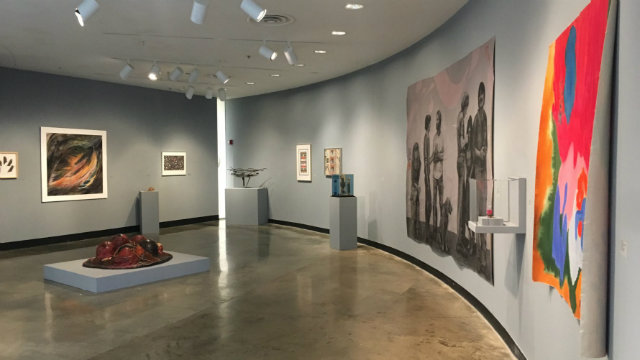 Each room of the exhibit features a mix of drawings, paintings, and sculpture from former WWAC members. (Photo by Mikaela Lefrak/WAMU)
Over the years, the WWAC grew to more than 700 members. It attracted federal grant money, and moved to bigger offices in Penn Quarter. Some women started becoming successful artists, and others found work in different fields. Judith Benderson went to law school; Elloise Schoettler got a job with the League of Women Voters.
“Your dream was to sell your artwork, but what we were really learning was how to function effectively in an organization,” said Schoettler, who now lives in Chevy Chase, Maryland.
Ultimately, the WWAC was a product of its time. By the mid-1980s, funding for women’s-only groups was drying up. The Center’s leadership also made some business choices that some former members suspect cost them grants. (For example, in promotional materials for a 1982 erotic art show, the WWAC gave equal billing to two funders: the National Endowment for the Arts, which had given the center a $9,000 grant, and a Georgetown sex shop, which had donated $100). The WWAC shuttered in 1987.
In the American University retrospective, each room holds a vibrant mix of paintings, collages, sculptures, and drawings by 92 former WWAC members. The pieces are as varied as the women who made them.
Holly Bass, a D.C.-based performance artist a generation younger than Benderson and Schoettler, said she feels like there is still is a need for women’s art collectives in Washington.
“I’ve never encountered as much sexism as I have encountered in the art world, where I really have felt at times that I was being overlooked simply for my gender,” Bass said.
While all the problems from the 1970s haven’t disappeared, Bass credits the center for the positive culture among women artists that she benefits from today. “The women in Washington are really supportive and really generous,” she said.
“So sometimes, an institution fades away, but its legacy continues in ways that actually are very powerful and palpable.”
Latitude runs at the American University Museum through Aug. 12.
This story originally appeared on WAMU. American University holds the license to WAMU.