 Mikaela Lefrak
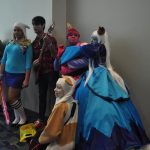
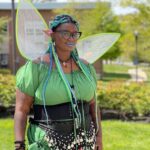
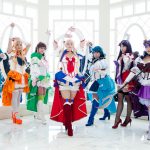
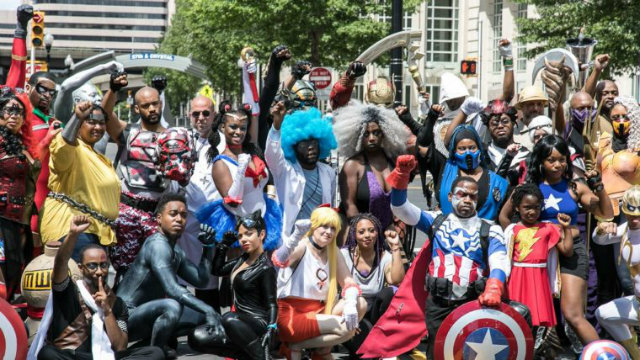 Cosplayers posed in Crystal City during Blerdcon 2017. (Photo by Otis Casey)
An unassuming airport hotel just outside D.C. is about to be overflowing with blerds.
Thousands of blerds—a portmanteau of “black” and “nerds”—will gather for three days in the Hyatt Regency Crystal City to celebrate sci-fi, cosplay, fantasy, comics, and anime. There will be a body painting demonstration, a cosplay contest, a 24-hour gaming room, and a traditional anime-inspired “maid café.” Organizers expect between 3,000 and 4,000 attendees.
But Blerdcon isn’t just your typical geek-culture convention. An emphasis on inclusivity and intersectionality runs throughout the lineup of events, which include a panel on the experiences of black nerds in the Black Lives Matter movement, a presentation on how black women are treated and portrayed in video games, a cosplay discussion led by people with disabilities, and a workshop on making body armor to fit larger bodies.
“These are subcultures within the larger geek culture that have not had the same representation and recognition as other mainstream groups,” said founder and co-chair Hilton George.
Two days before the convention was scheduled to kick off, George was still speeding around the DMV in his “office” (“It’s my car,” he laughed), making last-minute calls and picking up supplies. We caught up in the Hyatt, where he was on first-name basis with hotel staff.
George said he got hooked on the idea of Blerdcon a few years back, after noticing the diversity of attendees on the cosplay convention circuit. He wanted that diversity to be reflected in the conventions’ panels and organizing committees, he said, so what else was there to do besides create a new convention himself?
The first Blerdcon was “magical,” he said. “We saw all of these people of color, all of these intersectional people, people who are black-nerd-Latina, black-nerd-LGBTQ, black-nerd-disabled.” In many ways, blerd culture is a hallmark example of intersectionality, the analytic framework that centers around the interconnectedness of social categorizations like race and gender.
The majority of attendees are from the greater D.C. region: George estimated that about 60-75 percent will hail from within a hundred miles of the District.
One of them will be Bill Campbell, the founder of Rosarium Publishing, a D.C.-based sci-fi and comic book house. “Growing up when I did in the ’70s and ’80s, we were told that these nerdy things weren’t for us,” he said. “Liking comic books or science fiction or weird role-playing games, that wasn’t for us. But now we know that it is for us, and that there are other people who do it.”
Campbell’s planning to bring his 10-year-old daughter by Blerdcon sometime this weekend. “She’s an aspiring blerd,” he said. “I forced comic books on her, which she clung on to pretty quickly. I’m quite proud of her.”
While blerd culture is still a niche market, it also had a flagship year with the box office success of “Black Panther.” Four members of the Dora Milaje, the all-women special forces team from the fictional empire of Wakanda, will be on hand at Blerdcon to take photos and sign autographs. George called the Marvel superhero movie, which featured a majority-black cast, “a gateway drug for the non-nerd.”
Blerdcon runs from Friday, Jul. 27 at 11:00 am to Sunday, Jul. 29 at 3:00 pm.
This story originally appeared on WAMU.