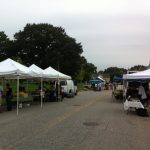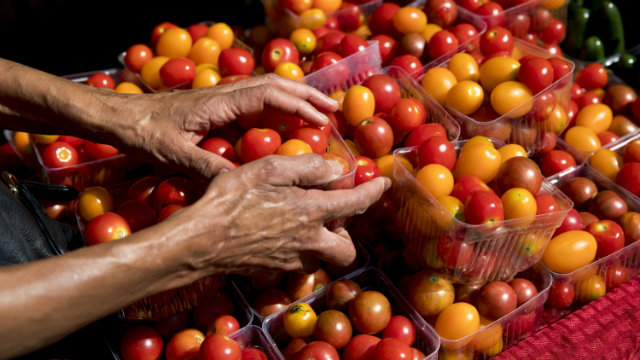
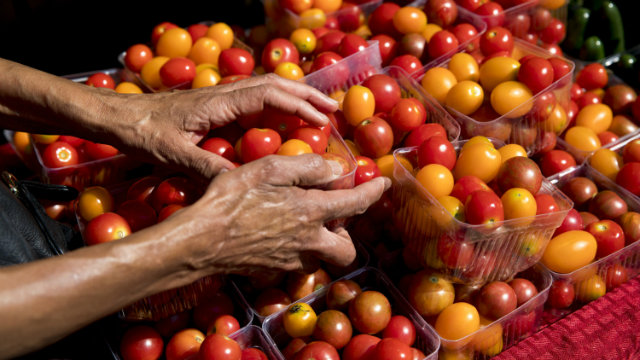
 At the Columbia Heights farmers market, a customer grabs a container of tomatoes from the Pleitez Produce Farm stand. (Photo by Tyrone Turner / WAMU)
Every Wednesday and Saturday, Elise Kengni sorts through tomatoes at the Columbia Heights Farmers Market. She says the produce there is fresher than what’s available at her neighborhood grocery store.
“When I eat it, I see the difference between those fruit I used to buy,” she says.
Kengni, an immigrant from Cameroon, is in her 70s. She has breast cancer, and maintains a careful diet in an effort to offset the stress of chemotherapy. “I’m trying to do my best to keep my body healthy,” she says.
But a perk that gives her access to healthy foods may be unreachable soon. The mobile payment processor that lets Kengni spend her SNAP funds at the market will be out of service come September. And as of now, there’s no replacement.
Kengni is one of the 120,000 District residents who receive SNAP benefits. SNAP—the Supplemental Nutrition Assistance Program formerly known as food stamps—is the country’s largest nutrition assistance program, run by the United States Department of Agriculture. Eligible low-income individuals and families get monthly benefits to spend on certain kinds of food.
SNAP benefits are put on a card, and people spend them by selecting the EBT option at a card machine. It’s like buying with a debit card: the amount of the purchase is deducted from the balance as long as there is money on the account.
Twice a week, Kengni checks her SNAP balance and heads to the Columbia Heights Farmers Market. In addition to the quality of the produce, Kengni likes shopping there because she gets SNAP perks she can’t get at the grocery. At some markets, local nonprofits will match her SNAP spending up to $10.
Here’s how it works: Kengni decides that she will spend $5 on tomatoes. She hands her SNAP card to a market volunteer, who runs it through a special app on a tablet. The volunteer gives Kengni five purple tokens.
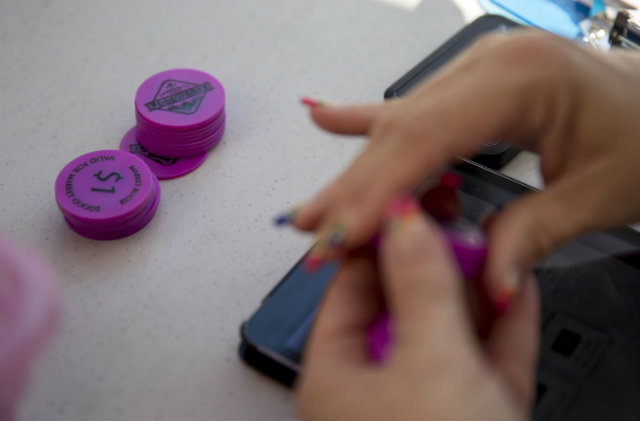 The purple tokens used at the Columbia Heights Farmers Market to extend the spending power of SNAP recipients. (Photo by Tyrone Turner / WAMU)
Kengni spends her five tokens at the tomato vendor, who gives her a special receipt. She goes back to the volunteer, presents the receipt and gets five more tokens without having to debit any from her SNAP balance, getting a match for each SNAP dollar she spends.
That volunteer swiped Kengni’s card using an app called MobileMarket+. Farmers markets nationwide have used it to manage SNAP purchases for the last four years.
But the company behind the app will stop service at the end of August because it lost its contract with the USDA.
Nick Stavely, the manager of Community Food Works, a nonprofit that operates and manages SNAP benefits at about a dozen D.C. farmers markets, says the results will be “pretty catastrophic, even if they’re not as immediate or obvious as some other concerns facing low-income communities.”
Stavely says it’s taken “detective work across a lot of different organizations” to figure out what’s happening and how to move forward.
Earlier this year, the USDA awarded its exclusive $1.3 million dollar contract to manage mobile SNAP payments to a company called Financial Transaction Management, based in Reston, Virginia. FTM was formed this year. Its sole employee, Angela Sparrow, told WAMU that the company’s “new application portal has been live since July 14th for new applicants.”
 Elise Kengi says she keeps a careful diet and prefers using her SNAP benefits at farmers markets rather than the grocery. (Photo by Tyrone Turner / WAMU)
Stavely estimates it would take any new company at least four to five months to get a new mobile service up and running, which would mean disruptions for SNAP users during the peak farmers market season.
Alternatives do exist, but they have limitations. Without the app, markets would either have to use a paper voucher system or purchase an EBT terminal, like ones at grocery stores.
Stavely’s markets have used vouchers before. He calls them “super clunky and time-consuming.” The voucher process involves calling a SNAP hotline to confirm an account’s balance. Then, receiving the funds from SNAP takes up to two business days. At the moment, Stavely’s markets only have about 60 vouchers total. After ordering vouchers from their backend processor, it takes a few weeks to receive them.
Then there are payment terminals, from other providers that have non-mobile contracts with the USDA. These kind of terminals are meant to be used at grocery stores, which have landlines. These terminals would also require a monthly cell phone plan, since they need mobile service to connect to SNAP account balances. And the terminals themselves are not cheap; they cost between $800-$1,100. There’s also a months-long waiting list to receive one from the USDA.
“It’s really difficult to make a purchase like that in the middle of the season,” said Stavely.
It’s likely that farmers markets won’t be able to serve SNAP recipient customers for months after the app ends its services.
“Low income customers are not be able to use SNAP funds during the height of the seaso …here in D.C., it’s a pretty sad scene,” Stavely said.
This interruption in the middle of busy season has consequences for everyone in the market ecosystem. Farmers sell more than $18 million in SNAP funds every year. Forty percent of markets use MobileMarket+ to process these funds.
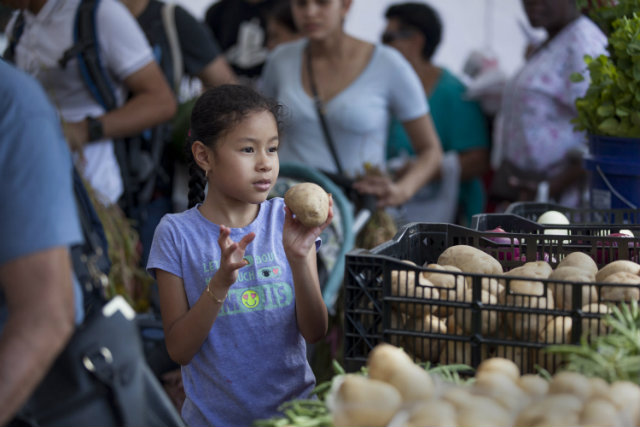 The Columbia Heights farmers market also provides children with free meals. Here, a young customer holds up a potato at the Pleitez Produce Farm stand. (Photo by Tyrone Turner / WAMU)
Expanding access and creating community
There are social benefits to farmers markets, too. Beverley Wheeler, the director of DC Hunger, says that access to markets empowers people by providing them with community and choice.
“We force them to not have convenience,” she said. “The farmers markets allows them a convenience, it allows them to actually get locally grown foods that are really healthy.”
“Many people often association farmers markets with gentrification, having strange artisanal foods,” Wheeler said. “As we have gotten more individuals in Wards 7 and 8 who are coming to markets, it’s become a gathering place — where people really are meeting each other, working with each other.”
The company behind MobileMarket +, Novo Dia, first said it would end the service on July 31. Last week, the nonprofit National Association of Farmers Market Nutrition Programs announced that they would fund the app for another 30 days, so markets will be able to process SNAP transactions through the end of August.
Stavely thinks there’s no way FTM could come up with an alternative as convenient as MobileMarket+ by then, but he says the extension gives him a little more time to try to figure out some sort of alternative payment for his SNAP customers.
They’ve come to budget their lives around his markets’ SNAP matching program, and love the range of options not available in their local grocery or corner stores.
“There’s a lot of stuff you can find from local farmers that really brings a big emotional significance to a lot of people,” he said.
For Kengni, it’s the tomatoes. If the market can’t process her SNAP payments anymore, she’ll have to go back to the grocery — which doesn’t double her dollars.
“Since I got sick, I’m not working,” she said. “I want to buy something healthy for my body, but I can’t afford it. “If you don’t fight for your body, who gonna do that for you? Nobody!”
This story was originally published on WAMU.