Martin Austermuhle
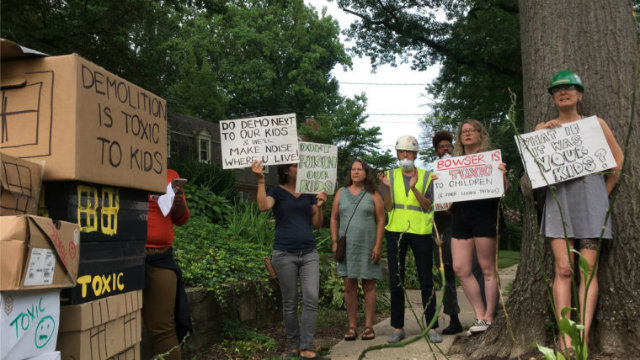 Some three-dozen protesters demonstrated outside of Mayor Muriel Bowser’s house on Monday morning, asking that she halt the planned demolition of a building on the D.C. General campus that is only 250 feet away from a family homeless shelter. (Photo by Martin Austermuhle / WAMU)
The early-morning quiet outside of D.C. Mayor Muriel Bowser’s home in upper Northwest was disturbed on Monday by loud chants from three-dozen protesters demanding that she delay the planned demolition of a building on the D.C. General campus until all the families at a nearby homeless shelter can move out.
“You say demo, we say hell no! Lead is toxic, you can stop this!” chanted the protesters as two police officers looked on. “Lead in our water, lead in our air, Mayor Bowser, do you care?”
The protesters, who took part in a mock demolition of a cardboard-box building and threw flour in the air to simulate construction dust, said they worry of the possible impacts of this month’s planned demolition of the three-story Building 9—including possible lead and asbestos dust—on families living at the D.C. General family homeless shelter, which is 250 feet away.
“There are about 250 youths still living there. And we know that the area itself, as well as the building specifically, is known for having lead and other neurotoxins. The demolition of it can absolutely increase the likelihood of those young children being exposed to what we know are unhealthy toxins and rodents. And so we’re simply asking her to wait until all the families are moved,” said Samantha Davis, one of the protesters.
The demolition of Building 9 is part of Bowser’s broader plan to clear the D.C. General campus—once a public hospital—for other uses, including a long-planned multi-use development that will include residential and commercial space. The campus is also included in one of the sites D.C. has pitched to Amazon as a possible home for HQ2.
Throwing flour into the air to symbolize the toxic dust that may come from demolishing Building 9 on the D.C. General campus (about 250 feet from the family homeless shelter), protestors chant, “You say demo, we say hell no!” pic.twitter.com/LJ5Zx3uhwU
— Martin Austermuhle (@maustermuhle) July 30, 2018
Bowser has pledged to close the long-troubled family homeless shelter on the campus in the fall—it will be replaced by six smaller shelters, three of which are expected to be ready this year—but has said the city will proceed with the demolition of other unused buildings in the meantime.
Homeless advocates have been trying to delay the demolition, and are currently circulating a letter and petition in which they ask Bowser to wait until the 150 families currently at the D.C. General shelter are moved out before the city proceeds with the demolition of Building 9. (Currently, there are 850 people and 33 organizations who have signed on to the petition.) Earlier this month, a bill in the D.C. Council to prohibit any demolition until the families have moved out was watered down; the version the Council approved only requires Bowser to report on any dust samples that show evidence of lead or asbestos exceeding certain limits.
City officials say environmental testing has found lead, asbestos, and mercury in Building 9, but add that additional testing done earlier this month found the amount of dust and fibers that would be released by the demolition to be “well below” permissible levels set by local and federal law. They also say they will be taking additional precautions to protect the families at the shelter while the demolition happens.
“We’ve hired an industrial hygienist to oversee this process. Their job is to make sure this process is done correctly, in line with all D.C. rules and regulations. And that’s the key: if it’s done properly, it is safe,” said Brian Butler, a project manager with the Department of General Services, at a hearing in March.
But for the protesters outside Bowser’s house on Monday morning—it’s unclear if she was there at the time—that’s of little consolation.
“We appreciate that they say they are taking as many precautions as possible, however any amount of exposure to neurotoxins is unacceptable,” said Davis.
Though Bowser’s plan to close the D.C. General shelter is broadly supported by Council members and homeless advocates, in recent months they have raised concerns that she may be rushing to shutter the facility—even though two of the three replacement shelters expected to be open this year have faced construction delays. Homeless advocates have asked that she wait until all replacement shelters are ready before closing D.C. General, but in a letter to the Council on July 13, Laura Zeilinger, the director of the Department of Human Services, said Bowser had no plans to wait that long.
“From day one, we have approached closing D.C. General with urgency because out conscience and values compel us to,” she wrote. “Today, we are just months away from safely closing D.C. General forever.”
This story was originally published on WAMU.