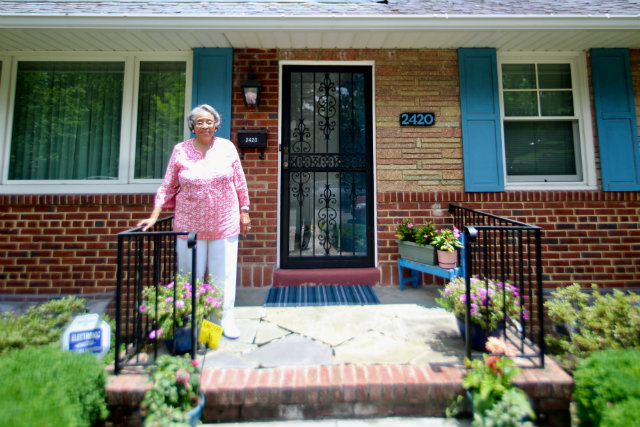
 Gloria Mae Gross outside her Hillcrest residence. She’s called the neighborhood home since 1967. (Photo by Vincent Rutherford Brown)
By DCist contributor Sarah Trembath
Gloria Mae Gross stands outside her spacious brick home in the Hillcrest neighborhood in Southeast. Though the rest of the city is hot this June afternoon, this place is shady and green.
Gross gestures as she explains the changes in the place she has called home for over 50 years. Over there is a new white family who bought, over here is a new black family who bought, and in between is a mixed-race couple (they bought, too). In the other direction, there are two other households: one good and one not so good because “they don’t keep up with the lawn the way they should.”
This manner of describing the community is not uncommon for Hillcrest homeowners, most of whom are civic-minded members of Washington’s black middle class. People notice race and class, but not in a way that is as contentious as it could be. It’s simply part of this neighborhood’s history.
Many of the longtime residents, like Gross, moved in after the passage of civil rights laws and the subsequent white exodus that some refer to as “flight.” This quiet community nestled between Pennsylvania Avenue and Naylor Road SE, nicknamed “The Silver Coast,” is clearly a hard-won haven for D.C.’s black middle class.
Its residents notice that newcomers of a different demographic want in.
More and more each year, young white families are becoming neighbors to the elder black ones in Hillcrest. Block parties, civic association meetings, and community events like Hillcrest Day are increasingly mixed across generation and race. It appears to be a friendlier merging than in some other D.C. neighborhoods. Many Hillcrestians make it clear that that neighborliness is the quality that they value over any other demographic.
“What matters is the neighbor, not the race of the neighbor,” says Gross’ 80-year-old church friend and neighbor, Harold Banks, who lives in Hillcrest with his wife Theresa.
But others, like 24-year-old black Hillcrest native Elana Casey, say they are concerned about displacement. She worries that incoming white residents equals outgoing black neighbors, as has been the pattern in numerous D.C. neighborhoods throughout the city’s recent history.
Gross agrees. “If we lose the neighborhood, we won’t get it back for another 50 or 100 years,” she says.
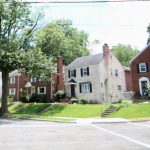
 A view of Hillcrest. (Photo by Vincent Rutherford Brown)
If D.C.’s history of segregation, forced displacement, protest, reconciliation, and occasional cross-cultural unity is any indication, these changes to Hillcrest could go either way. The story of the community—and its elders like Gross and the Banks—makes it clear that there is as much cause for concern as there is cause for confidence.
The land that Hillcrest sits on was once home to the Anacostan Native Americans. But after “the Indians were cleared up,” says The Hillcrest Civic Association bulletin from June 1928, the neighborhood “was laid out in great plantations that were worked by thousands of slaves.” The family home of the biggest plantation still stands in the heart of Hillcrest. It is now owned and occupied by a black family, just a stone’s throw from where Marion Barry lived while he was mayor.
By the early 20th century, Hillcrest was in the midst of a transformation from rural farm area to upscale, suburbanesque community. At that time, the new neighborhood marketed itself to “desirable” buyers as “the highest elevation close to the Capitol … where many sensible dwellers of the lowlands seek at least momentary relief from the summer’s sultry sun,” according to that same 1928 bulletin. Hillcrest, it said, was about 5 degrees cooler than the rest of the city and a place “where one can possess his soul in harmony and in peace.”
But as the community sold plots of land and laid down its infrastructure, it would not be open to people of color for another 40 years. Restrictive housing covenants and segregationist laws relegated racial minorities to the lower areas of Anacostia and its surrounding neighborhoods.
At the time, the Banks’ and Gross’ ancestors were escaping Southern vigilantism and sharecropper poverty in Virginia and forming better lives through blue collar work and education in West Virginia and Maryland, respectively.
By the 1940s and 1950s, when the two families were migrating to D.C. and settling in mostly segregated black neighborhoods, Hillcrest was shaping up to be an architecturally beautiful community with a quiet yet bustling shopping area. It had grown into a community that looked like the American dream. Photos taken by amateur photographer John Wymer show brand new homes with rolling lawns and the newest cars of the era. His notes say that “the southwest part of the area, between Fort Stanton Park and Alabama Avenue” was the “Negro neighborhood.”
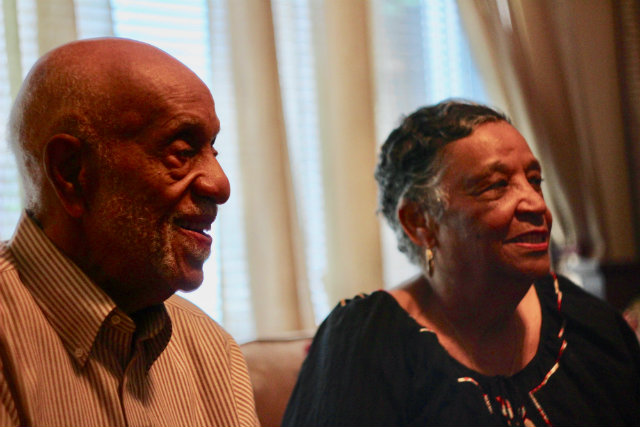 Harold and Theresa Banks, longtime Hillcrest residents. (Photo by Vincent Rutherford Brown)
By the middle of the 20th century, few blacks had been able to integrate into any upscale neighborhoods in America’s cities. But the group of neighborhoods along upper 16th Street in Northwest D.C. was a rare exception. Upper middle class blacks and whites lived there side by side, earning the community the nickname “Gold Coast” by virtue of it being valuable and rare. It foreshadowed the “Silver Coast” to come.
Even though most black Washingtonians had difficulty getting anything but menial labor in the city, the Banks both attended historically black colleges and universities and then worked white collar jobs while they raised their three daughters. Gross’ mother worked at the Pentagon in some of the jobs allowed to blacks at the time. Both families moved to Hillcrest in the mid-60s, shortly after the passage of federal laws outlawing discrimination in education and housing.
The Banks moved in 1965 with the help of a compassionate realtor. They were the first black family on their street. When they integrated the East Washington Heights Baptist Church shortly after moving, “half the congregation left,” says Theresa Banks. “They staged a walkout. Went across the street and became Episcopalians.”
At around the same time, Gross’ mother grew sick of the landlord neglect in their Trinidad community, and she bought a home in Hillcrest in 1966.
Like many Hillcrestians of her generation, Gross would work her way up in government jobs at the Pentagon and Internal Revenue Service and become active in the life of the community. She is one of many black Hillcrest residents who would band together to make the neighborhood and the city what they wanted it to be. These citizens supported the building of the recreation center, opposed low-end retail development, and even began Anthony Williams’ bid for mayor with the “Draft Anthony Williams” movement.
They organized night watches, garden tours, and nights out to the theater and ballet. Through church, they established Bible schools, counseling services, and many outreach programs to people in need. The area became home to some of the city’s most prominent blacks and was only “second” to the swanky Gold Coast in that way.
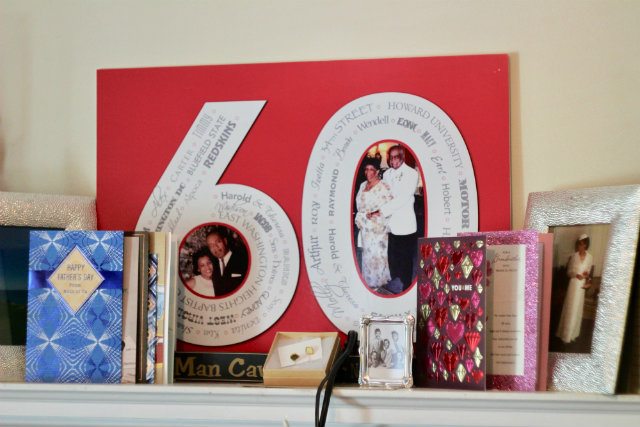 A mantle in the Banks’ home commemorates their 60th anniversary. (Photo by Vincent Rutherford Brown)
Now, the Silver Coast is attracting outsiders looking to live there. They are drawn by 1,200-square foot bungalows, 3,000-square foot colonials, and yards ranging from a few hundred square feet of green grass to an acre. They are attracted to the community that former Oklahoman Jenifer Sparks describes as “warm,” “welcoming,” “diverse,” “passionate,” and “supportive.”
Investors have recently begun pestering elder Hillcrestians to sell, though. “I am a local investor and would like to provide you with an unconditional all-cash offer on your property,” says one of the many fliers that Gross has received.
Harold Banks brushes it off. He gets those flyers, too, but he is living a good life in Hillcrest and this moment hardly registers as a concern. After all, the Banks family, like many in D.C.’s black middle class, has made it from slavery through Jim Crow and the civil rights movement to prosperity in four short generations.
“I don’t know where they think I’m going,” he says. “I’m anchored in.”
This story has been updated to reflect that the “Gold Coast” refers to a number of neighborhoods along upper 16th Street NW, not just Shepherd Park. A photo caption has been updated to reflect that Ms. Gross has lived in Hillcrest since 1967, but initially lived at a different residence on the block.